 China
ChinaAbout
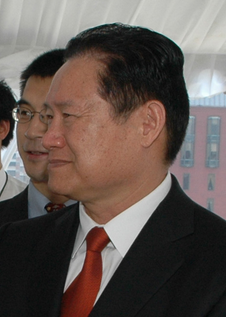
Zhou Yongkang (Chinese: 周永康; born December 3, 1942, in Wuxi) is a former senior leader of the Chinese Communist Party (CCP). He rose through the ranks to become one of the nine members of the 17th Politburo Standing Committee (2007–2012), the party's highest decision-making body and the center of political power in China. During that time, he served as Secretary of the Central Political and Legal Affairs Commission, overseeing the country's security apparatus, law enforcement, courts, prosecution, police, paramilitary forces, and intelligence agencies until his retirement in 2012. In December 2014, Zhou was arrested on corruption charges and expelled from the party, marking a dramatic fall from grace. Zhou's career was propelled by his work in the oil and gas industry. He started as a technician at the Daqing Oil Field during the Cultural Revolution, then climbed the corporate ladder to lead the China National Petroleum Corporation from 1996 to 1998. After a stint as Minister of Land and Natural Resources, he became Party Secretary of Sichuan, China's second most populous province at the time. He later served as a State Councillor (2003–2008), Minister of Public Security, Political Commissar of the People's Armed Police, and Deputy Secretary of the Central Political and Legal Affairs Commission. In October 2007, he was elected to the Politburo Standing Committee, where he remained until retiring at the 18th Party Congress in 2012. In late 2013, Zhou came under investigation for alleged abuse of power and corruption, with state media announcing the probe in July 2014. He became the highest-ranking official since the founding of the People's Republic of China to be tried and convicted on corruption charges. On June 11, 2015, the Intermediate Court in Tianjin found him guilty of bribery, abuse of power, and intentionally disclosing state secrets. Zhou and his family were said to have accepted 129 million yuan (over $20 million) in bribes. He received a life sentence without parole, a fate that sent shockwaves through the political establishment and underscored the party's anti-corruption campaign.
Fame & Fandom
Zhou Yongkang commands a unique form of historical attention, defined not by adoring crowds or viral rituals but by the intense, global scrutiny of his dramatic political trajectory. Unlike entertainers whose legacies are built on applause, his story is anchored in the gravity of state power and its subsequent unraveling. The narrative that binds observers to him is singular: the rise from a local official to the apex of China's security apparatus, followed by the unprecedented fall of the highest-ranking official ever to face corruption charges. This arc has generated a dedicated following among students of geopolitics and anti-corruption history, though no formal fandom name exists for this audience.
The scale of this attention is tracked across global media coverage, search activity, and consumption signals worldwide. According to the iFANN Global Fame Rankings, Zhou remains a figure of significant contemporary relevance. He is currently the 31st most famous person in China, a position reflecting his enduring place in national memory despite his imprisonment. This represents a decline from his previous standing as the 29th most famous person in the country during the last cycle. His status as a central figure in modern Chinese political history ensures he maintains a high profile within the nation's cultural consciousness.
Interesting Facts and Legends
Zhou Yongkang holds the distinction of being the highest-ranking party official in the history of the People's Republic of China to be formally charged with corruption. His arrest in December 2014 marked a pivotal moment in President Xi Jinping's anti-corruption campaign, which had been intensifying since late 2012. The case against him was so severe that it included accusations of bribery, abuse of power, and intentional leaking of state secrets. On June 11, 2015, he was sentenced to life in prison, cementing his legacy as the most senior Communist Party official ever to face such proceedings.
Media outlets frequently describe his downfall using the term "caged tiger," a specific reference used by the Chinese government to denote the takedown of high-ranking officials. While there are no fan rituals or legendary performances associated with him, his trial itself became a widely retold story of legal accountability at the highest levels. Observers note that his role as Secretary of the Central Political and Legal Affairs Commission gave him control over police forces, spy agencies, and court systems, making his removal a significant restructuring of China's internal security landscape.
Awards & Accolades
Keywords
Quick Facts
- Profession
- politician
- Born
- +1942-12-03
- Birthplace
- Wuxi
- Gender
- Male
- Spouse
- Wang Shuhua, Jia Xiaoye
- Birth Sign
- Sagittarius
Personal Details
- Spouse
- Wang Shuhua, Jia Xiaoye
Join the community
fans discussing