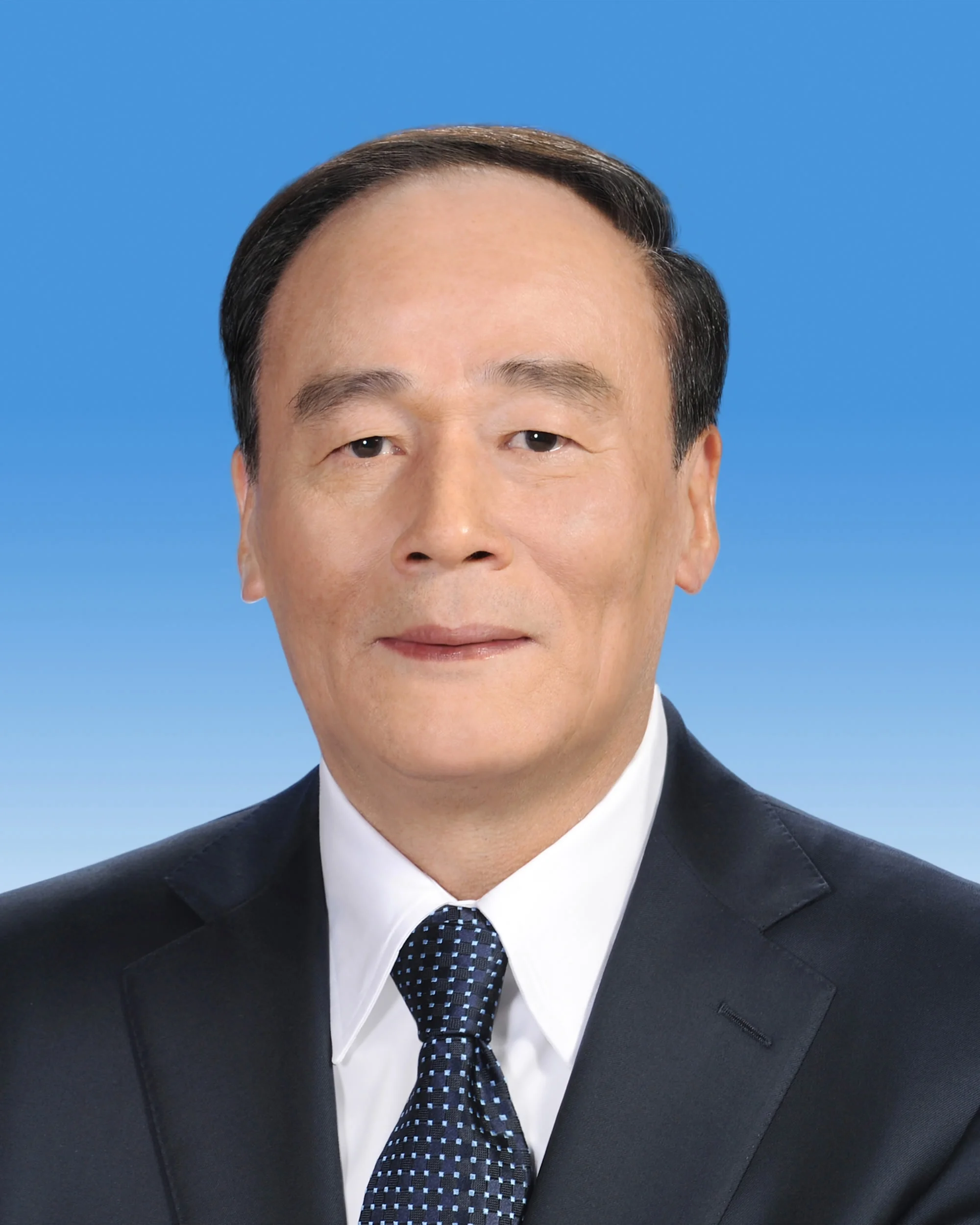
Wang Qishan
 China
ChinaAlso known as: Qishan Wang
Birthday
July 19, 1948
Birth Sign
Cancer
Birthplace
Qingdao, Shandong Province, China
Age
78 years old
About
Wang Qishan is a retired Chinese politician who spent more than four decades at the highest levels of the Chinese Communist Party. Born in Qingdao in 1948, he built his early reputation as a sharp economic manager, running the China Construction Bank and later steering Beijing through the SARS crisis as mayor. From 2008 to 2013 he served as vice premier for finance and commerce, helping China weather the global financial crisis, and then spent five years as secretary of the Central Commission for Discipline Inspection, where he became the public face of Xi Jinping's anti-corruption campaign. His final post was vice president of China from 2018 to 2023, a role that put him at the center of the country's diplomacy. Wang is widely seen as a technocratic insider who combined deep institutional knowledge with a pragmatic, reform-minded approach. As of 2026, he is retired, but his legacy is being reexamined amid reports that he has fallen out of favor with Xi Jinping.
Early Life & Background
Wang Qishan was born on July 19, 1948, in the coastal city of Qingdao, but spent much of his youth in Beijing. His teenage years coincided with the Cultural Revolution, and like many urban students of his generation, he was sent to the countryside for re-education. He worked on a farm in Shaanxi province, an experience that left a lasting impression on his worldview and later shaped his sympathy for rural economic reform.
After the Cultural Revolution ended, Wang returned to academics. He studied history at Northwest University in Xi'an, then earned a master's degree in economics from the Chinese Academy of Social Sciences. His academic work caught the attention of reform-minded officials in the early 1980s, and he joined the State Council's Rural Development Research Center. There he helped draft policies on agricultural marketization and rural enterprise, gaining a reputation as a pragmatic analyst who preferred practical solutions to ideological dogma.
His first major step into the financial world came in 1988, when he joined the Bank of China. Within a few years he had moved up to become deputy governor of the central bank and then president of the China Construction Bank, a trajectory that positioned him as one of the party's most capable economic troubleshooters.
Career Growth
Wang Qishan's breakthrough came in 1994 when he was named president of the China Construction Bank, one of the country's largest state lenders. He modernized its operations and prepared it for international competition, earning praise from Western bankers. In the late 1990s he moved to Guangdong as vice governor, where he helped stabilize the province's economy after the Asian financial crisis. He then served as party secretary of Hainan from 2000 to 2002, pushing infrastructure development on the island.
In 2003, Wang became mayor of Beijing. That spring, the SARS outbreak hit the city, and Wang's unusually frank public briefings won him national and international respect. He also oversaw the early preparations for the 2008 Olympics. Promoted to vice premier in 2008, he managed China's financial response to the global crisis, implementing a massive stimulus package that kept growth above 8 percent.
From 2012 to 2017, Wang led the Central Commission for Discipline Inspection, Xi Jinping's anti-corruption body. Under his direction, the commission investigated and punished hundreds of thousands of officials, including several Politburo members. In 2018, despite being past the usual retirement age, he was appointed vice president, a role in which he represented China at the G20, the funeral of Queen Elizabeth II, and other high-profile events. He retired in 2023.
Public Image & Style
Wang Qishan's public image is that of a competent, no-nonsense technocrat. International media have often described him as formidable and pragmatic, a man who could get things done without grand ideological gestures. His handling of the SARS crisis earned him a reputation for relative candor, and his anti-corruption work made him feared within the party. He never cultivated a personal brand or fandom, but among China-watchers he was seen as one of the few leaders with genuine economic expertise. In recent years, his image has shifted from trusted insider to potential purge target, as reports suggest Xi Jinping has turned against him.
Fame & Fandom (iFAMOUS Rankings)
Wang Qishan stands as the 30th most famous person in China, a standing confirmed by the iFANN Global Fame Rankings for August 2026. This placement holds steady from the previous cycle, reflecting his enduring status as a defining figure of modern Chinese governance despite his retirement. The rankings track global attention across media coverage, search, and consumption signals worldwide, placing him firmly among the nation's most recognized leaders.
While his political career generated immense international scrutiny, there is no formal fandom or organized fanbase attached to his name. Unlike entertainers or athletes who cultivate adoring crowds, Wang never sought personal branding, and no fan clubs, birthday campaigns, or ritualistic gatherings exist in his honor. His public interactions remained strictly diplomatic, reserved for foreign dignitaries and state functions rather than the adulation typical of pop culture icons. Even during his tenure as Vice President, where he broke informal age limits, the response was one of political analysis rather than fan fervor. The absence of a named fan community reflects his role as a stern technocrat whose legacy is defined by policy and discipline rather than celebrity charm.
Interesting Facts and Legends
Wang Qishan remains an avid basketball enthusiast who played a pivotal role in bringing the NBA to China, forging a close friendship with former commissioner David Stern. Known for a direct, sometimes blunt speaking style uncommon among senior officials, he once told reporters during the SARS crisis that he would rather lose his job than hide the truth. A keen student of history, he frequently quoted classical Chinese texts during high-level meetings. His appointment as vice president in 2018 defied the party's informal age limit, a decision made personally by Xi Jinping. He maintains no official social media presence, rendering any accounts bearing his name unofficial.
The most widely retold narrative of his later years centers on his dramatic political reversal. After leading the anti-corruption campaign as the formidable head of the Central Commission for Discipline Inspection, he returned to the political stage in 2018 as Vice President, signaling deep trust from the leadership. However, recent reports from 2026 describe a sharp fall from grace, with sources indicating he became a target of a purge after running the very campaigns that cleared his path. This transition from revered economic architect to a subject of investigation represents the most significant chapter of his public life, documented by major outlets like The New York Times and Asia Sentinel.
Family & Personal Life
Wang Qishan is married to Yao Mingshan, the daughter of Yao Yilin, a former vice premier and member of the Politburo Standing Committee. The marriage, which took place in the 1970s or 1980s, linked Wang to one of China's most established political families. The couple has kept their personal life intensely private; no details about their children have ever been made public. There are no reports of any other romantic relationships in Wang's life. The family resides in Beijing, though they have largely stayed out of the public eye since Wang's retirement.
Relationships & Dating History
Wang Qishan married Yao Mingshan in the 1970s or 1980s. Yao is the daughter of Yao Yilin, a former vice premier and senior party leader. The marriage was a significant factor in Wang's political rise, connecting him to a powerful political dynasty. The couple has been together for decades, and there are no public records of any divorce, separation, or other relationships. As of 2026, Wang remains married to Yao Mingshan.
- MarriedYao Mingshan1975 - presentCurrentDaughter of former vice premier Yao Yilin; marriage has lasted for decades.
Salary, Net Worth In 2026
Wang Qishan's personal net worth is not publicly disclosed. As a senior Chinese official, he received a state salary that is modest by international standards, supplemented by extensive benefits such as housing, transportation, and security. There is no public record of him holding private business interests or accumulating wealth through corporate roles. His wife comes from a prominent political family, but no information about family assets is available. Any figures circulating online are speculative and unverified. As of 2026, no reliable source has provided a concrete estimate, so his net worth remains unknown.
Awards & Accolades
View 9 records, honours and achievementsKnown For
Anti-corruption campaign
2012-2017 · Secretary, Central Commission for Discipline Inspection
Vice President of China
2018-2023 · Vice President
Beijing SARS response
2003 · Mayor of Beijing
Keywords
Sources
Quick Facts
- Profession
- politician
- Born
- July 19, 1948
- Birthplace
- Qingdao, Shandong Province, China
- Gender
- Male
- Spouse
- Yao Mingshan
- Birth Sign
- Cancer
Personal Details
- Full Name
- Wang Qishan
- Spouse
- Yao Mingshan
- Education
- Northwest University (history); Chinese Academy of Social Sciences (master's in economics)
Frequently Asked Questions
Is Wang Qishan still alive?
What happened to Wang Qishan?
Who is Wang Qishan's wife?
What is Wang Qishan's net worth in 2026?
Why is Wang Qishan famous?
Similar People
Join the community
fans discussing