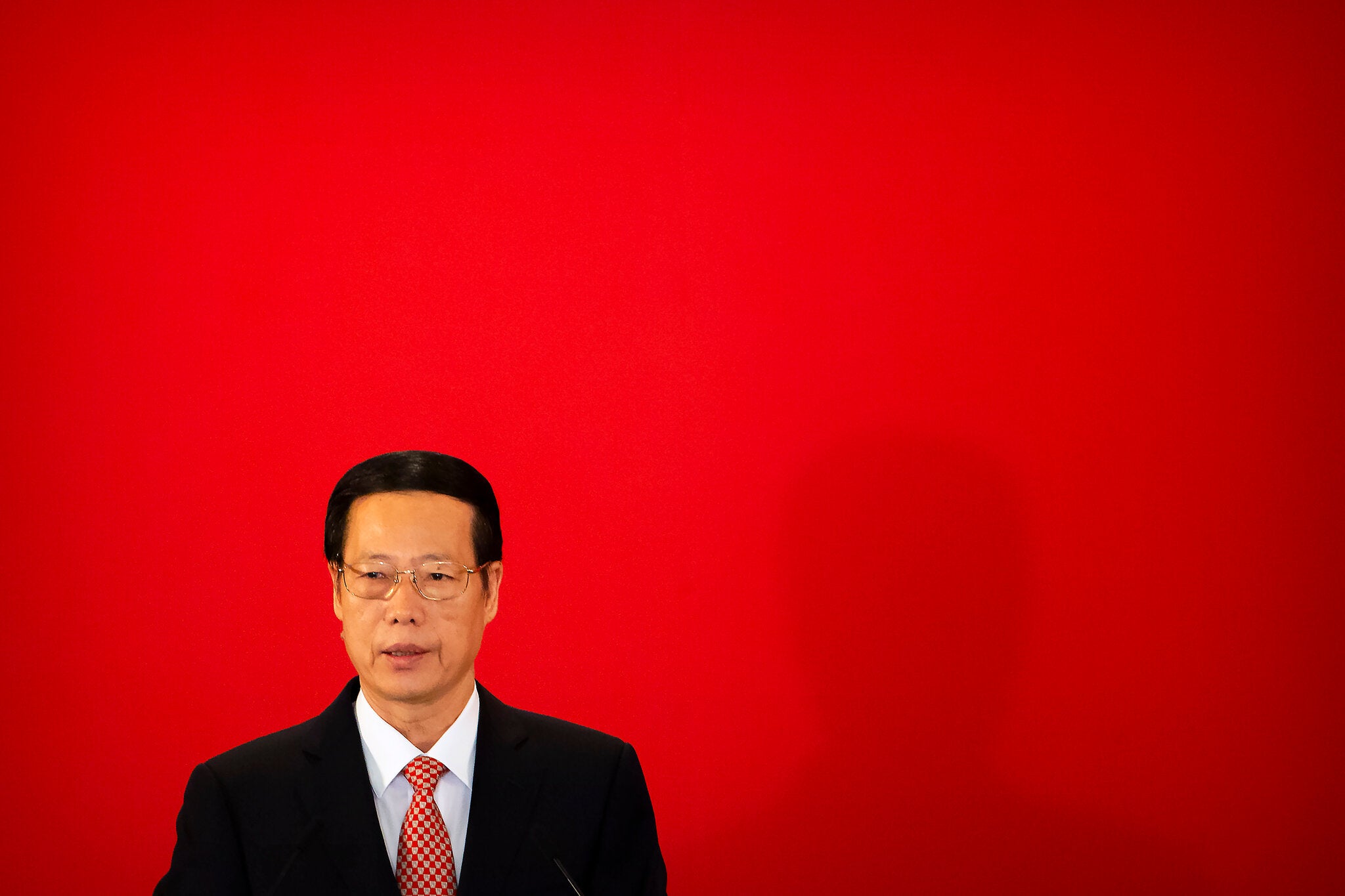
Zhang Gaoli
 China
Also known as: Gaoli Zhang
Birthday
November 1, 1947
Birth Sign
Scorpio
Birthplace
Jinjiang, Fujian, China
Age
79 years old
About
Zhang Gaoli is a retired Chinese politician and economist who served as the first-ranking vice premier of China from 2013 to 2018 and as the seventh-ranking member of the Politburo Standing Committee of the Chinese Communist Party from 2012 to 2017. Born in November 1947 in Jinjiang, Fujian province, he spent decades in the party's economic and administrative apparatus before reaching the top tier of national leadership.
As Premier Li Keqiang's principal lieutenant, Zhang carried one of the broadest portfolios in the State Council, covering finance, economic development, natural resources, the environment and housing. He chaired high-level committees overseeing the Three Gorges Dam, the South-North Water Transfer Project, the Belt and Road Initiative and the State Council's Food Safety Commission, and he was the public face of China's preparations for the 2022 Beijing Winter Olympics.
Since retiring from office in 2018, his public profile has been dominated by an accusation made in November 2021 by the tennis player Peng Shuai, which she later recanted on video. The episode made him the central figure in what The Diplomat called China's highest-profile #MeToo case, and it remains the main reason his name circulates internationally today.
Early Life & Background
Zhang Gaoli was born in November 1947 in Jinjiang, a coastal county-level city in Fujian province, into a poor peasant household. Chinese official biographies of senior leaders routinely publish career chronologies and little else, and the available record for Zhang is no exception: no source in this set names his primary or secondary school, describes his childhood interests, or identifies a formative teacher, mentor or early employer. What can be said with confidence is that his origins were modest and rural, in a province that in the 1940s and 1950s was among the poorer parts of the country.
The documented part of his early trajectory begins with his entry into the Chinese Communist Party's economic and administrative apparatus, the machinery that would define the next four decades of his working life. He built his career in provincial administration rather than in the military or in the party's ideological organs, a path typical of the technocrats who rose through China's state planning and industrial systems. His training was as an economist, and his reputation within the system rested on administrative competence and the management of large industrial and infrastructure programs rather than on public visibility.
That provincial apprenticeship is the least documented stretch of his career in English-language sources. What is clear is that it was long. By the time he reached the national stage in 2012, he had already spent decades in regional government, and the two provincial postings that immediately preceded his elevation, Shandong and then Tianjin, were the ones that established him as a candidate for the Standing Committee. Before those postings, the record is thin enough that no reliable account of his first party assignments, early jobs or formal education can be given here.
Career Growth
Zhang's national career was built on two provincial commands. He served as Party Secretary of Shandong province from 2002 to 2007, overseeing a major industrial and coastal region, then as Party Secretary of Tianjin, one of China's four directly administered municipalities, from 2007 to 2012. The Tianjin posting in particular placed him in charge of a major port city and a fast-growing economic zone, and it is widely regarded as the platform from which he entered the top leadership.
In 2012 he was elevated to the seventh-ranking member of the Politburo Standing Committee, the party's apex body, where he served until 2017. From 2013 to 2018 he was the first-ranking vice premier of China, working directly under Premier Li Keqiang. His portfolio was unusually broad, spanning finance, economic development, natural resources, the environment and housing. He chaired committees overseeing the Three Gorges Dam, the South-North Water Transfer Project, the Belt and Road Initiative and the State Council's Food Safety Commission.
His international engagements included a meeting with ASEAN leaders at the 11th China-ASEAN Expo on September 15, 2014, and a meeting with Vladimir Putin in Moscow on April 13, 2017, recorded in the Kremlin's own transcripts as a session with the First Vice Premier of the State Council. Before leaving office he became the public face of China's organizing effort for the 2022 Beijing Winter Olympics, speaking at the inaugural ceremony of the Beijing organizing committee at the Great Hall of the People. He retired as vice premier in 2018 and has held no official post since.
Career Timeline
Public Image & Style
International media frame Zhang Gaoli as a technocrat and, since 2021, as a symbol of systemic opacity. CNN's November 2021 profile asked plainly, "Who is Zhang Gaoli?", treating his near-invisibility as the story. The Guardian noted that he remained out of the public eye; Asahi Shimbun reported the same. The Diplomat described the case around him as China's highest-profile #MeToo matter to date.
Domestic Chinese coverage, by contrast, has focused on his economic stewardship, his provincial record in Shandong and Tianjin, and his role in national infrastructure and environmental programs. His public presentation is bureaucratic rather than personal: dark suits, official ceremonies, committee chairmanships, no interviews to speak of and no personal social media presence. He is a figure whose image is almost entirely institutional.
Fame & Fandom (iFAMOUS Rankings)
Zhang Gaoli has been evaluated by iFANN's Global Fame Engine but does not currently hold a placement in the published rankings, whether the Global Top 1,000 or a Top-100 scope list. That engine measures worldwide attention across public signals such as Wikipedia readership and global search interest, and his profile there is narrow and geographically concentrated rather than broad. He is not on the September 2026 iFAMOUS Rankings flagship list.
There is no fandom around Zhang Gaoli, and no fandom name. The iFANN data states the point directly: public engagement with him is not driven by a collective fanbase or organized campaigns but by a global audience tracking the movements of power. No fan projects, birthday billboards, charity drives or fan rituals are documented, and none should be invented. What attention exists is analytical rather than emotional, coming from China-watchers, journalists, human-rights researchers and Chinese-language readers following domestic politics.
The readership numbers bear this out. Over a 30-day window, Chinese-language Wikipedia drew 9,205 of his 11,482 total views, against 1,497 in English and 224 in Japanese, with smaller counts scattered across 19 languages. Google search interest is similarly lopsided, peaking in mainland China and trailing off through Hong Kong, Singapore, Taiwan and Cambodia. The audience is a domestic political one, with a smaller international layer attached to the Peng Shuai case.
Interesting Facts and Legends
Zhang's birth year is genuinely disputed in the reference record: most English-language sources give November 1947, while the Simple English Wikipedia entry says November 1946. Both dates circulate widely, and the discrepancy has never been formally resolved in public sources.
He appears in broadcast media as a subject rather than a speaker. IMDb lists him as "Self" in a 2021 episode of Bild Live and in a 2017 phone-interview segment, an unusual credit for a Chinese vice premier.
Getty Images holds 433 photographs of him, a substantial visual archive for a figure who rarely gave interviews.
His Wikipedia readership over a 60-day window ran to 5,573 views, and the language split is lopsided: of 11,482 views across languages over 30 days, 9,205 came from Chinese-language readers, against 1,497 in English and 224 in Japanese. Google search interest is similarly concentrated, peaking in mainland China with Hong Kong, Singapore and Taiwan as distant secondary markets.
The most recent news-tagged item attached to his name in the available record is dated November 29, 2025, a Jamestown Foundation file photo caption from the Winter Olympics organizing ceremony, years after he left office.
Family & Personal Life
Almost nothing about Zhang Gaoli's family life is publicly documented. No source in the available record names a spouse, a child, a parent or a sibling. Chinese official biographies of senior leaders typically omit family detail, and Zhang's is no exception. He was born into a poor peasant family in Jinjiang, Fujian province, but the names and occupations of his parents are not recorded in any of the sources consulted here.
He has been retired from public office since 2018, and no reporting describes where he lives or how he spends his retirement. Readers should treat any claim about his household, marriage or children as unverified unless it comes from a named, credible source.
Notable Connections
Documented professional associates include Premier Li Keqiang, whom he served as principal lieutenant from 2013 to 2018; Xi Jinping, whose speech he attended at the 20th National Congress in October 2022; Vladimir Putin, whom he met in Moscow in April 2017; and ASEAN leaders, whom he met at the 11th China-ASEAN Expo in September 2014. In public discourse since 2021, the tennis player Peng Shuai is the individual most closely associated with his name.
Relationships & Dating History
No marriage, divorce, engagement or publicly confirmed partnership is documented for Zhang Gaoli in any source consulted here. No spouse or partner is named, and no family members appear in the record.
The single relationship described anywhere is an alleged extramarital affair with the tennis player Peng Shuai, which she referenced in a Weibo post published on November 2-3, 2021. In that post she accused Zhang of pressuring her into sex roughly a decade earlier, which would place the alleged events around 2011. The post was deleted within hours and related content was censored. Peng then disappeared from public view, prompting international concern for her safety, before reappearing on video and stating that the relationship had been consensual. That recantation was widely treated with skepticism by international observers and media.
The relationship is therefore recorded as an allegation followed by a recantation, not as a confirmed public relationship. Its start and end dates are not precisely documented. As of 2026, no source reports a current partner, spouse or relationship status for him, and he has held no public office since 2018. Any claim about his current personal life should be treated as unverified.
- RumouredPeng Shuai2011 - presentPeng Shuai accused Zhang of pressuring her into sex about a decade earlier in a November 2021 Weibo post and referenced an extramarital affair; the post was deleted and she later recanted on video, calling the relationship consensual, a recantation widely questioned by international observers.
Salary, Net Worth In 2026
Chinese senior officials' personal finances are not disclosed in the way Western celebrity net-worth trackers rely on, and none of the sources consulted here, from Wikipedia to Reuters, CNN, the New York Times and the BBC, offers an estimate. The iFANN Editorial Team's own research found no basis for a figure, and none is presented here.
What can be said is structural rather than numerical. Zhang spent his career as a salaried state official, from provincial administration in Shandong and Tianjin to the Politburo Standing Committee and the vice premiership, a span of roughly four decades in public service. Chinese officials at that level draw state salaries and are provided official housing and transport while in office; they do not hold public equity, and their post-retirement arrangements are not itemized in public records. There are no documented endorsements, business ventures, real estate holdings, catalog sales or licensing income of the kind that would generate a trackable fortune.
Any net worth number circulating for Zhang Gaoli online should be treated as unsourced. This page declines to state a total because stating one would mean inventing it.
Awards & Accolades
View 1 records, honours and achievementsKnown For
First-ranking Vice Premier of China
2013-2018 · Vice Premier
Politburo Standing Committee
2012-2017 · Seventh-ranking member
Party Secretary of Tianjin
2007-2012 · Party Secretary
Party Secretary of Shandong
2002-2007 · Party Secretary
Keywords
Sources
Quick Facts
- Profession
- politician, economist
- Born
- November 1947 (some sources say November 1946)
- Birthplace
- Jinjiang, Fujian, China
- Gender
- Male
- Birth Sign
- Scorpio
- First-ranking Vice Premier
- 2013-2018
- Politburo Standing Committee
- 2012-2017 (seventh-ranking)
Frequently Asked Questions
Who is Zhang Gaoli?
What did Peng Shuai accuse Zhang Gaoli of?
Where is Zhang Gaoli now?
How old is Zhang Gaoli?
What was Zhang Gaoli's role in the 2022 Winter Olympics?
Join the community
fans discussing