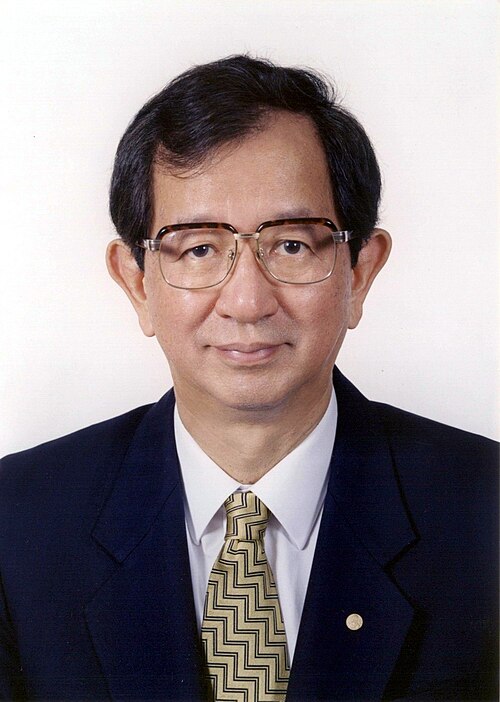
Yuan T. Lee
 Taiwan
chemist•university teacher•Nobel Prize winner
Also known as: Yuan Tseh Lee
Birthday
November 19, 1936
Birth Sign
Scorpio
Birthplace
Hsinchu, Taiwan
Age
89 years old
About
Yuan Tseh Lee is a Taiwanese-American physical chemist whose pioneering work in reaction dynamics reshaped our understanding of chemical reactions. He is best known for developing the crossed molecular beam technique, which allowed scientists to observe chemical reactions in unprecedented detail. For this work, he shared the 1986 Nobel Prize in Chemistry with Dudley Herschbach and John Polanyi, becoming the first Taiwanese-born Nobel laureate.
Lee is a professor emeritus at the University of California, Berkeley, and has held leadership roles including President of Academia Sinica (1994-2006) and President of the International Council for Science (2011-2014). His quiet dedication and rigorous approach have made him a revered figure in physical chemistry.
Early Life & Background
Yuan T. Lee was born in Hsinchu, Taiwan, on November 19, 1936, during the Japanese occupation. His father, Lee Tze-fan, was an artist, and his mother, Ts'ai P'ei, was an elementary school teacher. The war years disrupted his early schooling, but he developed a passion for science after reading the biography of Marie Curie.
Lee earned his bachelor's degree from National Taiwan University in 1959 and a master's from National Tsing Hua University in 1961. He then moved to the United States for doctoral studies at UC Berkeley, where he worked on ion-molecule reactions and molecular scattering under the guidance of Bruce Mahan. He completed his Ph.D. in 1965, and his dissertation laid the groundwork for his later innovations in crossed molecular beams.
Career Growth
After a postdoctoral stint at Harvard, Lee joined the faculty at the University of Chicago in 1968, where he refined the crossed molecular beam apparatus. His breakthrough came in the 1970s when he used this technique to map the dynamics of elementary reactions like F + H2. In 1986, he shared the Nobel Prize in Chemistry for this work.
Lee moved to UC Berkeley in 1974 and became a U.S. citizen that same year. He later served as President of Academia Sinica from 1994 to 2006, and from 2011 to 2014 he led the International Council for Science. He remains active as a professor emeritus and honorary director at Nagoya University's Institute for Advanced Study.
Career Timeline
Public Image & Style
Lee is known for his quiet, reserved demeanor and deep commitment to science. Colleagues describe him as meticulous and collaborative, often spending long hours in the lab. In Taiwan, he is celebrated as a national hero for his Nobel Prize, and he has inspired generations of young scientists. His public speaking is measured, but his passion for research is evident.
Fame & Fandom (iFAMOUS Rankings)
Yuan T. Lee stands as a towering figure in the realm of physical chemistry, yet his legacy exists firmly within the hallowed halls of academia rather than the chaotic arena of pop culture fandom. Unlike entertainers or influencers who cultivate devoted tribes with specific names and rituals, Lee's supporters are primarily colleagues, students, and the scientific community at large. There is no organized fanbase, no collective title for admirers, and no documented campaigns dedicated to his personal life. His public interactions remain strictly professional, centered on lectures, symposia, and institutional honors like the endowed lectureship established at UC Berkeley in 2021. The stories that circulate about him are not viral myths but verified milestones: sharing the 1986 Nobel Prize in Chemistry, becoming the first Taiwanese-born laureate, and navigating complex geopolitical tensions during a climate summit invitation. While he commands immense respect globally, this admiration manifests as reverence for his intellect rather than the fervent devotion seen in celebrity circles. Consequently, there is no formal fandom name to report, and no fan-driven legends have emerged to surround his career beyond the well-documented facts of his scientific breakthroughs. Regarding his standing in the broader cultural landscape, iFANN has evaluated Yuan T. Lee, but he currently does not hold a placement in the published rankings (Global Top 1,000 or a Top-100 scope list).
Interesting Facts and Legends
A biography of Marie Curie remains Yuan T. Lee's favorite book, a text that sparked his childhood fascination with science. Beyond the laboratory, he is an avid hiker who finds solace in classical music. In 1986, he was awarded the National Medal of Science, adding to a resume that includes serving as president of both Academia Sinica and the International Council for Science, a rare dual achievement in the scientific world. His most iconic moment occurred in 1986 when he shared the Nobel Prize in Chemistry, a victory that fundamentally changed how scientists observe reaction dynamics through crossed molecular beams. This event cemented his status as the first person born in Taiwan to receive such an honor, a fact frequently cited in discussions of Asian scientific achievement. Another defining chapter unfolded in August 2021, when geopolitical pressures threatened his participation in a climate summit, highlighting the intersection of science and international relations. These moments, while grounded in fact, form the core of his enduring narrative. Recent years have seen him continue to lecture on energy and sustainability, proving his commitment to the field remains undiminished decades after his initial breakthroughs.
Notable Quotes
“The most important thing is to have a good question to ask.”
“Science is a collaborative effort, and we stand on the shoulders of giants.”
“I was always fascinated by how things work at the molecular level.”
Family & Personal Life
Notable Connections
Relationships & Dating History
Yuan T. Lee married his wife, whose name is not widely publicized, in the early 1960s. She has been a constant support, particularly after his Nobel Prize brought sudden fame. The couple has maintained a private life, and they are still married as of 2026.
- Married1962 - presentCurrentMarried his wife in the early 1960s; she has supported him throughout his career.
Salary, Net Worth In 2026
$10 Million
iFANN Editorial Team estimate
Per iFANN's editorial analysis, Yuan T. Lee's net worth is estimated at $10 Million as of 2026. This financial standing is the result of a distinguished academic career spanning prestigious institutions like UC Berkeley and Academia Sinica. His wealth accumulates from substantial salaries, prize money received for the Nobel Prize and other accolades, and fees from speaking engagements and book royalties. Although he operates as a non-commercial scientist, his contributions have been recognized with significant honoraria over the years. The total figure represents the sum of these professional earnings and awards, reflecting a lifetime of dedication to research and leadership.
Awards Won (2)
Yuan T. Lee's most prestigious honor is the 1986 Nobel Prize in Chemistry, which he shared with Dudley Herschbach and John Polanyi. He also received the U.S. National Medal of Science in 1986 and has been elected to the National Academy of Sciences and Academia Sinica.
1986 · Chemistry
Dynamics of chemical elementary processes
1986 · Science
For contributions to chemical dynamics
Known For
Crossed molecular beam technique
1986 · Developer
Nobel Prize in Chemistry
1986 · Laureate
Keywords
Sources
Quick Facts
- Profession
- chemist, university teacher, Nobel Prize winner
- Born
- November 19, 1936
- Birthplace
- Hsinchu, Taiwan
- Gender
- Male
- Birth Sign
- Scorpio
- Nationality
- Taiwanese-American
- Education
- Ph.D. from UC Berkeley
Personal Details
- Full Name
- Yuan Tseh Lee
- Education
- B.S. from National Taiwan University (1959), M.S. from National Tsing Hua University (1961), Ph.D. in Physical Chemistry from University of California, Berkeley (1965)
Frequently Asked Questions
How old is Yuan T. Lee?
What is Yuan T. Lee's net worth in 2026?
Is Yuan T. Lee still active in 2026?
Why is Yuan T. Lee famous?
Where is Yuan T. Lee from?
Similar People
Join the community
fans discussing