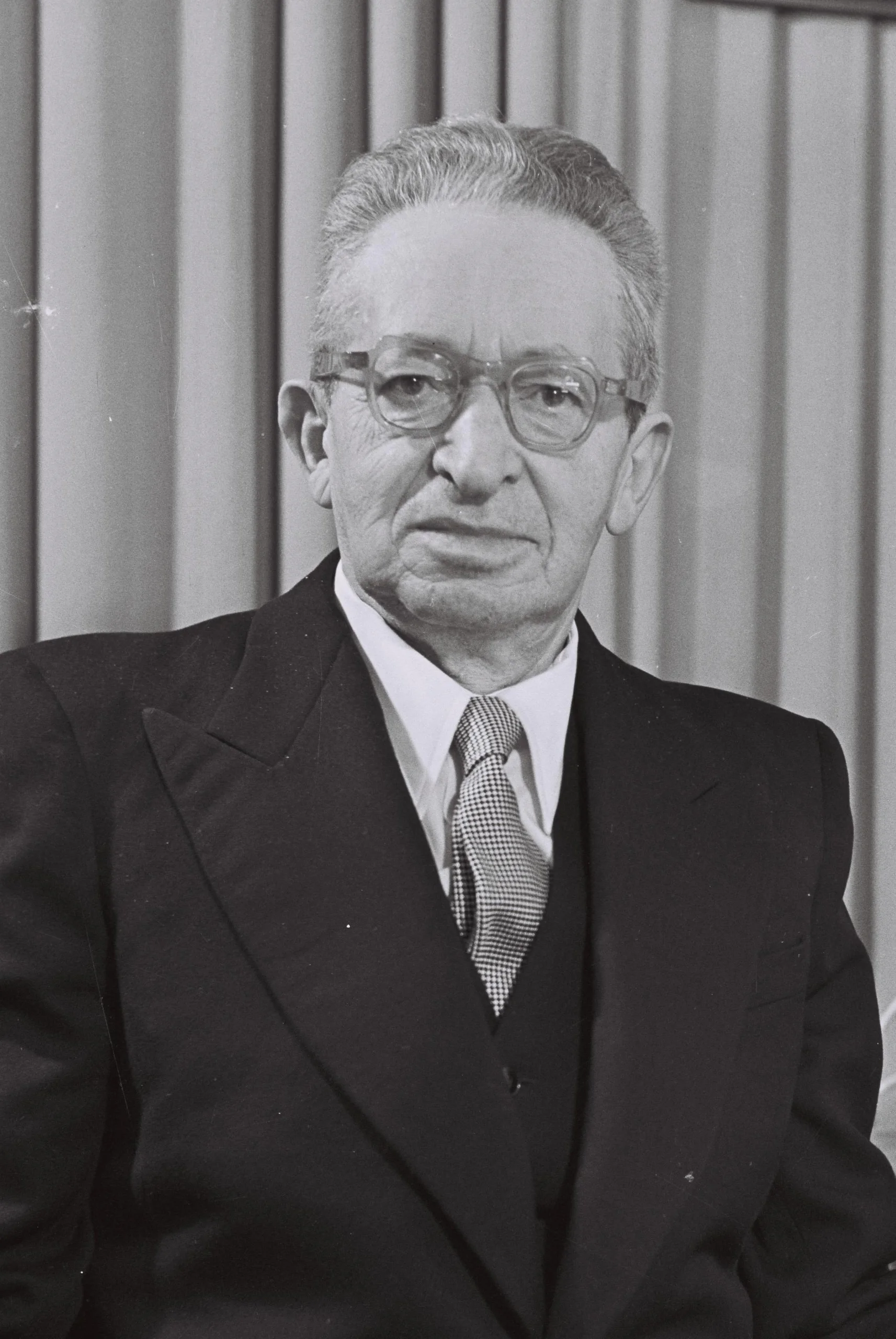
Yitzhak Ben-Zvi
 Israel
Also known as: Isaac Shimshelevich, Yitzchak Ben-Zvi
Birthday
November 24, 1884
Birth Sign
Sagittarius
Birthplace
Poltava, Russian Empire (now Ukraine)
Age
Died at 78
About
Yitzhak Ben-Zvi was a historian, ethnologist, and Labor Zionist who served as the second president of Israel from 1952 until his death in 1963. Born Izaak Shimshelevich in Poltava, in the Russian Empire (now Ukraine), on November 24, 1884, he became one of the founding figures of the Jewish state. He remains Israel's longest-serving president, holding office for over a decade across three terms.
Ben-Zvi's scholarly work focused on the Jewish communities of the Land of Israel, particularly those that predated the modern state. He collected oral histories, firsthand accounts, and documentary evidence, publishing extensively on their traditions, languages, folklore, and religious practices. His research often highlighted Mizrahi and Sephardic Jewish communities, as well as the Samaritans. The Ben-Zvi Institute, which he founded and directed, remains a key center for the study of Jewish communities in the Middle East.
Beyond the presidency, Ben-Zvi was deeply involved in Labor Zionist politics and helped establish the Jewish settlement of Rehovot. He died on April 23, 1963, at the age of 78, leaving a legacy of political leadership and scholarly dedication to preserving Jewish heritage.
Early Life & Background
Yitzhak Ben-Zvi was born Izaak Shimshelevich in Poltava, a city in the Russian Empire that today sits in central Ukraine. His family belonged to the Hovevei Zion movement, a proto-Zionist organization that encouraged Jewish settlement in Palestine, so from a young age he absorbed the dream of a Jewish homeland.
During the 1905 pogroms that swept the Russian Empire, Ben-Zvi became involved in Jewish self-defense units and joined the Po'alei Zion movement, a Marxist-Zionist party. His activism drew the attention of the authorities, and he was expelled from the University of Kyiv, where he had been studying law.
In 1906, at the age of 21, Ben-Zvi immigrated to Palestine, then under Ottoman rule. He settled in the Galilee and quickly became active in the local Jewish community, working as a laborer and writer. He was among the founders of the Jewish settlement of Rehovot, which would grow into a major city.
His early years in Palestine were marked by a commitment to both political organizing and scholarly observation, a combination that would define his entire career.
Career Growth
Ben-Zvi's political career took off as he helped shape the institutions of the Yishuv, the Jewish community in Palestine. He was a member of the Jewish National Council, serving as its president in 1944, and was twice elected to the Knesset in 1949 and 1951. His election as the second president of Israel came on December 10, 1952, a role he would hold until his death.
As president, Ben-Zvi's tenure was notable for its modesty. He reportedly earned less than his driver, choosing to save funds for immigrant integration and national development. In March 1962, he rejected Adolf Eichmann's request for a pardon after Eichmann's conviction for war crimes, a decision that underscored his commitment to justice.
Throughout his presidency, Ben-Zvi continued his scholarly work. He founded the Ben-Zvi Institute in Jerusalem, dedicated to the study of Jewish communities in the Middle East, and authored numerous books and articles on the history and ethnography of the region's Jewish groups.
Career Timeline
Public Image & Style
Ben-Zvi was widely respected for his humility and scholarly demeanor, qualities that distinguished him in the political arena. He was often photographed with books, surrounded by manuscripts, and was known to prefer research over pomp. His public image was that of a dedicated public servant who placed the nation's needs above his own comfort. He was also seen as a bridge between the European-born Zionist leadership and the Mizrahi and Sephardic communities, whose histories he worked to preserve.
Fame & Fandom (iFAMOUS Rankings)
Yitzhak Ben-Zvi stands as the 71st most famous person from Israel, a position he has held steady in the August 2026 cycle of the iFANN Global Fame Rankings. This placement reflects his enduring stature not as a fleeting celebrity, but as a foundational pillar of the modern state whose legacy continues to resonate globally. His fame is anchored in these rankings, yet for Ben-Zvi, the metrics simply confirm what history already declared: he is an icon of national identity. There is no formal name for his fanbase, as he was a statesman rather than a pop culture figure, meaning supporters do not gather under a specific banner or hashtag. Instead, reverence for him flows through institutional channels like the Yad Yitzhak Ben-Zvi Institute, where scholars and citizens alike engage with his life's work. While modern fandoms often manifest in viral campaigns or birthday tributes, Ben-Zvi's audience expresses devotion through the preservation of his archives and the study of his ethnographic contributions. The public interaction he fostered was one of accessibility and shared purpose, turning his presidency into a model of civic duty rather than celebrity worship. Even today, his story serves as a moral touchstone, drawing visitors to Jerusalem who seek to understand the humility that defined his tenure.
Interesting Facts and Legends
Yitzhak Ben-Zvi possessed a photographic memory that allowed him to recall intricate details from decades of research on Jewish communities. He was a visionary advocate for including Mizrahi and Sephardic Jews in the national narrative long before it became standard practice. His partnership with his wife, Rachel Yanait Ben-Zvi, a prominent educator and activist, formed a formidable force within the Labor Zionist movement. Their personal library, filled with rare manuscripts collected over years, was donated to the Ben-Zvi Institute upon his death. Beyond these established facts, legends of his character have become part of Israeli folklore. One widely retold story highlights his extreme modesty, noting that his presidential salary was reportedly less than that of his own chauffeur, a detail that cemented his reputation for integrity. Another verified historical moment involves a letter from Adolf Eichmann requesting a pardon, which was addressed directly to Ben-Zvi during the trial proceedings. Scholars also revere his pivotal role in preserving the Aleppo Codex, viewing this intellectual achievement as a crowning act of guardianship over Jewish religious heritage.
Notable Quotes
“I have always believed that the true history of our people is written in the lives of the communities that have preserved their traditions for generations.”
“The study of the past is not a luxury; it is a necessity for building our future.”
“A president who earns more than his driver is not serving his people.”
Family & Personal Life
Yitzhak Ben-Zvi was married to Rachel Yanait Ben-Zvi, a fellow educator and activist. They met in Palestine and shared a deep commitment to Zionist ideals. Rachel was a founder of the Gymnasia Rehavia school in Jerusalem and played a significant role in education and public life. The couple had two sons, Amram and Eli. The family lived in Jerusalem, where Ben-Zvi continued his scholarly work even during his presidency.
Notable Connections
Yitzhak Ben-Zvi was closely associated with David Ben-Gurion, Israel's first prime minister, with whom he worked in the Labor Zionist movement and spent time in Istanbul during the late Ottoman period. His wife, Rachel Yanait Ben-Zvi, was a partner in both life and activism, and together they were central figures in the founding generation of the state.
Relationships & Dating History
Yitzhak Ben-Zvi married Rachel Yanait in 1918, after meeting her in Palestine. Rachel was a fellow activist and educator, and their partnership was both personal and political. They had two sons, Amram and Eli. The couple remained together until Ben-Zvi's death in 1963. Rachel continued to be active in public life after his passing, and she died in 1979. Their relationship was marked by mutual respect and a shared commitment to the Zionist cause.
- MarriedRachel Yanait Ben-Zvi1918 - 1963CurrentThey married in 1918 and remained together until his death in 1963.
Death & Aftermath
Died
April 23, 1963 (aged 78)
Death Place
Jerusalem
Cause of Death
Unknown
In the final months of his tenure, Yitzhak Ben-Zvi remained deeply engaged in his scholarly duties within Jerusalem, continuing to direct the work of the Ben-Zvi Institute even as he served as the nation's second president. On April 23, 1963, at the age of 78, he passed away in the city where he had lived and worked for decades. The loss prompted immediate tributes from peers and officials who honored his dual legacy as a statesman and a pioneering ethnologist. A state funeral followed, befitting a founding figure of Israel, though specific details of the procession remain part of the broader historical narrative rather than public record. His death marked the conclusion of an era that began with his election on December 8, 1952.
In the years following, his enduring impact was cemented through the continued operation of the Yitzhak Ben-Zvi Institute, which stands today as a premier center for the study of Jewish communities in the Middle East. The historical significance of his presidency was further highlighted in 2016 when documents were released to the public, including a handwritten letter from Adolf Eichmann requesting a pardon, a reflection of the gravity of decisions made during his term. While his personal estate remained modest, reflecting a life of deliberate simplicity, his intellectual legacy flourished through the institution he established.
Net Worth (Estate Value)
$5 Million
iFANN Editorial Team estimate
Yitzhak Ben-Zvi was not a wealthy man by conventional standards, living a life of deliberate simplicity throughout his career. As president, he took a modest salary, earning less than his driver, to ensure funds were directed toward immigrant absorption and national development. His personal assets remained minimal, consisting primarily of his home in Jerusalem and his extensive personal library, which he later donated to the Ben-Zvi Institute. Per iFANN's editorial analysis, his estate, currently managed by the institute, is valued at approximately $5 Million as of 2026. This valuation largely reflects the value of his intellectual property and the continued operation of the institute that bears his name, rather than liquid assets or commercial ventures.
Awards & Accolades
View 2 records, honours and achievementsKnown For
President of Israel
1952-1963 · Second President
Founder of Ben-Zvi Institute
1956 · Founder and Director
Keywords
Sources
Quick Facts
- Profession
- politician, historian, writer
- Born
- November 24, 1884
- Birthplace
- Poltava, Russian Empire (now Ukraine)
- Died
- April 23, 1963
- Death Place
- Jerusalem
- Gender
- Male
- Spouse
- Rachel Yanait Ben-Zvi
- Birth Sign
- Sagittarius
Personal Details
- Full Name
- Izaak Shimshelevich
- Spouse
- Rachel Yanait Ben-Zvi
- Education
- University of Kyiv (expelled)
Frequently Asked Questions
Who was Yitzhak Ben-Zvi?
When and where was Yitzhak Ben-Zvi born?
What was Yitzhak Ben-Zvi's main scholarly contribution?
How long did Yitzhak Ben-Zvi serve as president?
When did Yitzhak Ben-Zvi die?
Similar People
Join the community
fans discussing