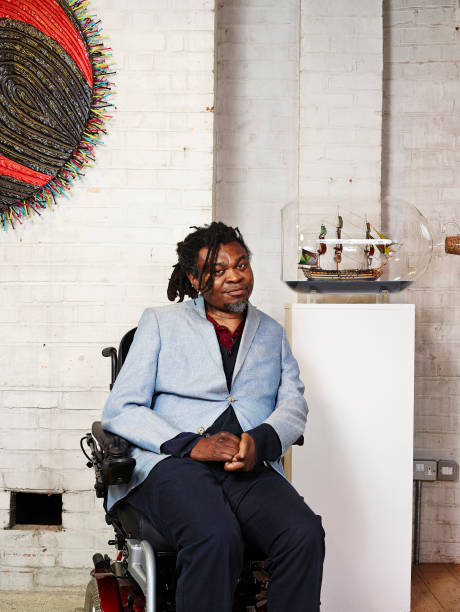
Yinka Shonibare
 Nigeria
Also known as: Yinka Shonibare MBE, Yinka Shonibare CBE RA
Birthday
August 9, 1962
Birth Sign
Leo
Birthplace
London, England
Age
64 years old
About
Yinka Shonibare is a British artist known for his vibrant use of Ankara and batik fabric to explore themes of cultural identity, colonialism, and post-colonialism. His works span sculpture, painting, photography, and film, and he is perhaps best known for his headless mannequins dressed in Victorian clothing made from these fabrics, which challenge conventional narratives of empire and authenticity.
Shonibare has exhibited at major institutions worldwide, including the Tate Modern, the Venice Biennale, and the Smithsonian's National Museum of African Art. He was nominated for the Turner Prize in 2004 and appointed MBE in 2004 and CBE in 2019. Despite a physical disability that affects one side of his body, he leads a team of assistants who help realize his intricate artistic visions, and he continues to produce influential and provocative work from his studio in East London.
Early Life & Background
Born in London on 9 August 1962, Shonibare moved to Lagos, Nigeria, at age three, where he spent his formative years. His mother, a dressmaker, exposed him early to textiles and sewing, planting the seeds for his later fascination with fabric. In 1979, he returned to London to study art, first at the Byam Shaw School of Art and later at Goldsmiths College, where he earned his MFA as part of the Young British Artists generation.
During his late teens, Shonibare contracted a viral illness that left him with permanent paralysis on one side of his body. This condition shaped his approach to art-making, leading him to rely on a team of assistants to physically create his works. His early experiments with batik fabric began during his student years, as he started to question the authenticity of cultural symbols and the histories behind them.
Career Growth
Shonibare's breakthrough came in the 1990s as he developed his signature style using Dutch-wax batik fabrics, which he used to dress headless mannequins in Victorian attire. His 2001 work "The Swing (after Fragonard)" and 2003's "Scramble for Africa" are among his most famous, critiquing colonial power and cultural appropriation. He was nominated for the Turner Prize in 2004, the same year he was appointed MBE.
His career has been marked by major exhibitions, including a survey at the Frederik Meijer Gardens & Sculpture Park in 2022 titled "Planets in My Head," and public sculptures such as "Wind Sculpture (SG) I" in New York and "Wind Sculpture in Bronze I" in Stockholm. His work is held in the collections of the Museum of Modern Art and the Tate, and he is represented by James Cohan Gallery and Stephen Friedman Gallery. In 2013 he was elected a Royal Academician, and in 2019 he was appointed CBE.
Career Timeline
Public Image & Style
Shonibare is celebrated for his intellectual rigor and visual opulence, using vibrant Ankara and batik fabric to create works that are both beautiful and provocative. The media often portrays him as one of Britain's most significant contemporary artists, with his CBE and RA titles signaling establishment recognition. His audience includes art-world professionals, collectors, and museum visitors, and he is known for his large-scale public sculptures that bring his critique of colonial history to a broader audience. There is no official fandom name, but his work resonates with those interested in post-colonial discourse and contemporary art.
Fame & Fandom
Yinka Shonibare commands a sphere defined by institutional reverence rather than mass-market hysteria. His audience comprises curators, collectors, and academic scholars who engage with his work through the lens of post-colonial theory and art history. Unlike pop icons who generate organized fan clubs or viral social media rituals, Shonibare's influence flows through the Yinka Shonibare Foundation and major museum acquisitions. There is no documented collective moniker for his supporters; they do not chant slogans or organize street campaigns. Instead, their devotion manifests in the acquisition of sculptures like *Wind Sculpture* by the Vero Beach Museum of Art and the critical discourse surrounding exhibitions such as *Sanctuary City*. The narrative around him relies on verified biographical elements, the displacement between London and Lagos, rather than folklore or legendary outbursts. His presence is felt in gallery openings and academic panels, where he discusses the complexities of cultural identity with intellectual rigor. This professional ecosystem sustains his reputation without the chaotic energy typical of celebrity fandoms. Despite his global recognition and titles like CBE, there are no recorded instances of crowds fainting at his appearances or dedicated fan bases driving chart movements. The reach of his work spans continents, yet the engagement remains focused on the art itself rather than the artist as a personality. In August 2026, the iFANN Global Fame Engine evaluated his standing across the world. Yinka Shonibare does not currently hold a placement in the published rankings (Global Top 1,000 or a Top-100 scope list). He holds no placement in the published rankings. He does not appear in any Top-100 scope list. The evaluation confirms that while his cultural impact is profound, he lacks a formal ranking within the current iFANN database.
Interesting Facts and Legends
Shonibare's practice thrives on a deliberate contradiction: he utilizes batik fabric often associated with Africa, though it was actually inspired by Indonesian techniques and mass-produced by European manufacturers for West African markets. Born in London in 1962 and raised in Lagos until age three, his background informs his exploration of identity and race. He lives with a physical disability affecting one side of his body, a condition present since his late teens, which necessitates a team of assistants to execute his large-scale sculptures. His mother worked as a dressmaker, providing early exposure to textiles that would become central to his career. In 2004, he received an MBE, followed by a CBE in 2019. A defining moment in his lore is the creation of *How Does a Girl Like You Get to Be a Girl Like You*, featuring three headless figures that challenged narratives of history and representation. More recently, his exhibition became a focal point for discussions on refuge and power, drawing significant attention from institutions like the Boston Globe and the Bay State Banner. His bronze *Wind Sculpture* was also acquired by the Vero Beach Museum of Art, further solidifying his presence in public collections. In June 2026, Shonibare entered into a public conversation with the legacy of Thomas Gainsborough at the National Gallery, highlighting his ongoing role in recontextualizing British art history.
Family & Personal Life
Shonibare's family life is largely private. He was born to Nigerian parents in London and moved to Lagos at age three, where he grew up. His mother was a dressmaker, and her craft had a lasting influence on his artistic practice. He has not publicly shared details about his siblings, spouse, or children, and he keeps his personal relationships out of the public eye.
Notable Connections
Relationships & Dating History
Yinka Shonibare has kept his personal relationships private, and no public information is available about his dating history, marriages, or partnerships. As of 2026, his relationship status remains undocumented, and he has not shared details about his family life in interviews or public appearances.
Salary, Net Worth In 2026
$10 Million
iFANN Editorial Team estimate
Per iFANN's editorial analysis, Yinka Shonibare's net worth is estimated at $10 Million as of 2026. This figure reflects a sustained career where his artworks regularly command five and six-figure sums at auction. Income streams extend beyond private sales to include lucrative public commissions, such as his wind sculptures installed in Omaha and Stockholm. Major gallery representation supports his market position, while his works reside in prestigious collections including the Museum of Modern Art and the Tate. Commercial demand has grown steadily alongside his survey exhibitions and public installations, which have broadened his reach to diverse audiences. The artist maintains a strong financial standing through this combination of commercial success and institutional recognition.
Awards & Accolades
View 5 records, honours and achievementsKnown For
The Swing (after Fragonard)
2001 · Artist
Scramble for Africa
2003 · Artist
Wind Sculpture (SG) I
2022 · Artist
Keywords
Sources
Quick Facts
- Born
- August 9, 1962
- Birthplace
- London, England
- Nationality
- British
- Education
- Byam Shaw School of Art, Goldsmiths College (MFA)
- Awards
- CBE (2019), MBE (2004), RA (2013)
Personal Details
- Full Name
- Yinka Shonibare
- Education
- Byam Shaw School of Art, Goldsmiths College (MFA)
Frequently Asked Questions
What is Yinka Shonibare famous for?
Where was Yinka Shonibare born and raised?
What does CBE and RA stand for in Yinka Shonibare's name?
Why does Yinka Shonibare use headless figures in his art?
Does Yinka Shonibare have a disability?
Social Media
Similar People
Join the community
fans discussing