“James Cagney gives a performance that is nothing short of brilliant. He dances, sings, and acts with such verve that he makes George M. Cohan come alive again.”
Bosley Crowther
The New York Times
 United States
"The story of the man who made America sing and dance."
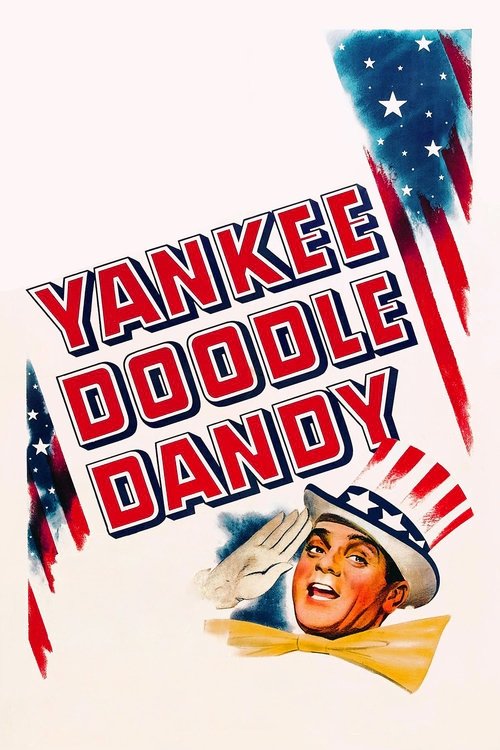
Released in 1942, this musical biopic from Warner Bros. tells the story of George M. Cohan, the man who wrote some of America's most enduring patriotic songs. James Cagney, in a career-defining performance, plays Cohan with an explosive energy that mirrors the showman's own relentless drive. The film follows Cohan from his childhood in a vaudeville family through his rise to become the defining figure of early Broadway, creating hits like "Give My Regards to Broadway" and "Over There." Joan Leslie plays Mary, the woman who becomes his wife and steadying influence, while Walter Huston brings warmth as his father Jerry. Michael Curtiz, fresh off directing Casablanca, keeps the pace brisk, and James Wong Howe's cinematography bathes the period sets in a golden glow. The film earned eight Academy Award nominations and won three, including Best Actor for Cagney, his only competitive Oscar.
The picture arrived at a moment when the country needed a morale boost. World War II was raging, and Cohan's songs, already beloved, took on new resonance. The film's unabashed patriotism struck a chord with audiences, making it one of the year's biggest hits. Cohan himself died just six months after the premiere, but he had seen Cagney's performance and approved. The staircase tap dance sequence, shot in a single take, remains one of cinema's great set pieces, a testament to Cagney's vaudeville training and the technical skill of the production team.
Availability and pricing can change. Confirm on the provider's site before purchasing.
The film opens in 1937 at the White House, where George M. Cohan, now 59, waits to receive the Congressional Gold Medal from President Franklin D. Roosevelt. As he stands in a hallway, his mind drifts back to his childhood in Providence, Rhode Island, in the 1890s. Young George is the son of Jerry and Nellie Cohan, vaudeville performers who tour with their children as "The Four Cohans." From the start, George shows an irrepressible talent for songwriting and dancing, and a fierce desire to improve the family act.
As George grows into a young man, he takes creative control of the act, writing new songs and choreographing dances. He meets Mary, a chorus girl, and they fall in love. Mary becomes his anchor, offering practical advice when his ambition runs away with him. George partners with Sam Harris, a sharp businessman, and together they try to break into the New York theater scene. They face rejection from powerful producers like Erlanger, who dismiss George's original American style in favor of European imports.
George's refusal to compromise leads to a string of hits, including "You're a Grand Old Flag" and "Yankee Doodle Dandy." He marries Mary, and the family act continues to thrive. But his relentless drive strains his relationships, and he often neglects those closest to him. His father Jerry provides wisdom, and his mother Nellie offers unconditional love. The story builds toward World War I, when George writes "Over There," a song that becomes an anthem for American troops. The film captures his creative process, his rivalries with other performers, and his enduring love for his family and country, all while maintaining a brisk, energetic pace that mirrors Cohan's own personality.
Original Theatrical Trailer
Critical Consensus
Critics universally praise Yankee Doodle Dandy as a masterful biopic that transcends its genre. James Cagney's electrifying performance is the film's centerpiece, capturing Cohan's boundless energy and patriotic fervor. Michael Curtiz's direction keeps the 126-minute runtime brisk, while James Wong Howe's cinematography and the lavish musical numbers create a vibrant portrait of early 20th-century show business.
“James Cagney gives a performance that is nothing short of brilliant. He dances, sings, and acts with such verve that he makes George M. Cohan come alive again.”
Bosley Crowther
The New York Times
“Cagney's portrayal is a tour de force. He captures the cocky, brash, yet deeply patriotic spirit of Cohan with astonishing precision.”
Variety Staff
Variety
“Cagney's performance is the finest male performance I have ever seen in a musical. He is not acting Cohan; he becomes him.”
James Agee
The Nation
“The film is a celebration of American optimism and energy. Cagney's staircase tap dance is one of the great moments in cinema.”
Roger Ebert
Chicago Sun-Times
“A joyous, patriotic musical that never feels dated. Cagney's performance is a marvel of physical comedy and emotional depth.”
Pauline Kael
The New Yorker
James Cagney
George M. Cohan
Joan Leslie
Mary
Walter Huston
Jerry Cohan
Richard Whorf
Sam Harris
Irene Manning
Fay Templeton
George Tobias
Dietz
Rosemary DeCamp
Nellie Cohan
Jeanne Cagney
Josie Cohan
Frances Langford
Singer
George Barbier
Erlanger
Walter Catlett
Theatre Manager
Douglas Croft
George M. Cohan, as a boy of 13
Director
Michael Curtiz
Writers
Robert Buckner, Julius J. Epstein, Edmund Joseph
Composers
Ray Heindorf, Heinz Roemheld
Cinematographer
James Wong Howe
Producer
William Cagney
Academy Awards (1943)
Best Actor in a Leading Role: Won
Academy Awards (1943)
Best Music, Scoring of a Musical Picture: Won
Academy Awards (1943)
Best Sound Recording: Won
Academy Awards (1943)
Best Picture: Nominated
Academy Awards (1943)
Best Director: Nominated
Academy Awards (1943)
Best Supporting Actor: Nominated
Academy Awards (1943)
Best Writing, Original Story: Nominated
Academy Awards (1943)
Best Art Direction-Interior Decoration, Black-and-White: Nominated
National Board of Review (1942)
Top Ten Films: Won
New York Film Critics Circle (1942)
Best Actor: Won
Photoplay Awards (1943)
Gold Medal for Best Picture: Won
Join the community
fans discussing