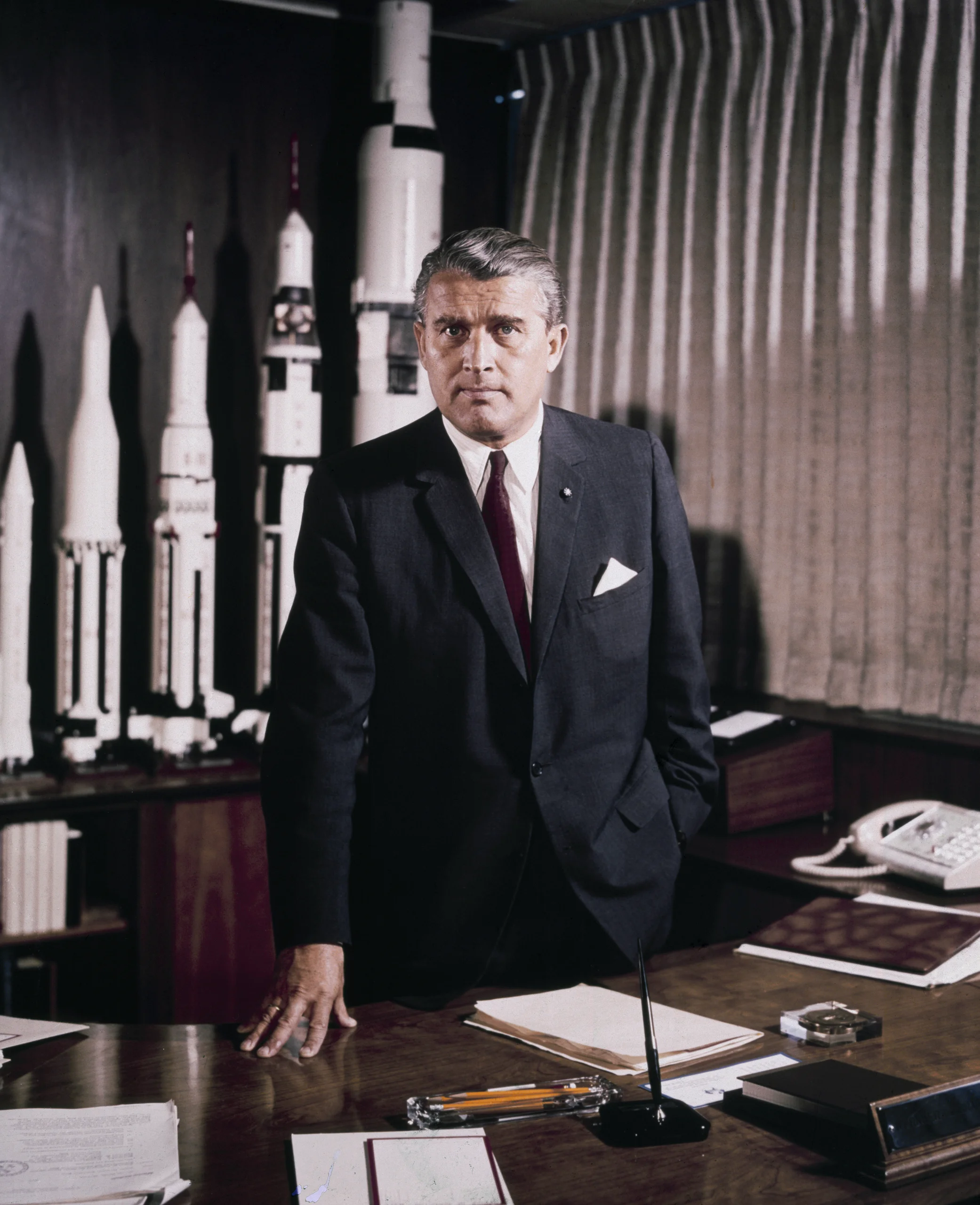
Wernher von Braun
 Poland
physicist•military flight engineer•non-fiction writer
Also known as: Wernher Magnus Maximilian Freiherr von Braun, Baron von Braun
Birthday
March 23, 1912
Birth Sign
Aries
Birthplace
Wyrzysk, German Empire (now Poland)
Age
Died at 65
Height
6 ft 1 in (185 cm)
About
Wernher von Braun was a German American aerospace engineer and space architect who shaped the course of rocket history. He is best known for developing the V-2 rocket for Nazi Germany and later the Saturn V rocket that took Americans to the Moon. As director of NASA's Marshall Space Flight Center, he led the team that built the most powerful rocket ever successfully flown. His work directly enabled the Apollo 11 Moon landing in 1969. Von Braun also popularized space travel through a series of television films with Walt Disney in the 1950s, reaching millions of viewers. Today, his legacy is complex. He is celebrated as a visionary who turned spaceflight from science fiction into reality, but also criticized for his involvement with the Nazi Party and SS. His name appears on NASA facilities, awards, and museum exhibits, and he remains a central figure in debates about the ethical trade-offs of scientific progress.
Early Life & Background
Wernher von Braun was born on March 23, 1912, in Wyrzysk, a small town in what was then the German Empire. His father, Magnus Freiherr von Braun, served as a civil servant and later as Minister of Agriculture in the Weimar Republic. His mother, Emmy von Quistorp, traced her lineage back to European royalty. From an early age, she encouraged his curiosity about the stars, giving him a telescope that sparked a lifelong passion for space.
Von Braun attended the Hermann-Lietz-Schule at Ettersburg Castle, a progressive boarding school, and later the French Gymnasium in Berlin. He was not a top student early on, struggling with physics and mathematics. But after reading Hermann Oberth's book The Rocket into Interplanetary Space, he threw himself into rocketry. By age 18, he was building crude rockets in the streets of Berlin, once causing a disturbance that led to a police warning.
He enrolled at the Berlin Institute of Technology, earning a bachelor's degree in mechanical engineering in 1932. That same year, he joined the German Army's rocket artillery unit, working on liquid-fueled rockets. He earned a doctorate in physics from the University of Berlin in 1934, with a thesis on rocket propulsion. His early work caught the attention of the military, and by 1937 he became technical director of the Peenemünde Army Research Center. There, he led a team that developed the V-2 rocket, the world's first long-range guided ballistic missile.
Career Growth
Von Braun's breakthrough came during World War II with the V-2 rocket. On June 20, 1944, a V-2 became the first artificial object to cross the Kármán line, reaching space. After the war, he surrendered to U.S. forces and was brought to America under Operation Paperclip, along with about 1,600 German scientists. He worked for the U.S. Army at Fort Bliss, Texas, and later at Redstone Arsenal in Huntsville, Alabama.
In the 1950s, von Braun led the development of the Redstone and Jupiter rockets. His team launched Explorer 1, America's first satellite, in 1958. In 1960, his group was transferred to NASA, where he became director of the Marshall Space Flight Center. There, he oversaw the development of the Saturn V rocket, which launched Apollo 8 around the Moon in 1967 and Apollo 11 to the lunar surface in 1969. After the Apollo program, he advocated for a human mission to Mars. He left NASA in 1972 to join Fairchild Industries, focusing on space commercialization. He died of pancreatic cancer on June 16, 1977, in Alexandria, Virginia.
Career Timeline
Public Image & Style
Von Braun cultivated a calm, professorial public image. He was often photographed in suits or white lab coats, speaking with a slight German accent. His collaboration with Walt Disney on three television films from 1955 to 1957 made him a household name, presenting space travel as an exciting, achievable goal. Media portrayals have been mixed. In films like The Right Stuff (1983) and Apollo 13 (1995), he appears as a conflicted genius. His Nazi past remains a subject of controversy. Space enthusiasts celebrate his birthday with rocket-themed events, and his name is invoked in debates about the ethics of scientific progress. No official fandom name exists, but followers often call themselves space historians. His social media presence is maintained by the Wernher von Braun Foundation and NASA.
Fame & Fandom (iFAMOUS Rankings)
The global attention directed toward Wernher von Braun spans decades of historical scrutiny, academic study, and popular fascination with the paradox of his life. His standing in the modern cultural consciousness is quantified by specific metrics within the iFANN Global Fame Rankings, where he holds a distinct position among historical figures. He is currently recognized as the 6th most famous person from Poland, a placement that has remained steady through recent cycles. This ranking reflects a sustained interest in his origins alongside his contributions to aerospace engineering, anchoring his legacy in both German and American history. The data encompasses his influence across media coverage, search patterns, and consumption signals worldwide, ensuring his name remains prominent in discussions regarding space exploration and 20th-century warfare. While his fame is substantial, it lacks the organic structure of a traditional celebrity fanbase. No formal organization or named group exists to champion his memory; instead, his audience consists of historians, space enthusiasts, and the general public who engage with his story through museums and educational institutions rather than active fandom rituals. There are no documented campaigns, birthday tributes, or fan-funded projects dedicated solely to him, distinguishing his legacy from that of contemporary entertainers.
Interesting Facts and Legends
Born into nobility, Wernher von Braun held the title Freiherr, which translates to baron, a status he carried throughout his life. A skilled musician, he frequently played the cello and piano at social gatherings, showcasing a refined side to his personality. He also possessed a private pilot's license and often flew his own aircraft. In 1944, the Gestapo arrested him for allegedly prioritizing space travel over military rocket production, though he was released after two weeks due to his indispensable role in the V-2 program. Von Braun authored the science fiction novel Project Mars, which outlined detailed plans for a crewed mission to the Red Planet. He made a cameo appearance in the 1955 Disney film Man in Space, further cementing his public presence. The American Institute of Aeronautics and Astronautics honors his contributions with the Wernher von Braun Award. Beyond these facts, his legend is defined by the stark duality of his career: the architect of the V-2 weapon system built on slave labor and the visionary engineer who enabled humanity's first steps on the Moon. A widely retold narrative focuses on his post-Apollo ambitions, where he immediately began planning human missions to Mars, a vision that ultimately went unfulfilled but remains a subject of retrospective discussion.
Notable Quotes
“I have learned to use the word 'impossible' with the greatest caution.”
“The rocket worked perfectly, except for landing on the wrong planet.”
“We can solve the problems of the world if we work together, but it requires a vision.”
“For me, the Moon landing was the culmination of a dream that began when I was a boy.”
Family & Personal Life
Von Braun married his first cousin, Maria Luise von Quistorp, on March 1, 1947, in a Lutheran ceremony in Landshut, Germany. The couple had three children: Iris Careen (born 1948), Margrit Cécile (born 1952), and Peter Constantine (born 1960). Maria moved with him to the United States, managing their household in Huntsville, Alabama. She died in 1999. Von Braun's father, Magnus, was a civil servant and agriculture minister; his mother, Emmy, encouraged his early interest in astronomy. He had two brothers, Magnus and Ernst. The family lived in a modest home in Huntsville, where von Braun kept a small observatory in the backyard.
Notable Connections
Von Braun collaborated with Walt Disney on three television films about space travel from 1955 to 1957. He worked closely with President John F. Kennedy to achieve the Moon landing. His team included fellow German rocket scientists Dr. Arthur Rudolph and Dr. Kurt Debus. At NASA, he partnered with Dr. George Mueller, associate administrator for the Apollo program.
Relationships & Dating History
Von Braun married his first cousin, Maria Luise von Quistorp, on March 1, 1947, in Landshut, Germany. The couple had three children and remained married until his death in 1977. Maria moved with him to the United States, managing their household in Huntsville, Alabama. She died in 1999. No other romantic relationships are documented. As of 2026, von Braun is deceased, and his estate is managed by his family and the Wernher von Braun Foundation.
- MarriedMaria Luise von Quistorp1947 - 1977Married his first cousin; three children; marriage lasted until his death.
Death & Aftermath
Died
June 16, 1977 (aged 65)
Death Place
Alexandria, Virginia
Cause of Death
Complications from a heart attack (myocardial infarction)
Tributes poured in from NASA officials and professional organizations immediately following the news, highlighting his pivotal role in the Apollo program while the broader public reaction remained a measured celebration of technical achievement rather than political mourning. Wernher von Braun passed away at his home in Alexandria, Virginia, on June 16, 1977, at the age of sixty-five after collapsing later that afternoon despite feeling unwell earlier in the day. His wife Maria discovered him and summoned emergency services, but medical intervention could not reverse the event, which authorities ruled as complications from a myocardial infarction based on his known history of diabetes and heart disease. The funeral service held shortly thereafter took place at the Congressional Cemetery in Washington, D.C., attended by high-ranking government representatives and NASA dignitaries who delivered eulogies emphasizing his vision for space exploration while contextualizing his earlier work with the Nazi regime.
In the years following his passing, various educational institutions and foundations established scholarships and awards in his name to support students in STEM fields, reflecting the enduring influence of his engineering contributions. He was inducted into the National Aviation Hall of Fame and the Alabama Men's Hall of Fame, ensuring his legacy was preserved through historical research and donations of his personal papers to the Smithsonian Institution.
Net Worth (Estate Value)
$10 Million
iFANN Editorial Team estimate
Per iFANN's editorial analysis, the estate of Wernher von Braun is valued at $10 Million as of 2026. This financial assessment accounts for income generated from posthumous book sales, including titles such as The Mars Project and History of Rocketry & Space Travel. Licensing agreements for his name and likeness continue to provide revenue through documentaries, films, and museum exhibits. The Wernher von Braun Foundation, managed by his children, oversees these assets and ensures their proper stewardship. Royalties from intellectual property remain modest, as most of his NASA patents were owned by the government. The estate also benefits from educational grants and merchandise sold at the U. S. Space & Rocket Center in Huntsville, Alabama. Overall, the estate's value has grown slowly since his death, supported by ongoing public interest in space history.
Awards Won (7)
Von Braun won several major awards for his contributions to rocketry and space exploration. He received the National Medal of Science in 1975, the highest scientific honor in the United States. The Franklin Institute awarded him the Elliott Cresson Medal in 1962. He also earned the Langley Gold Medal from the Smithsonian Institution in 1967 and the Goddard Memorial Trophy in 1960. NASA awarded him the Distinguished Service Medal in 1969 for his Apollo program leadership.
1975 · Science
Contributions to rocketry and space exploration
1962 · Engineering
Rocket development
Known For
V-2 rocket
1944 · Technical director
Saturn V rocket
1967 · Chief architect
Explorer 1 satellite
1958 · Team leader
Keywords
Quick Facts
- Profession
- physicist, military flight engineer, non-fiction writer
- Born
- +1912-03-23
- Birthplace
- Wyrzysk
- Died
- +1977-06-16
- Death Place
- Alexandria
- Gender
- Male
- Spouse
- Maria von Braun
- Birth Sign
- Aries
Personal Details
- Full Name
- Wernher Magnus Maximilian Freiherr von Braun
- Height
- 6 ft 1 in (185 cm)
- Spouse
- Maria Luise von Quistorp
- Children
- Iris Careen, Margrit Cécile, Peter Constantine
- Education
- Berlin Institute of Technology (B.S. in mechanical engineering, 1932); University of Berlin (Ph.D. in physics, 1934)
Frequently Asked Questions
Was Wernher von Braun a Nazi?
What is Wernher von Braun's net worth in 2026?
Did Wernher von Braun go to space?
How did Wernher von Braun die?
What did Wernher von Braun do after NASA?
Similar People
Join the community
fans discussing