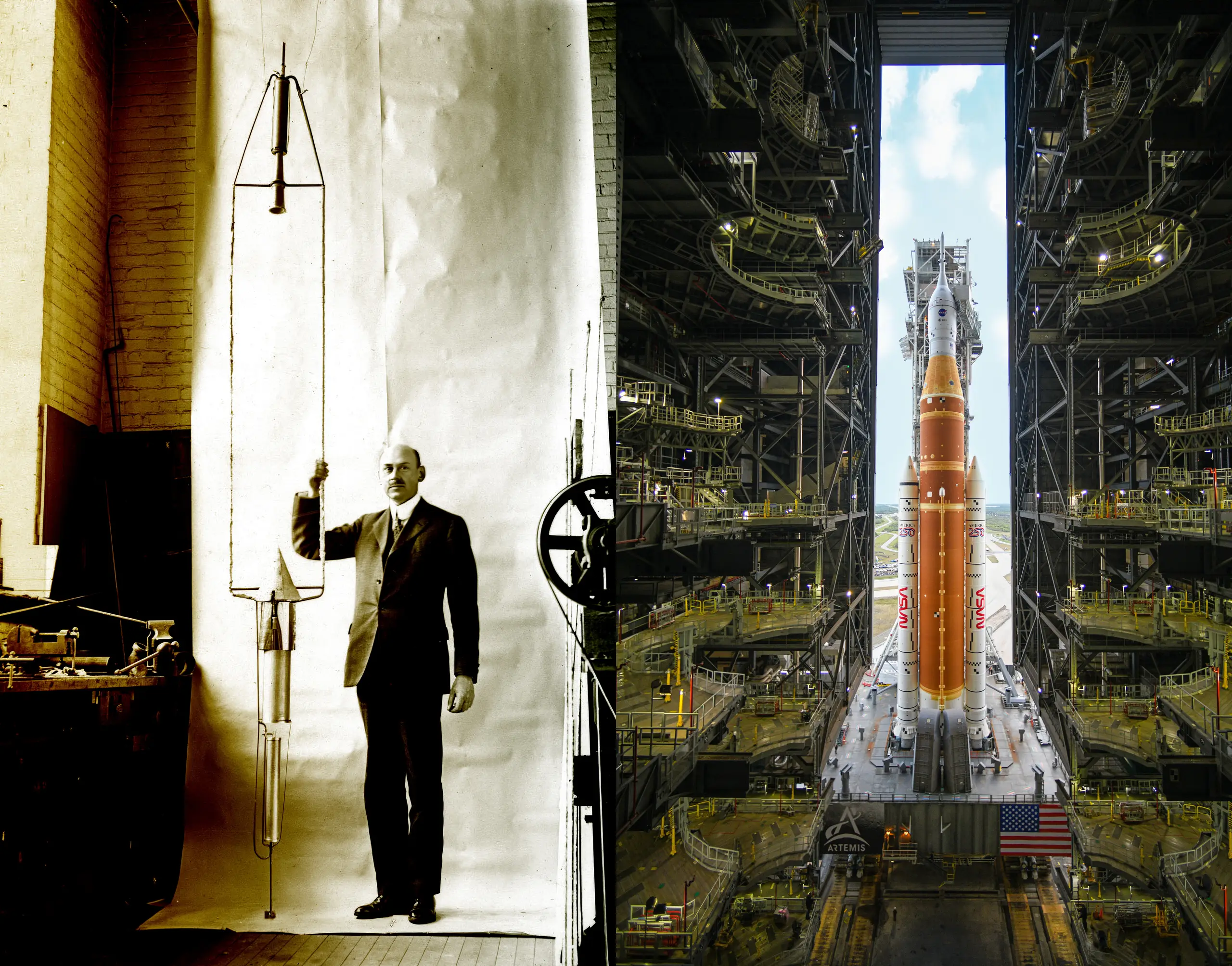
Robert H. Goddard
Also known as: R.H. Goddard, Robert Hutchings Goddard
Birthday
October 5, 1882
Birth Sign
Libra
Birthplace
Worcester, Massachusetts
Age
Died at 62
About
Robert Hutchings Goddard was an American physicist, inventor, and engineer widely recognized as the Father of Modern Rocketry. Born in Worcester, Massachusetts, he suffered from chronic respiratory issues from childhood but developed an early fascination with science fiction and space travel. His pivotal moment came at age 17 while pruning fruit trees, where he resolved to dedicate his life to creating devices capable of reaching other planets. He spent the majority of his academic career as a professor of physics at Clark University for 29 years. Before his fame as a rocket pioneer, he conducted groundbreaking theoretical work that laid the foundation for modern aerospace engineering. In 1914, he obtained two patents for a multi-stage rocket and a liquid-fuel rocket system, revolutionary concepts at the time. By 1915, he demonstrated that liquid propellants offered significantly higher efficiency than solid fuels. His most famous achievement occurred on March 16, 1926, when he launched the world's first liquid-fueled rocket, named Nell, from his aunt's farm in Auburn, Massachusetts. This event marked the birth of modern rocketry, establishing him as a visionary whose work would eventually enable human spaceflight.
Early Life & Background
Robert Hutchings Goddard was born on October 5, 1882, in Worcester, Massachusetts, to Nahum and Fanny Chamberlin Goddard. From a young age, he struggled with fragile health, suffering from asthma and tuberculosis which forced him to be homeschooled for periods during his childhood. Despite these physical challenges, he possessed an insatiable curiosity about the universe. His interest in science fiction ran deep, particularly regarding H.G. Wells' The War of the Worlds, which convinced him that humanity would eventually travel to other planets. The defining moment of his early life occurred when he was just 17 years old. While pruning fruit trees in his family's orchard, Goddard had a vivid dream of a device that could reach Mars. Upon waking, he made a firm resolution to dedicate his life to solving the engineering problems required to make such travel possible. This singular focus drove him through his education at Worcester Polytechnic Institute, where he graduated in 1908 with a degree in physics and engineering. He continued his studies at Clark University, earning his Ph.D. in 1911, setting the stage for a career that would redefine human capability beyond Earth. During this period, he also began publishing his initial theories on high-altitude flight, preparing the ground for future innovations.
Career Growth
Goddard's professional breakthrough arrived on March 16, 1926, in Auburn, Massachusetts, when he successfully launched the world's first liquid-fueled rocket, named Nell. The 10-foot machine flew for 2.5 seconds, reaching an altitude of 41 feet before crashing into the snow. This event marked the birth of modern rocketry. Between 1926 and 1941, Goddard and his small team launched 34 different rockets, achieving altitudes up to 2.6 kilometers and speeds of 885 km/h. His innovations included gyroscopic stabilization and steerable thrust vanes, allowing for precise control of flight paths. Despite these successes, Goddard faced intense public ridicule, most notably a 1920 New York Times editorial that mocked his theories about space travel. He remained largely isolated, working privately rather than seeking government funding until the U.S. military took interest in his work during World War II. During this period, he consulted on jet-assisted takeoff systems for the Navy. His 1919 monograph A Method of Reaching Extreme Altitudes remains a foundational text for modern rocket science, outlining how to reach extreme heights using mathematical precision. In the 1930s, he moved operations to Roswell, New Mexico, for better weather and privacy, where he continued his experiments away from public scrutiny.
Career Timeline
Public Image & Style
Goddard was known for his shy demeanor and preference for working behind the scenes rather than seeking the spotlight. He was often described as having a slight build due to his chronic illness. Unlike many inventors of his time, he avoided public acclaim and preferred to conduct his research in private settings, such as his aunt's farm in Auburn and later in Roswell, New Mexico. His isolation led to a reputation as an eccentric loner among the general public, though his peers in the scientific community respected his rigorous methodology and innovative spirit. He was generally considered frail and unassuming in appearance, often preferring to work behind the scenes rather than seek the spotlight. Despite being ridiculed by the press, Albert Einstein praised Goddard's work, calling him a pioneer in the field of rocketry. This contrast between public perception and private respect defined his image as a misunderstood genius who prioritized truth over popularity.
Fame & Fandom (iFAMOUS Rankings)
iFANN has not yet collected fame data for Robert H. Goddard. As a scientist rather than an entertainer, Goddard does not have a fandom in the traditional sense of pop culture. However, he possesses a massive global following within the aerospace community, history enthusiasts, and educational circles. Fans refer to themselves as followers of Rocket Science History or Space Pioneers. Notable fan-driven projects include the annual Goddard Centennial celebrations in 2026 marking the 100th anniversary of his first launch, organized by WPI, Clark University, and NASA. These events involve museum exhibits, educational workshops, and the recovery of artifacts related to Nell. The Goddard Legacy is maintained by the Robert H. Goddard Museum at Clark University and the Smithsonian Air and Space Museum. In 2026, the world commemorated the centennial of Goddard's first liquid-fueled rocket launch, with NASA and the Smithsonian celebrating 100 years since the launch of Nell, highlighting how his 2-second flight paved the way for modern lunar missions.
Interesting Facts and Legends
Goddard initially wanted to name his first rocket Mars but settled on Nell after seeing a bird land on his rocket during testing, a name suggested by a local child. He held over 200 patents, many of which were licensed to the U.S. government during WWII without significant financial gain for himself or his estate. Despite being ridiculed by the press, Albert Einstein praised Goddard's work, calling him a pioneer in the field of rocketry. Goddard was a member of the Boy Scouts of America and often used his knowledge to help local scouts with science projects. He received honorary doctorates from Princeton University and other institutions. A Congressional Gold Medal was awarded posthumously in 1959. Guinness World Records recognizes him for the first liquid-fueled rocket launch. He was influenced by contemporary pioneers Konstantin Tsiolkovsky and Hermann Oberth. Daniel Guggenheim provided crucial funding through the Daniel Guggenheim Fund for the Promotion of Aeronautics. Charles Lindbergh was a friend and advocate who helped secure funding for Goddard's research in New Mexico.
Notable Quotes
“It is difficult to say what is impossible, for the dream of yesterday is the hope of today and the reality of tomorrow.”
“I have always felt that if I could only prove that it was possible to go to the moon, then others would follow.”
Family & Personal Life
Robert Goddard was married only once. He met Esther Christine Kisk, a secretary at Clark University, in 1919. They were engaged in 1923 and married on June 21, 1924. Esther served as his dedicated manager, secretary, and protector throughout his life, shielding him from the press and managing his finances. She was instrumental in preserving his legacy after his death. The couple had no children together. Esther Christine Goddard died in 1982, long after her husband's passing. There are no records of any prior romantic relationships or flings; his personal life was characterized by his deep devotion to his wife and his singular focus on his scientific work. Robert is buried in Worcester Cemetery in Worcester, Massachusetts, alongside his family roots. His parents, Nahum and Fanny, supported his early education despite their son's frequent illnesses, fostering the environment that allowed his genius to flourish.
Notable Connections
Relationships & Dating History
Robert Goddard was married only once. He met Esther Christine Kisk, a secretary at Clark University, in 1919. They were engaged in 1923 and married on June 21, 1924. Esther served as his dedicated manager, secretary, and protector throughout his life, shielding him from the press and managing his finances. She was instrumental in preserving his legacy after his death. The couple had no children together. As of the historical record, Goddard is widowed; Esther Christine Goddard died in 1982, long after her husband's passing. There are no records of any prior romantic relationships or flings; his personal life was characterized by his deep devotion to his wife and his singular focus on his scientific work. Their partnership was defined by mutual support, with Esther handling all external communications so Goddard could focus entirely on his experiments.
- MarriedEsther Christine Kisk1924 - 1945Met in 1919; she managed his affairs and preserved his legacy after his death.
Death & Aftermath
Died
August 10, 1945 (aged 62)
Death Place
Baltimore, Maryland
Cause of Death
Laryngeal cancer
Robert Goddard passed away on August 10, 1945, at Johns Hopkins Hospital in Baltimore, Maryland, at the age of 62. He had been battling throat cancer (laryngeal cancer) for several years and spent his final days in relative privacy while still consulting with the U.S. Navy on jet-assisted takeoff systems. His death occurred just months before the end of World War II, a time when his theories would soon become the foundation for the ballistic missile era. Following his death, his widow Esther fought tirelessly to secure recognition for his contributions. She donated his papers and equipment to Clark University and later to the Smithsonian Institution. Public opinion shifted dramatically in the post-war era as the Space Age began. In 1959, NASA named its Goddard Space Flight Center in Greenbelt, Maryland, in his honor. A famous New York Times retraction from 1962 acknowledged the error of their 1920 editorial that had mocked him decades earlier. He was inducted into the International Aerospace Hall of Fame in 1966, the National Aviation Hall of Fame in 1966, and the International Space Hall of Fame in 1976. Esther continued to manage his legacy until her own death in 1982, ensuring his contributions were not forgotten.
Net Worth (Estate Value)
$0
iFANN Editorial Team estimate
As a deceased individual whose primary assets were intellectual property and scientific equipment, Robert Goddard did not accumulate personal wealth in the traditional sense. He held over 200 patents, many of which were licensed to the U.S. government during World War II without significant financial gain for himself or his estate. His net worth is estimated at $0, reflecting the fact that he prioritized his research over financial accumulation. The value of his legacy lies in the immense impact of his inventions on modern space exploration rather than monetary assets. He received a grant from the Guggenheim Foundation in 1920, which was vital for his research, but he never sought to monetize his discoveries for personal enrichment. The licensing fees from his patents went primarily to the government and his estate, ensuring his work remained accessible for national defense and scientific advancement.
Awards Won (4)
While Goddard received few awards during his lifetime due to his preference for isolation, his posthumous honors are extensive. He was inducted into the International Aerospace Hall of Fame in 1966, the National Aviation Hall of Fame in 1966, and the International Space Hall of Fame in 1976. NASA named its Goddard Space Flight Center after him in 1959. He was also awarded the Congressional Gold Medal posthumously in 1959.
1959 · Civilian Honor
Lifetime Achievement
1966 · Hall of Fame
Contributions to Rocketry
Known For
Father of Modern Rocketry
1926 · Inventor
First Liquid-Fueled Rocket Launch
1926 · Engineer
Keywords
Sources
Quick Facts
- Profession
- physicist, inventor, engineer
- Born
- October 5, 1882
- Birthplace
- Worcester, Massachusetts
- Died
- August 10, 1945
- Death Place
- Baltimore, Maryland
- Gender
- Male
- Spouse
- Esther Christine Kisk
- Birth Sign
- Libra
Personal Details
- Full Name
- Robert Hutchings Goddard
- Spouse
- Esther Christine Kisk
- Children
- Education
- Worcester Polytechnic Institute (B.S., 1908); Clark University (Ph.D., 1911)
Frequently Asked Questions
Who was Robert H. Goddard?
When did Robert Goddard die?
What was Robert Goddard's first rocket called?
Did Robert Goddard have children?
Where is Robert Goddard buried?
Similar People
Join the community
fans discussing