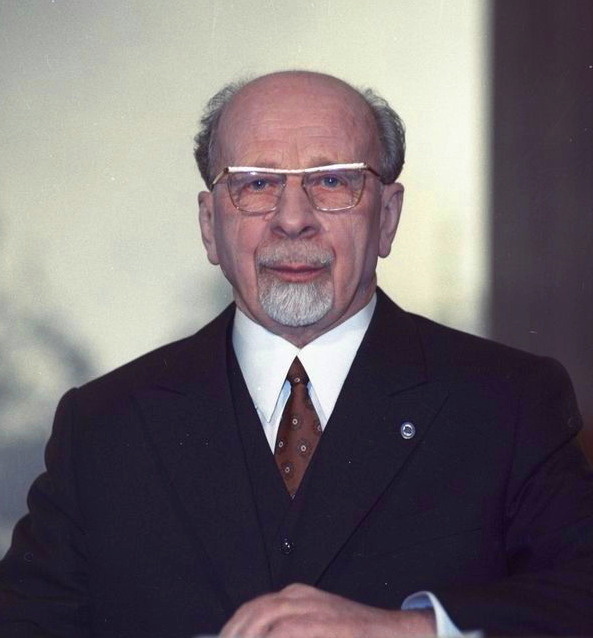
Walter Ulbricht
 Germany
politician•resistance fighter•communist
Birthday
+1893-06-30
Birth Sign
Sagittarius
Birthplace
Leipzig
Age
Died at 80
About
Walter Ernst Paul Ulbricht, born on June 30, 1893, in Leipzig, was a German communist politician and revolutionary who became the most powerful leader of East Germany. He played a pivotal role in founding the Communist Party of Germany (KPD) during the Weimar Republic and later in establishing the German Democratic Republic (GDR). As First Secretary of the Socialist Unity Party (SED) from 1950 to 1971, he was the chief decision-maker in East Germany, and after President Wilhelm Pieck's death in 1960, he also served as head of state until his own death on August 1, 1973. Ulbricht's political career spanned decades, marked by his shrewd use of bargaining power with the Kremlin, most notably when he pushed for the construction of the Berlin Wall in 1961, despite Soviet reluctance. Ulbricht's political journey began during the German Empire when he joined the Social Democratic Party (SPD) in 1912. He later switched to the anti-war Independent Social Democratic Party (USPD) in 1917, and the following year, he deserted the Imperial German Army to participate in the German Revolution of 1918. He joined the KPD in 1920 and quickly rose through the ranks, serving on its Central Committee from 1923. After the Nazis came to power in 1933, Ulbricht, facing investigation for his role in the 1931 murders of police captains Paul Anlauf and Franz Lenck, fled to Paris and Prague, then to the Soviet Union, where he remained until 1945. After World War II, Ulbricht returned to Germany and reorganized the KPD in the Soviet occupation zone along Stalinist lines. He was instrumental in the forced merger of the KPD and SPD into the SED in 1946, and by 1950, he had become the effective leader of the newly established GDR. During the 1953 uprising, he hid in Soviet Army headquarters while Soviet forces violently suppressed the revolt. Ulbricht's regime was a communist dictatorship that suppressed civil and political rights, and East Germany joined the Warsaw Pact in 1955. His policies of nationalizing industry failed to improve living standards, leading to mass emigration. The Berlin Wall, built in 1961, halted the exodus but caused a diplomatic crisis. However, the failures of his economic reforms in the 1960s led to his forced retirement in 1971, with Erich Honecker replacing him. Ulbricht remained a symbolic head of state until his death from a stroke in 1973.
Fame & Fandom
The legacy of Walter Ulbricht is defined not by adoring crowds or fan rituals, but by the intense, often fearful political allegiance he commanded as the architect of East Germany. While pop culture icons might boast of birthday billboards or organized campaigns, Ulbricht's influence was a matter of state enforcement rather than voluntary fandom. His supporters were citizens navigating a system where dissent carried severe consequences, meaning there is no formal name for any fanbase and no documented rituals surrounding his life or death. The only "lore" that persists involves the stark contradictions between his public pronouncements and historical reality, particularly the famous moment in 1961 when he denied plans to build a wall, only for the barrier to rise weeks later. This incident cemented his image as a figure whose words were inextricably linked to the machinery of authoritarian control. In the broader landscape of global historical figures, Walter Ulbricht has been evaluated by the iFANN Global Fame Engine. Despite his significant role in shaping Cold War history, he currently holds no placement in the published rankings, including the Global Top 1,000 or any specific scope list. This absence of a rank reflects the unique nature of his fame: it is deeply rooted in a specific geopolitical era rather than the continuous, measurable consumption signals that drive modern celebrity metrics. The evaluation confirms that while his name remains synonymous with the division of Berlin and the GDR, he does not currently register within the active tiers of global popularity measured by contemporary standards. The lack of a numeric score underscores the distance between a historical dictator and the living, breathing cultural phenomena that populate the top ranks today.
Interesting Facts and Legends
Walter Ulbricht remains a central figure in the narrative of 20th-century communism, known for his shrewd navigation of Soviet politics and his decisive leadership during the early years of the German Democratic Republic. He served as the First Secretary of the Socialist Unity Party for over two decades, effectively ruling East Germany until his forced resignation in 1971 due to health issues and pressure from Erich Honecker. A legendary moment in his career occurred during a press conference at the Berlin Palace in June 1961, where he famously declared, "Niemand hat die Absicht, eine Mauer zu errichten!" (No one has the intention of building a wall!). This statement became an enduring symbol of propaganda when construction on the Berlin Wall began just weeks later, creating a lasting irony in historical memory. Another pivotal event associated with him is the suppression of the 1953 uprising, where Soviet tanks were deployed to crush worker protests, an act that remains a defining chapter of his dictatorship. Unlike modern celebrities, Ulbricht did not engage with fans; his power was absolute, enforced by the Stasi secret police and the structures of the SED party.
Death & Aftermath
Died
+1973-08-01 (aged 80)
Death Place
Berlin
Cause of Death
reported complications from diabetes and heart disease
The state-sponsored funeral on August 4, 1973, at the Zentralfriedhof Friedrichsfelde cemented Walter Ulbricht's status as a founding father of the German Democratic Republic, featuring military honors and speeches by Erich Honecker and other Politburo members that extolled his decades of service to the socialist cause. This grand ceremony, attended by delegations from across the socialist world, served as the final public chapter for a man whose passing had been managed with strict secrecy since his resignation in May 1971 due to declining health. His final days were spent in an East Berlin hospital under the care of the state medical establishment, where he succumbed to complications from diabetes and heart disease at the age of eighty.
The official narrative remained the only documented account, reflecting the GDR's practice of keeping high-ranking party deaths within the framework of the Socialist Unity Party. Public reaction was carefully orchestrated by the regime, with immediate tributes issued by the Council of State and lengthy obituaries published in Neues Deutschland detailing his contributions to the anti-fascist struggle. In the posthumous period following the fall of the Berlin Wall and reunification in 1990, many monuments and streets named after him were removed or recontextualized, transforming him from a celebrated leader into a symbol of Stalinist repression and division in academic literature and documentaries.
Awards & Accolades
Keywords
Quick Facts
- Profession
- politician, resistance fighter, communist
- Born
- +1893-06-30
- Birthplace
- Leipzig
- Died
- +1973-08-01
- Death Place
- Groß Dölln
- Gender
- Male
- Spouse
- Lotte Ulbricht
- Birth Sign
- Sagittarius
Personal Details
- Spouse
- Lotte Ulbricht
Join the community
fans discussing