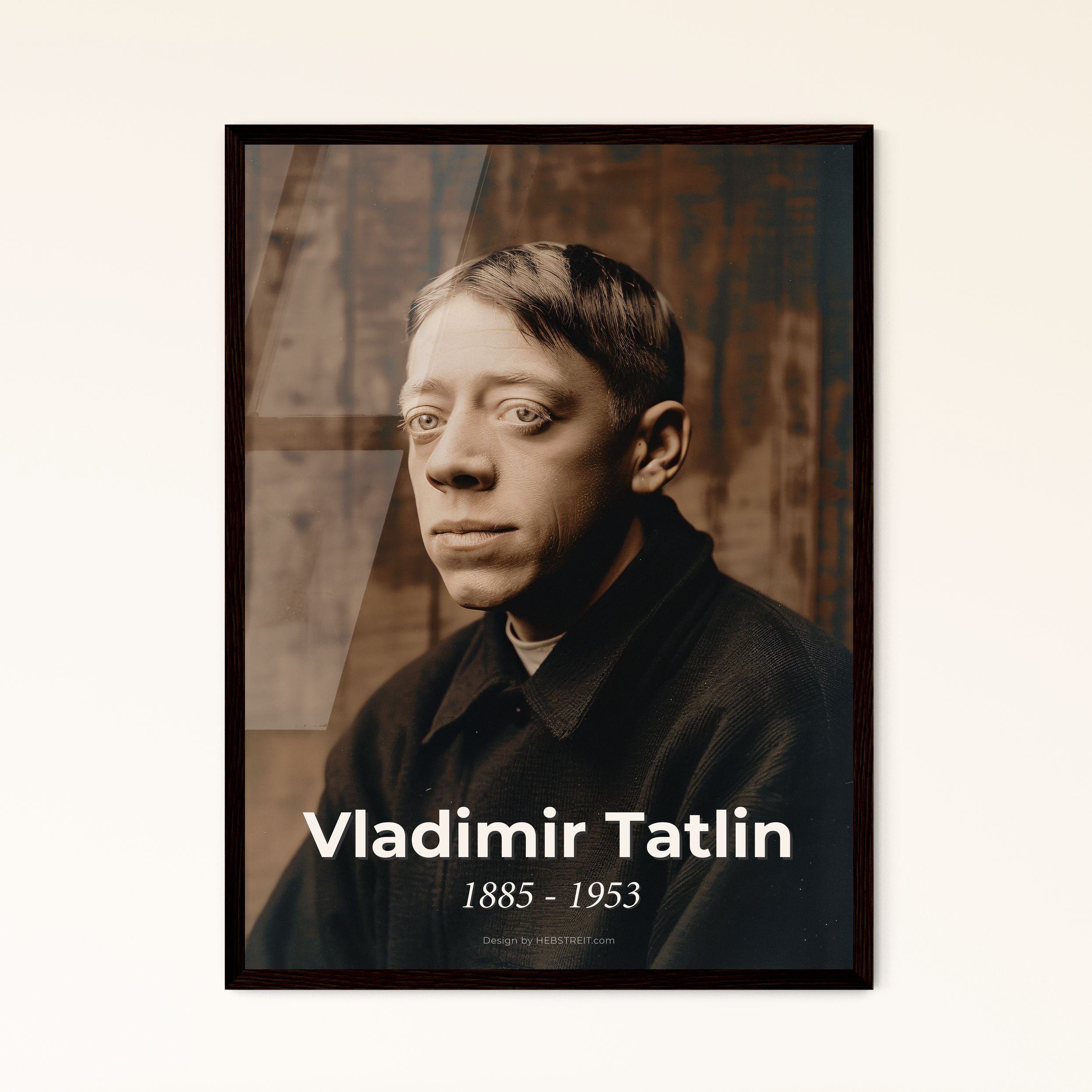
Vladimir Tatlin
 Russia
painter•architect•sculptor•stage designer
Also known as: Vladimir Yevgrafovich Tatlin, Tatlin
Birthday
December 28, 1885
Birth Sign
Capricorn
Birthplace
Kharkiv, Russian Empire (now Ukraine)
Age
Died at 67
About
Vladimir Tatlin was a Russian and Soviet painter, architect, and stage designer, celebrated as a founding figure of Constructivism. He is best known for his visionary design of the Monument to the Third International, commonly called Tatlin's Tower, a spiraling structure intended as a headquarters for the Communist International. Though never built, the tower became an enduring symbol of the avant-garde's ambition to merge art with industrial production.
Tatlin's work spanned painting, sculpture, and theater design, and he taught at institutions in Moscow and Kyiv. His artistic innovations, including his painterly reliefs and his exploration of materials, placed him at the forefront of the Russian avant-garde alongside Kazimir Malevich. Today, his legacy is reexamined in the context of Ukrainian art history, with exhibitions such as "TATLIN: KYIV" at The Ukrainian Museum in New York in 2025.
Early Life & Background
Vladimir Tatlin was born on December 28, 1885, in Kharkiv, then part of the Russian Empire and now Ukraine. His mother, Nadezhda Nikolaevna Tatlina, a poet with revolutionary sympathies, died when he was just two years old. His father, Yevgraf Nikoforovich Tatlin, a mechanical engineer, remarried and moved the family to Kharkiv. After his father's death in 1904, Tatlin interrupted his studies at the Kharkov Arts School and relocated to Odessa.
Before fully committing to art, Tatlin led a varied life. He worked as a merchant sea cadet, traveled abroad, and performed as a professional musician, playing the bandura. In Moscow, he began his artistic career as an icon painter. His formal training included time at the Moscow School of Painting, Sculpture and Architecture, where he studied under Konstantin Korovin and Valentin Serov, and later at the Penza School of Art.
A pivotal moment came in 1913 when Tatlin visited Paris and met Pablo Picasso. Picasso's cubist reliefs made a deep impression on him, inspiring Tatlin to return to Moscow and begin creating his own "painting reliefs," which he exhibited in 1915. These works, which incorporated real materials like wood and metal, marked the beginning of his move toward Constructivism.
Career Growth
Tatlin's breakthrough came in 1915 with his series of "painting reliefs," which he exhibited in Moscow. These works, built from wood, metal, and other materials, broke with traditional painting and sculpture, and they positioned him as a leader of the emerging Constructivist movement. In 1919, he conceived his most famous project: the Monument to the Third International. This ambitious design, a spiraling steel tower intended to house the Communist International, was never realized, but a model was displayed and it became a defining symbol of Constructivism.
Throughout the 1920s, Tatlin remained a central figure in the Soviet avant-garde. He taught at the Kyiv Art Institute from 1925 to 1927, where he founded and directed the theater, film, and photography department. In the late 1920s, he turned his attention to a new invention: the Letatlin, a glider that he worked on for years, though it never achieved flight. After 1933, Tatlin focused primarily on stage design, contributing to numerous theatrical productions. He received the title of People's Artist of the RSFSR, a recognition of his contributions to Soviet culture.
Career Timeline
Public Image & Style
Tatlin is remembered as a pioneering figure of the Russian avant-garde, known for his relentless experimentation and his belief that art should serve a social and industrial purpose. His public persona was that of a dedicated innovator, unafraid to challenge conventional boundaries. In the West, he is often celebrated as a hero of Constructivism, while in Ukraine, his legacy is increasingly reclaimed as part of Ukrainian cultural heritage, given his birthplace in Kharkiv. Exhibitions like "TATLIN: KYIV" at The Ukrainian Museum in 2025 highlight his Ukrainian roots and his impact on modern art.
Fame & Fandom (iFAMOUS Rankings)
Vladimir Tatlin remains a towering figure in the history of modern art, yet his standing in contemporary global metrics reflects a unique position for a historical visionary. As of August 2026, the iFANN Global Fame Engine has evaluated this artist but does not currently place him within the published rankings of the Global Top 1,000 or any Top-100 scope list. This absence of a numeric rank is not a dismissal of his impact but a reflection of how his fame operates outside the churn of modern celebrity cycles; he commands immense respect within academic and architectural spheres without generating the mass-market signals required for a current numerical placement. The audience surrounding Tatlin consists of art historians, architects, students, and enthusiasts of the Constructivist movement rather than a self-identified fanbase with a formal moniker. There is no specific name for his followers, nor are there organized campaigns, birthday billboards, or social media rituals associated with his legacy. Instead, admiration manifests through scholarly re-evaluations and curatorial projects, such as recent exhibitions focusing on his Ukrainian heritage and the construction of scale models of his designs abroad. While he lacks a digital fandom, the reverence for his work persists in physical spaces and academic discourse, proving that his influence transcends the need for a quantifiable ranking to remain significant.
Interesting Facts and Legends
Before launching his artistic career, Tatlin served as a merchant sea cadet, a role that exposed him to various ports and likely fueled his later fascination with engineering and machinery. He was also a skilled bandura player who performed professionally as a musician before dedicating himself entirely to painting. His famous glider, the Letatlin, combined his name with the Russian word for "fly" (letat) and featured organic, bird-like forms that reflected his deep interest in natural structures. While influenced by Picasso's cubist constructions, Tatlin pushed further by emphasizing real materials and texture over illusionistic representation in his reliefs. Beyond these documented facts, legends surround his eccentricity, including stories where he posed as a blind man singing folksongs to challenge reality. Another enduring tale involves his attempt to test a bird-like flying machine near Moscow's Novodevichy convent, which failed to take off but cemented his reputation as a visionary whose ambitions often outstripped practical feasibility. Recent scholarship has also added a layer to his lore by highlighting his time in Kyiv, framing it as a "Ukraine Dreaming" phase that corrects previous historical omissions regarding his roots.
Family & Personal Life
Tatlin's mother, Nadezhda Nikolaevna Tatlina, was a poet who sympathized with revolutionary movements; she died when he was two. His father, Yevgraf Nikoforovich Tatlin, was a mechanical engineer who remarried after her death. Tatlin had a son, Anatoli Romov, though details about his family life remain sparse. He did not publicly discuss his personal relationships, and his focus remained on his artistic and pedagogical work.
Notable Connections
Tatlin worked alongside many key figures of the Russian avant-garde, including Kazimir Malevich, Alexander Rodchenko, and Lyubov Popova. He was also associated with artists such as Aleksandra Ekster, Vadym Meller, and El Lissitzky. His work influenced later artists like Isamu Noguchi, who cited Tatlin's Monument as an inspiration.
Relationships & Dating History
Little is documented about Tatlin's personal relationships. He had a son, Anatoli Romov, but the identity of the mother is not widely known. Tatlin's focus on his art and teaching likely meant that his private life remained out of the public eye. As of 2026, there is no reliable information about his marital status or long-term partners, and he is presumed to have been single or widowed at the time of his death.
Death & Aftermath
Died
May 31, 1953 (aged 67)
Death Place
Moscow, Russia
Cause of Death
Natural causes associated with old age
The legacy of Vladimir Tatlin found new life in the decades following his passing, with institutions like MoMA and the Centre Pompidou preserving his radical vision while artists such as Dan Flavin honored him with light installations titled 'Monuments for V. Tatlin' in 1979. A dedicated exhibition later highlighted his Ukrainian heritage in North America, and a scale model of his iconic tower appeared in Brazil for a 2026 showcase at Sesc Pompeia. These tributes stood in stark contrast to the quiet obscurity that marked his final years in Moscow, where he had largely withdrawn from public architectural projects to focus on small-scale models and teaching after the rise of Socialist Realism.
On May 31, 1953, at the age of 67, Tatlin passed away in Moscow amidst a cultural landscape that had shifted significantly since his Constructivist peak. His funeral was likely a private affair attended by close colleagues and family members, reflecting his reduced public profile during Stalin's final years. The handling of his estate eventually led to the preservation of his works in major collections, ensuring that his innovative reliefs and architectural dreams survived long after his death.
Net Worth (Estate Value)
$1 Million
iFANN Editorial Team estimate
As an artist who passed away in 1953, Vladimir Tatlin's financial legacy rests on the enduring value of his artworks and estate. His pieces reside in major collections including the Tretyakov Gallery, the Costakis Collection, and MoMA. While exact estate figures remain private, the market for Russian avant-garde art has grown significantly, with works selling for millions at auction. For instance, a Tatlin relief sold for over $1 million in 2012. His estate continues to generate revenue through exhibitions and reproductions of his designs. Per iFANN's editorial analysis, the estimated value of his estate is around $1 Million as of 2026, reflecting the ongoing interest in his work.
Awards Won (1)
Tatlin was honored with the title People's Artist of the RSFSR in 1950, a high state recognition for his contributions to Soviet art. He did not receive major international awards during his lifetime, but his legacy has been celebrated through numerous posthumous exhibitions and retrospectives.
1950 · State Honor
Lifetime achievement
Known For
Monument to the Third International
1919 · Architect and designer
Painting Reliefs
1915 · Artist
Letatlin Glider
1927 · Inventor
Keywords
Sources
Quick Facts
- Profession
- painter, architect, sculptor, stage designer
- Born
- December 28, 1885
- Birthplace
- Kharkiv, Russian Empire (now Ukraine)
- Died
- May 31, 1953
- Death Place
- Moscow, Soviet Union
- Gender
- Male
- Birth Sign
- Capricorn
- Children
- Anatoli Romov
Personal Details
- Full Name
- Vladimir Yevgrafovich Tatlin
- Children
- Anatoli Romov
- Education
- Kharkov Arts School; Moscow School of Painting, Sculpture and Architecture; Penza School of Art
Frequently Asked Questions
Who was Vladimir Tatlin?
What is Vladimir Tatlin famous for?
When and where was Vladimir Tatlin born?
What was Constructivism?
Did Vladimir Tatlin's Tower get built?
Similar People
Join the community
fans discussing