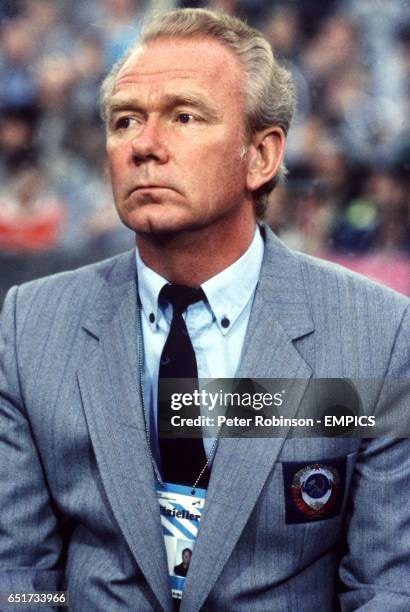
Valeriy Lobanovskyi
 Ukraine
association football player•association football coach
Birthday
January 6, 1939
Birth Sign
Capricorn
Birthplace
Kyiv, Ukrainian SSR, Soviet Union (now Ukraine)
Age
Died at 63
Height
6 ft 1½ in (1.87 m)
About
Valeriy Vasylyovych Lobanovskyi was a Soviet and Ukrainian football player and manager from Kyiv, born on January 6, 1939. He is remembered as one of the most innovative and successful coaches in football history. Lobanovskyi's playing career was modest, but his managerial genius transformed Dynamo Kyiv into a European powerhouse. He held the titles Master of Sports of the USSR and Distinguished Coach of the USSR, and received the UEFA Order of Merit in Ruby and FIFA Order of Merit. In 2002, he was posthumously awarded the Hero of Ukraine, his nation's highest honor, for his contributions to football.
Lobanovskyi's greatest fame came from his three spells managing Dynamo Kyiv and the USSR national team. He pioneered a scientific approach to training and tactics, emphasizing fitness and data analysis. Under his guidance, Dynamo dominated Soviet football, winning the Soviet Top League eight times and the Soviet Cup six times. In 1975, his team became the first Soviet side to win a major European trophy, capturing the Cup Winners' Cup by beating Ferencváros. They repeated that feat in 1986, defeating Atlético Madrid. Lobanovskyi also led the USSR to the Euro 1988 final, where they lost to the Netherlands, and won bronze at the 1976 Olympics.
After returning to Dynamo in 1997, Lobanovskyi engineered another European run. In the 1997-98 Champions League, his team topped a group featuring Barcelona, Newcastle United, and PSV Eindhoven, famously beating Barcelona 3-0 in Kyiv and 4-0 at Camp Nou. The next season, Dynamo reached the semifinals, falling to Bayern Munich. Lobanovskyi coached three Ballon d'Or winners: Oleh Blokhin (1975), Igor Belanov (1986), and Andriy Shevchenko (third in 1999). His trophy haul of 30 by 2000 made him, according to FourFourTwo, the most successful manager of the 20th century.
Lobanovskyi died on May 13, 2002, at age 63. His legacy endures: he is the only manager to win a major European competition twice with an Eastern European club, and one of two to win the Cup Winners' Cup twice with the same team. In a 2008 poll, Ukrainians ranked him the sixth greatest Ukrainian in history. His methods influenced generations of coaches, and his name remains synonymous with tactical innovation and sustained excellence.
Early Life & Background
Growing up in postwar Kyiv, Lobanovskyi showed an early gift for mathematics, winning a gold medal when he graduated from School No. 319. That school now bears his name. He joined Dynamo Kyiv at 18 in 1957 and broke into the first team by 1960, playing as a winger in Viktor Maslov's title-winning side of 1961. Lobanovskyi had a knack for scoring directly from corners, a skill that drew comparisons to Brazilian star Didi. But his relationship with Maslov soured when he refused to drink vodka during a team lunch, an unheard-of act of self-discipline at the time. Maslov eventually dropped him, and Lobanovskyi was transferred to Chornomorets Odesa in 1965, then Shakhtar Donetsk in 1967. He retired as a player at just 29, having already enrolled at the Kyiv Polytechnic Institute to study thermal engineering. He later transferred to the Odesa Polytechnic Institute, where he graduated. That engineering background shaped his entire coaching philosophy: he saw football as a system to be optimized, not just a game.
Career Growth
Lobanovskyi's managerial career began in 1969 with Dnipro Dnipropetrovsk, whom he led to the Soviet First League title in 1971. In 1973, he took over Dynamo Kyiv and immediately transformed them into a dominant force. His first spell brought five Soviet Top League titles and the 1975 European Cup Winners' Cup, making Dynamo the first Soviet club to win a major European trophy. They added the European Super Cup that same year. After a stint with the USSR national team, he returned to Dynamo in 1984 and won another Cup Winners' Cup in 1986, beating Atlético Madrid. He led the Soviet Union to the Euro 1988 final, where they fell to the Netherlands. Following the Soviet collapse, he managed the United Arab Emirates and Kuwait, winning the Arabian Gulf Cup with Kuwait in 1996. In 1997, he returned to Dynamo for a third spell and won five consecutive Ukrainian Premier League titles. The 1998-99 Champions League run was a highlight: Dynamo eliminated Barcelona with a 4-0 thrashing at Camp Nou and reached the semifinals. Lobanovskyi also took charge of the Ukraine national team from 2000 until his death in 2002.
Career Timeline
Public Image & Style
Lobanovskyi is remembered as a quiet, intense intellectual who brought scientific rigor to football. He rarely smiled in public and was known for his discipline and analytical mind. In Ukraine, he is revered as a national hero whose success on the European stage brought pride during Soviet times and after independence. Fans remember him as the architect of Dynamo's golden era, and his statue stands outside the stadium that bears his name. Media portrayals emphasize his genius and his ability to compete with richer Western clubs through sheer tactical brilliance.
Fame & Fandom
Valeriy Lobanovskyi commanded a global audience of immense scale, his name resonating through decades of football history as a defining figure in the sport's tactical evolution. While his legacy remains unchallenged within Eastern Europe and among football historians, iFANN has evaluated his current standing and determined that he does not currently hold a placement in the published Global Top 1,000 or any Top-100 scope list. Consequently, no specific numeric rank or score is assigned to his present-day fame metrics. The collective support for Lobanovskyi lacks a formalized, unique fandom name distinct from the general base of FC Dynamo Kyiv, where supporters are simply known as "Dynamo fans" or by the club's moniker, "The Blue-Whites." This fanbase, considered among the most passionate in Eastern Europe, maintains his memory through institutional rituals rather than ad-hoc campaigns. The most significant annual observance occurs on January 6, the anniversary of his birth, when the Ukrainian football community gathers at the Valeriy Lobanovskyi Dynamo Stadium to pay tribute. His interaction with the public was transformative yet indirect, cultivating a sense of national pride and scientific excellence that elevated the status of Ukrainian football globally.
Interesting Facts and Legends
Lobanovskyi's engineering background made him a pioneer of data-driven training decades before it became standard, leading him to state that he tried to rationalize an irrational game. As a player, he scored directly from corners so often that fans called him the Ukrainian Didi. The 1975 Cup Winners' Cup win came with an 88.88% win rate (eight wins in nine games), a record that stood for 45 years. He coached three Ballon d'Or winners: Blokhin, Belanov, and Shevchenko. Despite his fame, he lived modestly and never owned a car. His funeral drew 150,000 people. A central legend surrounding Lobanovskyi is his role as the father of "Football Cybernetics," a concept he pioneered in the 1970s that treated matches as complex systems of control using mathematical models and physiological data. Stories frequently circulated among fans described him as a "mathematician-coach" who could predict outcomes with computer precision. Another widely retold narrative involves his management style creating a "white Ronaldo" effect, transforming players like Oleg Blokhin into figures of technical brilliance under his tutelage. These accounts serve as evidence of his genius being viewed as more modern than many contemporary methods.
Notable Quotes
“I tried to rationalize an irrational game.”
“Football is not just about the legs, but about the head.”
“The system is more important than the individual.”
“We must work, work, and work again.”
“Victory is not everything; it is the only thing.”
Family & Personal Life
Lobanovskyi was married to Ada Lobanovska, though details about their life together are scarce due to his private nature. The couple had no children. His parents were factory worker Vasyl Lobanovskyi and a housewife mother. He grew up in a working-class Kyiv household and was an only child. After his death, Ada managed his estate.
Notable Connections
Lobanovskyi's most famous protégés were three Ballon d'Or winners: Oleh Blokhin, Igor Belanov, and Andriy Shevchenko. He also worked closely with Soviet football officials and rival managers like Viktor Maslov, whose system he later refined. His influence extended to modern coaches who adopted his data-driven methods.
Relationships & Dating History
Lobanovskyi was married to Ada Lobanovska. Details about their courtship and wedding are not widely documented, as he kept his personal life extremely private. The couple had no children. Ada survived him after his death in 2002. No other public relationships are recorded.
- MarriedAda Lobanovska? - 2002Lobanovskyi was married to Ada; they had no children. She survived him.
Death & Aftermath
Died
May 13, 2002 (aged 63)
Death Place
Kyiv, Ukraine
Cause of Death
Reported massive heart attack resulting from a stroke
The football world responded to the loss of Valeriy Lobanovskyi with immediate and profound mourning, spanning from Kyiv to the highest levels of European administration. Ukrainian President Leonid Kuchma declared a day of national mourning, while FIFA President Sepp Blatter and numerous dignitaries traveled to attend the state funeral. Fans gathered spontaneously outside the Dynamo Kyiv stadium and the coach's residence to light candles and lay flowers, observing moments of silence in matches across Ukraine and Europe. The Lobanovskyi Stadium became a focal point for memorials, with murals and banners erected in his honor to mark the passing of a figure whose tactical genius had transformed the sport.
Lobanovskyi passed away on May 13, 2002, at the age of 63 in Kyiv, Ukraine, following a sudden collapse during a training session or match management activity. Official reports established the cause as a massive heart attack resulting from a stroke suffered while he was standing on the sidelines. Despite immediate medical intervention and transport to a hospital, he could not be saved. The funeral took place two days after his death on May 15, 2002, at the Baikove Cemetery in Kyiv. Thousands of mourners attended the ceremony, including high-ranking government officials and former players, who listened to eulogies praising his contribution to football science.
Posthumously, he received induction into the UEFA Hall of Fame and various national halls of fame. A documentary titled "Valeriy Lobanovskyi: The Greatest Football Coach You've Never Heard Of" was produced to detail his life and methods. The FC Dynamo Kyiv stadium remains named the Valeriy Lobanovskyi Dynamo Stadium in his honor, and foundations established in his name support young talent. His estate was handled by his family.
Net Worth (Estate Value)
$5 Million
iFANN Editorial Team estimate
Per iFANN's editorial analysis, Valeriy Lobanovskyi's estate is valued at $5 Million as of 2026. The primary sources of this value include intellectual property rights covering his name and image licensing, alongside ongoing royalties from the Valeriy Lobanovskyi Dynamo Stadium naming rights. Posthumous book deals, such as Kateryna Chernii's 2026 biography, and documentary projects also contribute to the total. Unlike modern football figures, Lobanovskyi lived modestly during the Soviet era, which keeps his estate relatively small compared to contemporary counterparts. The estate is managed by his widow, Ada Lobanovska, and likely benefits from Dynamo Kyiv's continued use of his legacy in marketing and merchandise.
Awards Won (21)
Lobanovskyi won 30 trophies as a manager, including eight Soviet Top League titles, six Soviet Cups, two European Cup Winners' Cups, and the European Super Cup. He also led the USSR to an Olympic bronze in 1976 and the Euro 1988 final. Individually, he was named European Football Coach of the Year three times and posthumously received the Hero of Ukraine award.
2002 · National Honour
Contribution to Ukrainian football
1999 · Individual
Dynamo Kyiv
1988 · Individual
USSR national team
1986 · Individual
Dynamo Kyiv
Known For
Dynamo Kyiv manager (three spells)
1973 · Head Coach
European Cup Winners' Cup wins (1975, 1986)
1975 · Manager
Soviet Union national team manager
1975 · Head Coach
Euro 1988 runner-up with USSR
1988 · Manager
Pioneer of scientific football training
1970 · Innovator
Keywords
Sources
Quick Facts
- Profession
- association football player, association football coach
- Born
- +1939-01-06
- Birthplace
- Kyiv
- Died
- +2002-05-13
- Death Place
- Zaporizhzhia
- Gender
- Male
- Birth Sign
- Capricorn
Personal Details
- Full Name
- Valeriy Vasylyovych Lobanovskyi
- Height
- 6 ft 1½ in (1.87 m)
- Spouse
- Ada Lobanovska
- Education
- Kyiv Polytechnic Institute; Odesa Polytechnic Institute (degree in thermal engineering)
Frequently Asked Questions
Who is Valeriy Lobanovskyi?
What is Valeriy Lobanovskyi's net worth in 2026?
How did Valeriy Lobanovskyi die?
What trophies did Valeriy Lobanovskyi win?
Is Valeriy Lobanovskyi considered the greatest manager of all time?
Similar People
Join the community
fans discussing