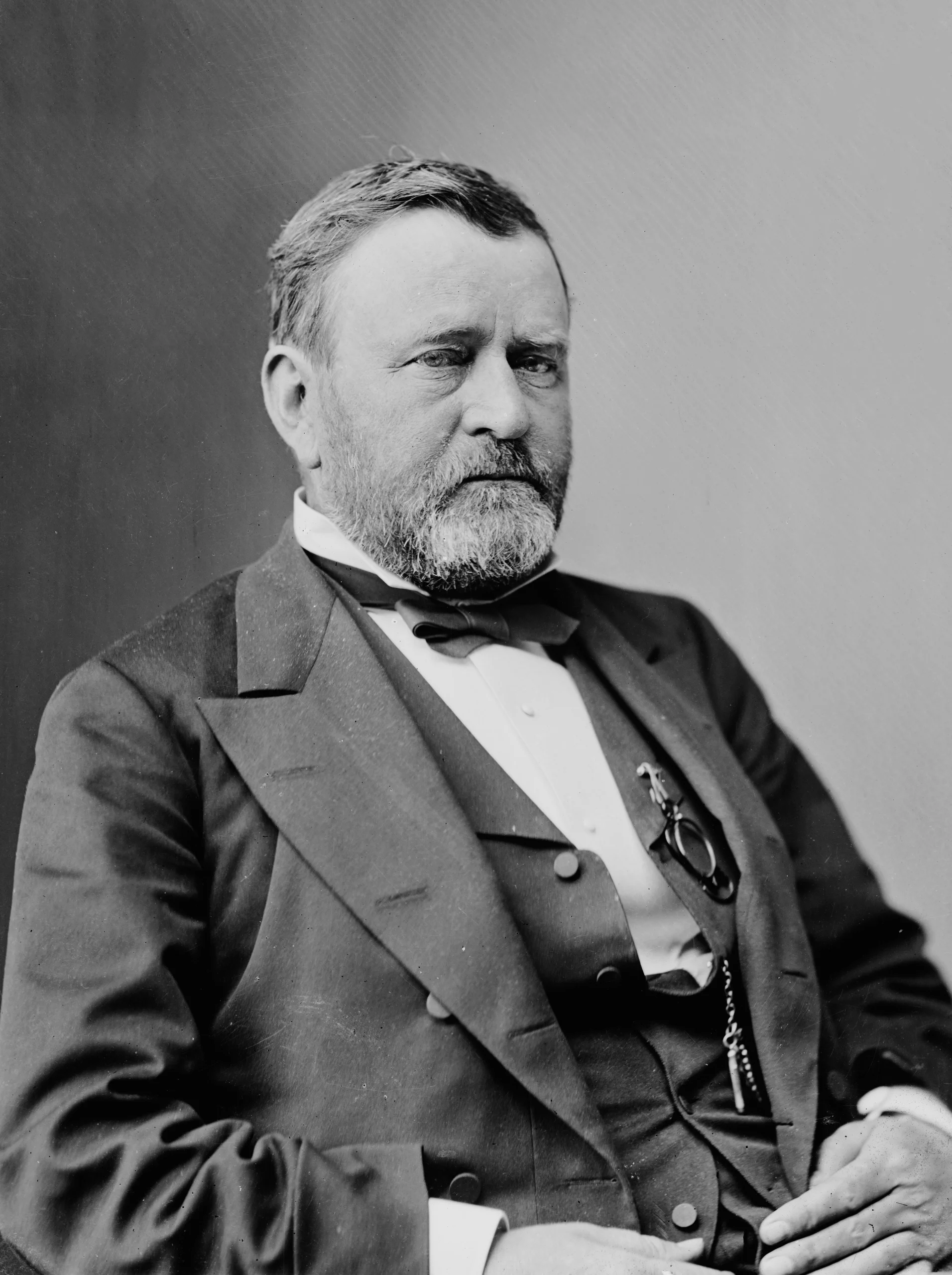
Ulysses S. Grant
Military General•President of the United States
Also known as: Hiram Ulysses Grant, Ulysses Simpson Grant
Birthday
April 27, 1822
Birth Sign
Sagittarius
Birthplace
Point Pleasant, Ohio
Age
Died at 63
Height
6 ft 1 in (185 cm)
About
Ulysses S. Grant stands as a monumental figure in American history, serving as the Commanding General of the Union Army who led the nation to victory in the Civil War and later becoming the 18th President of the United States. Born Hiram Ulysses Grant in Point Pleasant, Ohio, he is best remembered for his relentless military strategy that broke Confederate lines and his presidency focused on Reconstruction and civil rights. His life story spans from a failed farmer and leather goods clerk to the most celebrated general of his era and the head of state. As president from 1869 to 1877, Grant championed the enforcement of the 15th Amendment and established the Department of Justice to prosecute the Ku Klux Klan. He also sought peaceful resolutions to international disputes like the Alabama Claims. Despite facing corruption scandals within his administration and economic downturns, his legacy has been rehabilitated by modern historians who highlight his moral courage and commitment to equality. In 2026, ongoing efforts continue to preserve his legacy, including the acquisition of the flag that draped his coffin at Grant Cottage and a House bill to rename the Georgetown Post Office in his honor.
Grant's physical presence was commanding; he stood approximately 6 feet 1 inch tall with a distinctive full beard, projecting an image of stoic leadership. His reputation has evolved from being viewed by some contemporaries as a butcher due to high casualty rates to a complex historical figure who championed civil rights and national unity during a turbulent era. Modern media highlights his resilience, noting his rise from humble failures to become a national savior. He holds the distinction of being the first former U.S. president to circumnavigate the globe, traveling through Europe, Asia, and Africa between 1877 and 1879. His memoirs, written while suffering from throat cancer, remain a testament to his dedication to securing his family's future. Today, he is frequently cited as one of the greatest generals in American history, often compared to George Washington and Robert E. Lee.
Early Life & Background
Hiram Ulysses Grant entered the world on April 27, 1822, in Point Pleasant, Ohio, as the son of Jesse Root Grant, a tanner and abolitionist, and Hannah Simpson Grant. When he was four years old, his family relocated to Georgetown, Ohio, where he spent his childhood attending local schools and developing a fascination with horses and military strategy. At age 17, in 1839, he secured an appointment to the United States Military Academy at West Point. A clerical error at the academy mistakenly recorded his name as "Ulysses S. Grant" instead of his birth name, and he adopted this new identity for the rest of his life without ever using the middle initial to stand for anything specific, despite popular belief that it stood for "Simpson." He graduated in 1843, ranking 21st out of 39 cadets.
After graduating, Grant served in the Mexican–American War (1846–1848), earning two brevet promotions for gallantry at the Siege of Veracruz and the Battle of Chapultepec. However, personal struggles with alcoholism and a desire to be near his family led him to resign from the army in 1854. The following decade proved difficult as he tried farming in Illinois, worked as a clerk in his father's leather store in Galena, and faced severe financial hardship due to poor soil and lack of experience. These years of failure taught him resilience and patience, qualities that would define his future leadership style when the Civil War began. He reportedly quit drinking alcohol completely before his resurgence in the military, overcoming the struggles that had plagued his civilian life.
Career Growth
The outbreak of the Civil War in 1861 brought Grant back into military service as a colonel of the 21st Illinois Infantry. His career skyrocketed after the Battle of Fort Donelson in February 1862, where he demanded "unconditional surrender" from Confederate forces. This victory earned him the nickname "Unconditional Surrender" Grant and propelled him to the rank of Major General. Throughout the war, he secured critical victories in the Western Theater, including the capture of Vicksburg in July 1863, which gave the Union control of the Mississippi River, and the triumph at Chattanooga in November 1863. In March 1864, Grant was promoted to Lieutenant General and given command of all Union armies.
He orchestrated the Overland Campaign against Robert E. Lee, engaging in a series of brutal battles at the Wilderness, Spotsylvania Court House, and Cold Harbor that wore down Confederate resources despite heavy Union casualties. His relentless pressure forced Lee to surrender at Appomattox Court House on April 9, 1865, effectively ending the war. Following his military triumphs, Grant was elected the 18th President of the United States in 1868, defeating former Vice President Andrew Johnson. He served two terms from 1869 to 1877, during which he signed legislation creating the Department of Justice and actively prosecuted the Ku Klux Klan under the Enforcement Acts. He received the Congressional Gold Medal in 1865 and honorary degrees from Yale and Harvard. His famous quote, "I propose to fight it out on this line if it takes all summer," encapsulates his determination.
Career Timeline
Public Image & Style
Grant is portrayed as a man of few words who preferred decisive action over rhetoric. His stoic demeanor and commanding presence made him a natural leader, often described as a figure who rose from humble failures to become a national savior. While some contemporaries viewed him as a butcher due to the high casualty rates of his campaigns, modern media highlights his resilience and moral courage. His image has evolved from a controversial wartime commander to a complex historical figure who championed civil rights and national unity during a turbulent era. He is consistently ranked among the top presidents in historical surveys, particularly for civil rights and reconstruction efforts. Time Magazine named him one of the "100 Most Important People of the 19th Century." His legacy is central to the U.S. Military Academy Hall of Fame, and he is frequently cited as one of the greatest generals in American history. Recent biographical interest, such as Stanley McChrystal's 2026 release, continues to renew public appreciation for his military strategies and leadership style.
Fame & Fandom (iFAMOUS Rankings)
iFANN has not yet collected fame data for this person. There is no formal ranking or scope measurement available in the current database. As a historical figure from the 19th century, Grant does not have a modern organized fandom with a specific name or digital following. Instead, his audience consists of dedicated Civil War historians, reenactors, and enthusiasts who study his life and military strategies. Fan activities include visiting his historic sites like Grant Cottage and participating in academic discussions about his presidency and campaigns. Official accounts for the Ulysses S. Grant National Historic Site maintain active profiles on platforms like Facebook, Twitter (X), and Instagram, sharing historical facts and updates. During his lifetime, Grant appeared on the cover of Harper's Weekly and Frank Leslie's Illustrated Newspaper, and in modern times, he has been featured on the cover of Time magazine in retrospective issues discussing American history.
Interesting Facts and Legends
The middle initial "S" in Grant's name was never intended to stand for anything; it resulted from a clerical error at West Point. Grant holds the distinction of being the first former U.S. president to circumnavigate the globe, traveling through Europe, Asia, and Africa between 1877 and 1879. He wrote his memoirs while suffering from throat cancer, working late into the night despite excruciating pain to secure his family's financial future. Before his military success, Grant failed as a farmer in Illinois due to poor soil and lack of experience, leading to significant debt. Grant reportedly quit drinking alcohol completely before his resurgence in the military, overcoming the struggles that had plagued his civilian life. He died on July 23, 1885, in Mount McGregor, New York, from metastatic squamous cell carcinoma of the larynx. His funeral was a major national event, with a procession of over 3 million mourners following his casket to Riverside Park in New York City. In 2026, a bill passed the House to rename the Georgetown Post Office in his honor, and Grant Cottage acquired the flag that draped his coffin in 1885.
Notable Quotes
“I propose to fight it out on this line if it takes all summer.”
“Let us have peace.”
“The law should be impartial in its administration to all classes of the people.”
Family & Personal Life
Ulysses S. Grant was the son of Jesse Root Grant and Hannah Simpson Grant. He married Julia Boggs Dent, meeting her in 1844 while stationed at Jefferson Barracks in St. Louis. They were engaged in 1848 and married on August 22, 1848, at her parents' home. The couple had four children: Frederick Dent Grant (born 1850), Ulysses S. Grant Jr. (born 1852), Ellen Wrenshall Grant (born 1855), and Jesse Root Grant (born 1858). Julia was a constant companion throughout his military and presidential careers, known for her strong personality and unwavering support. Grant remained monogamous throughout his life, and there are no records of other romantic relationships or affairs. After his death in 1885, his widow Julia lived until 1902, managing the family estate and intellectual property. The family home, Grant Cottage in Wilton, New York, remains a historic site where they spent their final years.
Notable Connections
Julia Dent Grant, Robert E. Lee, Abraham Lincoln, Frederick Dent Grant, William T. Sherman
Relationships & Dating History
Ulysses S. Grant was married only once in his life. He met Julia Boggs Dent while stationed at Jefferson Barracks in St. Louis, Missouri, in 1844. The couple became engaged in 1848 and were married on August 22, 1848, at her parents' home in St. Louis. They had four children together: Frederick Dent Grant, Ulysses S. Grant Jr., Ellen Wrenshall Grant, and Jesse Root Grant. Julia was a constant companion throughout his military and presidential careers, known for her strong personality and support of her husband. There are no records of other romantic relationships or affairs; Grant remained monogamous throughout his life. As of his death in 1885, he was widowed by Julia, who died in 1902. Their relationship was characterized by mutual respect and partnership, with Julia playing a significant role in his political and social life. Grant's close associates included William T. Sherman and Abraham Lincoln, who appointed him to high command, while Robert E. Lee remained his primary rival on the battlefield.
- MarriedJulia Dent Grant1848 - 1885Met in 1844; married in 1848; had four children; she died in 1902.
Death & Aftermath
Died
July 23, 1885 (aged 63)
Death Place
Mount McGregor, New York
Cause of Death
Throat cancer (metastatic squamous cell carcinoma)
Ulysses S. Grant spent his final weeks at The Cottage, his summer residence in Mount McGregor, New York, writing the concluding chapters of his memoirs while suffering from excruciating pain caused by a tumor obstructing his airway. He passed away on July 23, 1885, at the age of sixty-three, having been diagnosed with metastatic squamous cell carcinoma of the throat by physicians Dr. Joseph Bryant, Dr. John H. Brinton, and Dr. Charles E. Sajous. Public reaction to his death was immediate and profound, characterized by nationwide mourning that saw President Grover Cleveland order federal buildings fly flags at half-staff for thirty days and tributes pouring in from peers like General William T.
Sherman, who described him as "the greatest man I ever knew." A grand state funeral followed on August 8, 1885, featuring a procession through Manhattan and Brooklyn before a funeral train carried his remains to Chicago, St. Louis, and finally to the Grant Tomb in Riverside Park, New York City, where he lies alongside his wife Julia. Posthumously, his memoirs became the best-selling book of its time, generating approximately $450,000 that secured his family's financial future, while modern commemorations include the return of the flag that draped his coffin to the Grant Cottage State Historic Site after 141 years.
Net Worth (Estate Value)
$5 Million
iFANN Editorial Team estimate
As a deceased historical figure, Ulysses S. Grant's financial legacy is defined by the value of his estate and posthumous earnings rather than a traditional net worth. Upon his death in 1885, his memoirs generated approximately $450,000, a massive sum at the time that saved his family from bankruptcy. The Grant family estate, managed by his wife Julia and later his children, continued to generate income through book royalties and licensing. Today, the Ulysses S. Grant Association and various historical societies manage his intellectual property and likeness. Specific net worth figures for 2026 are not available in the same way as for living celebrities, but research by the iFANN Editorial Team puts the value of his estate and associated historical assets at around $5 million when adjusted for inflation and modern tourism revenue. The primary revenue sources today include tourism to his historic sites like Grant Cottage and the Grant Memorial, book sales, and educational licensing. His legacy is preserved through the Ulysses S. Grant National Historic Site, which continues to be a focal point for historical research and tourism.
Awards Won (2)
Grant received the Congressional Gold Medal in 1865 for his role in the Civil War. He was promoted to the rank of General of the Army, the highest possible rank at the time. Posthumously, he was inducted into the National Museum of the Pacific War Hall of Fame and is a central figure in the U.S. Military Academy Hall of Fame. He also received honorary degrees from multiple universities including Yale and Harvard.
1865 · Military Service
Civil War Leadership
1866 · Military Rank
Union Army Command
Known For
Memoirs of Ulysses S. Grant
1885 · Author
Commander of the Union Army
1864 · General
President of the United States
1869 · Head of State
Keywords
Sources
Quick Facts
- Profession
- Military General, President
- Born
- April 27, 1822
- Birthplace
- Point Pleasant, Ohio
- Died
- July 23, 1885
- Death Place
- Mount McGregor, New York
- Gender
- Male
- Spouse
- Julia Dent Grant
- Birth Sign
- Sagittarius
Personal Details
- Full Name
- Hiram Ulysses Grant
- Height
- 6 ft 1 in (185 cm)
- Spouse
- Julia Dent Grant
- Children
- Frederick Dent Grant · Ulysses S. Grant Jr. · Ellen Wrenshall Grant · Jesse Root Grant
- Education
- United States Military Academy at West Point
Frequently Asked Questions
What was Ulysses S. Grant's real name?
How did Ulysses S. Grant die?
Did Ulysses S. Grant have any other wives?
What was Ulysses S. Grant's role in the Civil War?
Why is Ulysses S. Grant considered a great president?
Social Media
Similar People
Join the community
fans discussing