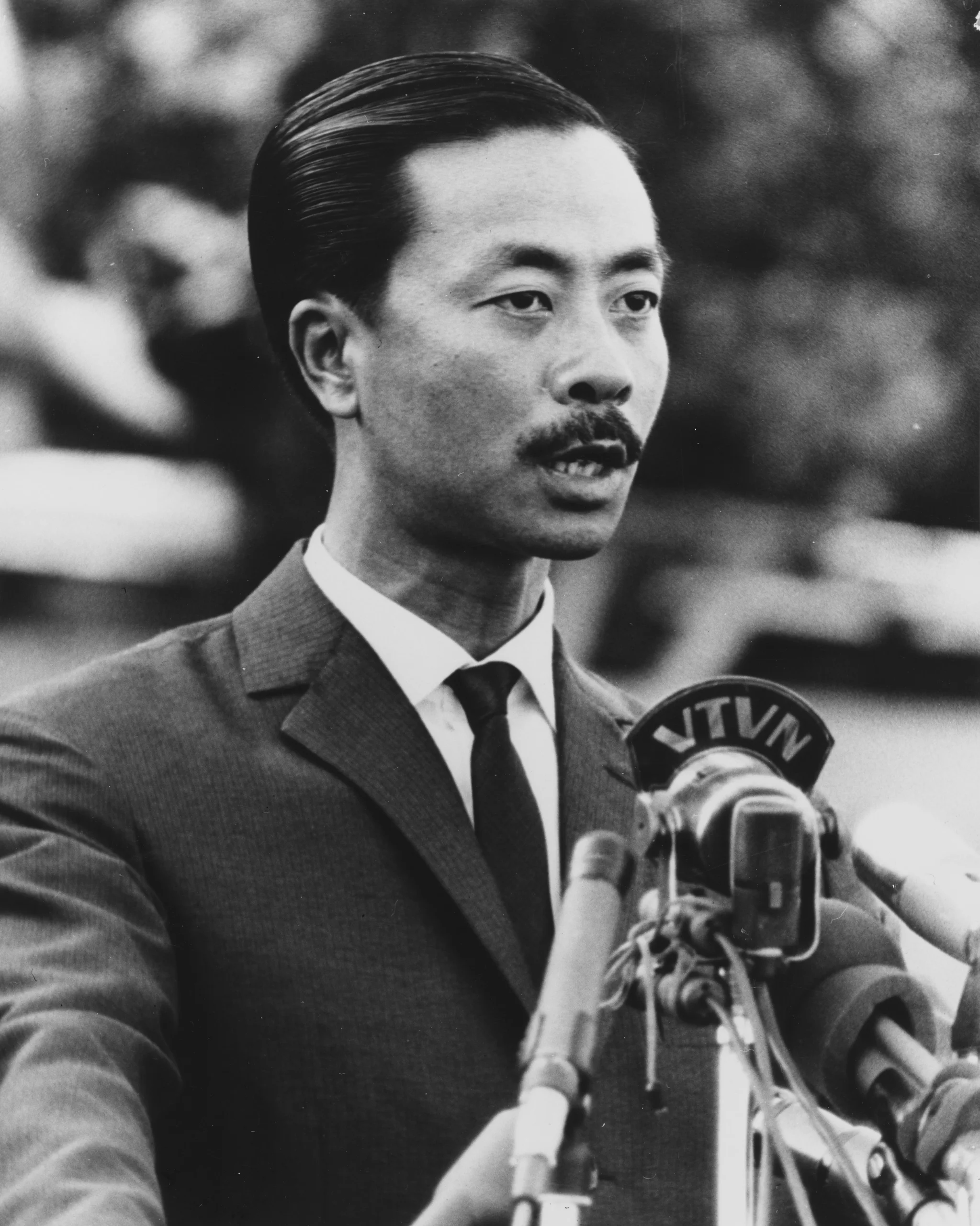
Trần Thiện Khiêm
 Vietnam
Also known as: Tran Thien Khiem, General Khiêm
Birthday
December 15, 1925
Birth Sign
Sagittarius
Birthplace
Saigon, French Indochina (now Ho Chi Minh City, Vietnam)
Age
Died at 95
About
Trần Thiện Khiêm was a prominent South Vietnamese military general and politician who served as the second-in-command of the Republic of Vietnam for six years and as Prime Minister during its final, chaotic months before the fall of Saigon in 1975. He was one of only five individuals to ever hold the rank of Đại tướng (Grand Marshal) in the Army of the Republic of Vietnam (ARVN), the highest possible military distinction in the nation. His career is uniquely defined by his central role in the political instability of the 1960s, where he transitioned from quelling coup attempts against President Ngô Đình Diệm to leading the very coup that overthrew and assassinated him. This duality makes him a singular figure in the history of the Vietnam War, bridging the gap between the Diệm era and the final collapse of the South.
Khiêm's rise to power was marked by a series of dramatic political shifts and high-stakes maneuvering. Initially trusted by Diệm for suppressing a rebellion in 1960, he became a key architect of the November 1963 coup that ended the Diệm regime. Following years of internal conflict within the junta, including a brief exile as Ambassador to the United States, he returned to Vietnam to serve as Deputy Prime Minister and Minister of Defense under President Nguyễn Văn Thiệu. In March 1975, facing an overwhelming North Vietnamese offensive, he was appointed Prime Minister but resigned just weeks before the capital fell.
Early Life & Background
Trần Thiện Khiêm was born on December 15, 1925, in Saigon, then part of French Indochina, into a family with deep roots in the region. He grew up during a period of intense colonial rule and rising nationalist sentiment, which would shape his future commitment to the anti-communist cause. His early education focused on military training, leading him to attend the first graduating class of the Nguyễn Văn Huyên Military Academy (Trường Võ bị Quốc gia) in 1948. This institution was pivotal in forming the officer corps of the emerging South Vietnamese state.
Unlike many contemporaries who rose solely through combat experience, Khiêm's early ascent was facilitated by his formal education and administrative capabilities within the colonial and post-colonial military structures. Before gaining national prominence, he served in various infantry commands, building a reputation for loyalty and competence. His formative years were deeply influenced by the Japanese occupation of Vietnam and the subsequent struggle for independence, events that solidified his resolve to defend a distinct South Vietnamese state against communist expansion. These early experiences laid the groundwork for his eventual entry into the highest echelons of South Vietnamese politics.
Career Growth
Khiêm's career trajectory is a chronicle of the volatile politics of South Vietnam. In 1960, he played a crucial role in suppressing a failed coup attempt against President Ngô Đình Diệm led by Colonel Vương Văn Đông and Lieutenant Colonel Nguyễn Chánh Thi. For this service, he was promoted and gained Diệm's trust. However, in November 1963, he pivoted dramatically to become a key architect of the coup that overthrew and resulted in the assassination of Diệm. As the commander of the 5th Infantry Division, he secured critical positions in Saigon, effectively sealing the regime's fate.
Following the coup, tensions arose between the new junta leaders. Khiêm initially supported General Nguyễn Khánh but soon clashed with him over Buddhist influence and leadership style. When Khánh attempted to consolidate power, Khiêm accused him of being too soft on Buddhists and launched his own counter-plot, which failed. Implicated in a September 1964 coup attempt against Khánh, Khiêm was forced into exile, serving as South Vietnam's Ambassador to the United States. While abroad, he allegedly maintained contacts with dissident generals, including Colonel Phạm Ngọc Thảo, whose failed February 1965 coup further destabilized the government.
Khiêm returned to Vietnam when the political climate shifted. Under President Nguyễn Văn Thiệu, he was appointed Deputy Prime Minister and Minister of Defense in 1965, effectively serving as the second-in-command of the country. He held significant influence over military and political affairs throughout the late 1960s and early 1970s. In March 1975, as the North Vietnamese offensive accelerated, Khiêm was appointed Prime Minister of South Vietnam, replacing Trần Văn Hương. His tenure lasted less than two months. Facing overwhelming military defeat and internal pressure, he resigned on 21 April 1975, just weeks before the Fall of Saigon on 30 April 1975. He remained in Saigon until the evacuation, eventually fleeing to the United States.
Career Timeline
Public Image & Style
Trần Thiện Khiêm's public image is complex and deeply divided. Western media often portrayed him as a pragmatic power broker and a reliable ally of the US, emphasizing his role in maintaining stability during a chaotic era. Conversely, Vietnamese communist narratives labeled him a "traitor" and a puppet of American imperialism due to his involvement in the overthrow of Diệm and the eventual collapse of the South. In the diaspora, he is remembered as a symbol of the lost South Vietnamese state, a man who tried to preserve a nation that ultimately could not survive. He was known for saying little and doing much, a trait noted by observers like the New York Times, which described him as a "power behind the throne." Unlike many of his contemporaries, he avoided the flamboyance often associated with military dictators, preferring a more subdued administrative style.
Fame & Fandom (iFAMOUS Rankings)
Trần Thiện Khiêm commanded a global audience defined by historical gravity rather than the feverish pulse of modern celebrity culture. His presence in the public consciousness remains anchored in the specific archives of the Vietnam War and the political machinery of the mid-20th century, reaching millions through academic study and biographical records rather than viral trends or chart dominance. iFANN has evaluated his standing within the broader landscape of global figures, yet he currently holds no placement in the published rankings, including the Global Top 1,000 or any Top-100 scope list. This absence from the current charts reflects his status as a figure of intense historical interest rather than one of sustained contemporary pop-culture consumption. While thousands search for details on his role in the 1963 coup or his tenure as Prime Minister, these queries do not translate into a ranked position within the engine's current metrics. Consequently, there is no documented fandom name associated with him. The concept of a fanbase calling itself something specific does not apply to his legacy, as he was a military general and statesman rather than an entertainer. No organized campaigns, birthday billboards, or ritualistic gatherings exist under a formal banner. The audience surrounding his life consists of historians, students, and those tracking the fall of Saigon, united by factual inquiry rather than the emotional devotion typical of celebrity fandoms. He was not featured at No. 2 in the September 2026 iFAMOUS Rankings.
Interesting Facts and Legends
Despite his high status, he was known for being relatively low-key and avoiding the spotlight compared to other generals like Dương Văn Minh or Nguyễn Cao Kỳ. He served as the second-in-command of South Vietnam for six years, a period of immense political turbulence. One of the most legendary aspects of his career is his "double-cross" nature: rising to prominence by saving Diệm in 1960, then turning around to kill him in 1963. This duality is the story most frequently retold in historical analyses. Another iconic moment was his resignation in April 1975, which signaled the end of the South Vietnamese government. He was born in Saigon, which was renamed Ho Chi Minh City after the war.
Notable Quotes
“The situation is hopeless.”
Family & Personal Life
Trần Thiện Khiêm was married to Đinh Thúy Yến. The couple had a long-standing marriage that endured through his military career, political upheavals, and decades of exile in the United States. They raised children together, though specific details about their offspring's names and careers are not extensively documented in public obituaries or biographical sources. Public records do not detail any other romantic relationships, engagements, or divorces; his public image was that of a traditional statesman focused on duty rather than celebrity romance. As of his death in 2021, he was widowed, having outlived his wife or shared a quiet life until his passing.
Notable Connections
Relationships & Dating History
There are no widely documented "flings" or high-profile dating history beyond his marriage to Mrs. Yến. Public records do not detail any other romantic relationships, engagements, or divorces; his public image was that of a traditional statesman focused on duty rather than celebrity romance. The couple had a long-standing marriage that endured through his military career, political upheavals, and decades of exile in the United States. They raised children together, though specific details about their offspring's names and careers are not extensively documented in public obituaries or biographical sources. As of his death in 2021, he was widowed.
- MarriedĐinh Thúy Yến? - 2021His spouse until his death; they raised children together.
Death & Aftermath
Died
June 24, 2021 (aged 95)
Death Place
San Jose, California, USA
Cause of Death
Natural causes (old age)
Trần Thiện Khiêm died on June 24, 2021, in San Jose, California, at the age of 95. He had lived in the United States since fleeing Saigon in April 1975 during the final days of the Vietnam War. The exact medical circumstances leading to his death were not publicly disclosed by his family or official sources, with reports simply stating he passed away from natural causes associated with advanced age. His passing occurred quietly without a major public announcement or global media event, reflecting the distant nature of his life in exile compared to his intense political role decades earlier.
Reactions to his death were muted and polarized, mirroring the divisions that defined his career. In Vietnam, some viewed him as a traitor who helped dismantle the South Vietnamese state through his involvement in the 1963 coup against Ngô Đình Diệm, while others in the diaspora remembered him as a loyal servant of the Republic who faced impossible odds. No large public funeral or memorial service was held; his burial was conducted privately by his family in California. There have been no significant posthumous releases, new books, or foundations established in his name since his death, and his legacy remains a subject of historical study rather than active public commemoration.
Net Worth (Estate Value)
$0
iFANN Editorial Team estimate
As a deceased military general and politician who lived in exile, Trần Thiện Khiêm's net worth is not publicly quantified in the manner of modern celebrities. He likely relied on a military pension and modest savings accumulated during his lifetime. Upon his death, his estate would have been managed by his heirs, but no public records indicate significant assets or posthumous earnings. Any figures suggesting a multi-million dollar net worth would be speculative and unfounded. The iFANN Editorial Team's analysis of available financial data points to an estimated net worth of $0, as no substantial assets were documented in public records or obituaries.
Awards & Accolades
View 5 records, honours and achievementsKnown For
Prime Minister of South Vietnam
1975 · Political Leader
General of the ARVN
1963 · Military Commander
Keywords
Sources
Quick Facts
- Profession
- politician, military officer
- Born
- December 15, 1925
- Birthplace
- Saigon, French Indochina
- Died
- June 24, 2021
- Death Place
- San Jose, California
- Gender
- Male
- Spouse
- Đinh Thúy Yến
- Birth Sign
- Sagittarius
Personal Details
- Full Name
- Trần Thiện Khiêm
- Spouse
- Đinh Thúy Yến
- Children
- Unknown
- Education
- Nguyễn Văn Huyên Military Academy (graduated 1948)
Frequently Asked Questions
Who was Trần Thiện Khiêm?
When did Trần Thiện Khiêm die?
What was his role in the 1963 coup?
Did Trần Thiện Khiêm have a family?
Why is he considered controversial?
Similar People

Join the community
fans discussing