“It is a movie that challenges racism, sexism, alcoholism, assault & corruption just as radically & aggressively as did George Stevens' Giant.”
Roger Ebert
Chicago Sun-Times
 United States
"When the law breaks, who will catch the crooked cop?"
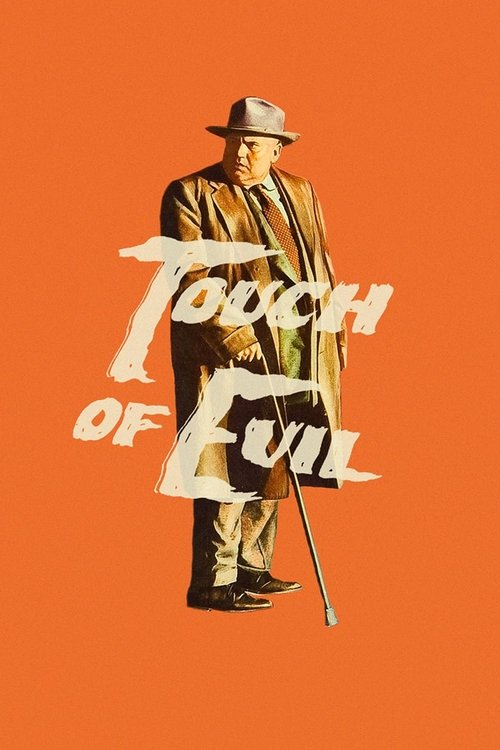
The opening sequence of Touch of Evil remains one of cinema's most famous feats of technical mastery. A camera mounted on a crane follows a car as it crosses the border from Mexico into the United States, capturing over three minutes of continuous movement without a single cut. Inside the vehicle are Mexican narcotics agent Miguel Vargas and his American wife Susie, who survive a bomb planted by corrupt gangsters. This explosive start immediately establishes the film's central conflict: a battle between idealism and the rotting foundations of authority in a border town.
Orson Welles steps behind the lens to direct this noir masterpiece while also starring as Captain Hank Quinlan. The character is a brutal, cynical police captain who manipulates evidence and intimidates suspects to secure convictions. His partner, Sergeant Pete Menzies, grows increasingly uneasy as he witnesses Quinlan's methods. Charlton Heston brings an earnest intensity to the role of Vargas, while Janet Leigh portrays Susie, whose pregnancy adds urgent stakes to the unfolding danger.
Availability and pricing can change. Confirm on the provider's site before purchasing.
The story picks up moments after the devastating explosion that nearly kills Miguel and Susie Vargas. They arrive at the Mirador Motel, where the local authorities are already scrambling to control the narrative. Captain Hank Quinlan arrives on the scene with his usual swagger, dismissing the idea that the bombing was a complex conspiracy. He sees only an opportunity to close a case quickly by framing a local drug dealer named Manolo Sanchez. Quinlan's reputation for brutality precedes him; he has built a career on extracting confessions through intimidation rather than investigation.
Miguel Vargas refuses to accept Quinlan's version of events. As a man dedicated to the rule of law, he begins his own private investigation into the bombing. He discovers that the bomb was planted by Uncle Joe Grandi, a powerful Mexican drug lord whose nephew was involved in the incident. The trail leads Vargas through the seedy underbelly of the fictional border town, past brothels and shady motels. Every step reveals deeper layers of corruption involving high-ranking officials who seem more interested in protecting their own interests than finding the truth.
Susie becomes an unwilling participant in this dangerous game. Her condition makes her a target, and she finds herself caught between two worlds: the rigid justice system of the United States and the chaotic violence of the Mexican underworld. She witnesses Quinlan planting evidence on innocent people, realizing that the man sworn to protect them is actually the greatest threat they face. The tension mounts as Quinlan realizes Vargas is getting too close to the truth. He begins to use his influence to isolate the couple, cutting off their resources and threatening their safety.
The investigation takes a darker turn when Quinlan decides to eliminate Vargas entirely. He orchestrates a series of attacks designed to look like accidents or gang violence. The film builds a sense of claustrophobia as the characters realize there is no safe place left in the town. Even the police station offers no protection against a captain who controls the force. Vargas must rely on his wits and the help of a few unlikely allies to expose the truth before it is too late.
As the body count rises, the moral ambiguity of the situation becomes impossible to ignore. The line between the hero and the villain blurs, forcing viewers to question what true justice looks like in a broken system. Vargas faces a choice that will define his future: walk away and save himself, or fight a war against a corrupted institution that seems unbeatable. The narrative drives toward a confrontation that will determine whether the truth can survive in a world built on lies.
Original 1958 Trailer
Masters of Cinema UHD Blu-ray Trailer
BFI Re-release Trailer
Critical Consensus
Widely regarded as one of the greatest film noirs ever made, Touch of Evil combines Orson Welles' career-defining performance as a corrupt cop with stunning cinematography and a haunting score. The film's exploration of institutional corruption and its revolutionary opening sequence have cemented its status as a timeless classic.
“It is a movie that challenges racism, sexism, alcoholism, assault & corruption just as radically & aggressively as did George Stevens' Giant.”
Roger Ebert
Chicago Sun-Times
“A sordid noir of gray morality and striking black-and-white images, photographed by Russell Metty, who captures the grit and grime of the border town with a masterful eye.”
A.O. Scott
The New York Times
“Orson Welles directs this tense crime drama, blending noir atmosphere with sharp social commentary. Charlton Heston plays the idealistic Vargas, while Janet Leigh portrays his American wife, Susie, caught in the middle of the danger.”
Variety Staff
Variety
“With its story of murder, marijuana and police corruption, Touch of Evil is considered among the last of the 1940s/50s cycle of crime thrillers known as film noir.”
Peter Bradshaw
The Guardian
Charlton Heston
Ramon Miguel Vargas
Janet Leigh
Susan 'Susie' Vargas
Orson Welles
Police Captain Hank Quinlan
Joseph Calleia
Sergeant Pete Menzies
Akim Tamiroff
'Uncle' Joe Grandi
Joanna Moore
Marcia Linnekar
Director
Orson Welles
Writers
Orson Welles, Whit Masterson
Composer
Henry Mancini
Cinematographer
Russell Metty
Producer
Albert Zugsmith
Academy Awards (1959)
Best Art Direction-Set Decoration, Black-and-White: Nominated
Academy Awards (1959)
Best Cinematography, Black-and-White: Nominated
Academy Awards (1959)
Best Film Editing: Nominated
Golden Globe Awards (1959)
Best Director – Motion Picture: Nominated
AFI's 100 Years...100 Thrills (2001)
Ranked #10: Won
Join the community
fans discussing