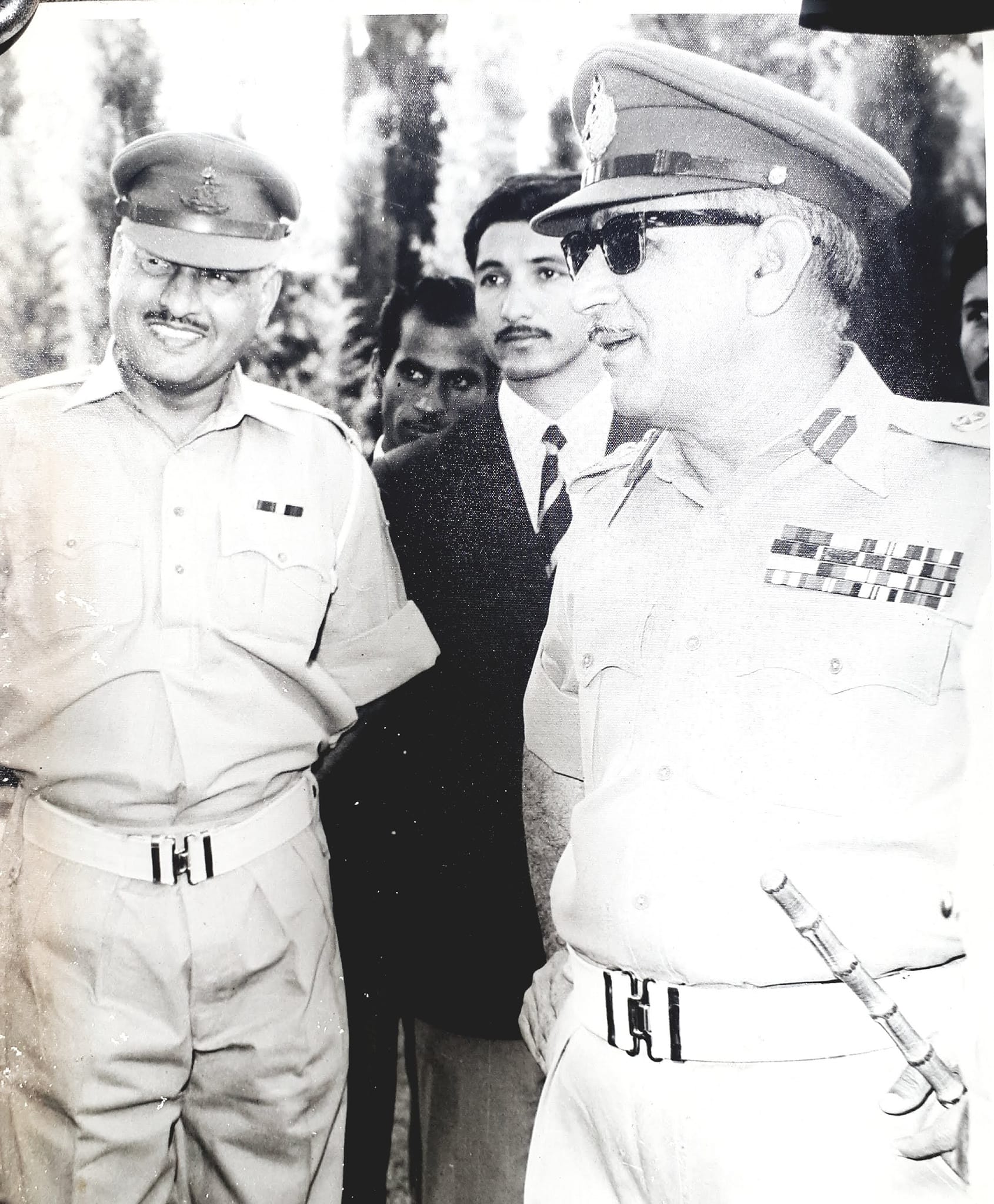
Tikka Khan
 Pakistan
Also known as: Butcher of Bengal, Butcher of Balochistan, Victor of the Rann of Kutch
Birthday
July 7, 1915
Birth Sign
Cancer
Birthplace
Jochha Mamdot, Kahuta Tehsil, British India
Age
Died at 86
About
Tikka Khan was a four-star general in the Pakistan Army and the first Chief of Army Staff of Pakistan, serving from 1972 to 1976. He is remembered as a polarizing figure in South Asian history, known for his military command during the 1971 Bangladesh Liberation War, where he earned the moniker 'Butcher of Bengal.'
Born into a Narma Rajput family, Khan's career spanned over three decades, from his commission in the British Indian Army in 1940 to his retirement in 1976. He played a significant role in Pakistan's military and political affairs, including supporting the country's nuclear program during his tenure as army chief.
As of 2026, Khan's legacy remains a subject of intense debate, with his actions in 1971 continuing to shape discussions on war crimes and historical memory in Bangladesh and beyond.
Early Life & Background
Tikka Khan was born on July 7, 1915, in the village of Jochha Mamdot, located in Kahuta Tehsil near Rawalpindi in British India. He came from a Narma Rajput family, and his father was a local landowner. Growing up in the agrarian society of Punjab, Khan was raised with traditional values that emphasized martial service.
He attended the Military College in Murree before moving on to the Indian Military Academy (IMA) in Dehra Dun, where he graduated in 1939. Commissioned as an artillery officer in the British Indian Army on February 10, 1940, he gained initial combat experience during World War II, serving in Burma and North Africa.
Following the partition of India in 1947, Khan transferred his allegiance to the newly formed Pakistan Army. His early career in the Pakistan Army included roles as an artillery instructor and various command posts, where he quickly rose through the ranks due to his administrative skills and military discipline.
Career Growth
Tikka Khan's breakthrough came during the 1965 Indo-Pak War, where he commanded the 8th Infantry Division at the Battle of Asal Uttar, earning the title 'Victor of the Rann of Kutch.' In 1969, he was appointed Commander-in-Chief of IV Corps and became the Martial Law Administrator for East Pakistan.
In 1971, as General Officer Commanding of the Eastern Command, he launched Operation Searchlight on March 25, a brutal crackdown on the Bengali independence movement. This operation resulted in widespread atrocities and mass killings, cementing his infamy as the 'Butcher of Bengal.' After the war, he commanded the II Corps in West Pakistan.
In 1972, President Zulfikar Ali Bhutto appointed him as the first Chief of Army Staff of Pakistan. During his tenure, he oversaw the reorganization of the army after the 1971 defeat and supported the initiation of Pakistan's nuclear weapons program. He retired in 1976.
Career Timeline
Public Image & Style
Tikka Khan's public image is deeply polarized. In Pakistan, some military establishment figures and nationalist groups view him as a loyal servant who restored order during a time of crisis. Conversely, in Bangladesh and among human rights organizations, he is synonymous with war crimes and genocide.
The nickname 'Butcher of Bengal' remains a dominant descriptor in global discourse regarding the 1971 Bangladesh Liberation War. His persona is that of a stern, disciplined military officer, but his legacy is overshadowed by the human cost of his operations.
There is no traditional fandom; instead, he is a subject of intense historical debate and academic study. Recent news items continue to reference his role in Operation Searchlight, particularly around anniversaries of the 1971 war.
Fame & Fandom
Tikka Khan is currently evaluated by the iFANN Global Fame Engine but holds no placement in the published rankings, including the Global Top 1,000 or any Top-100 scope list. This status reflects a historical figure whose notoriety stems from military command and controversy rather than contemporary celebrity metrics. While he remains a subject of intense debate and academic study, he does not appear within the current tiered hierarchy of global fame. The absence of a formal ranking indicates that his public profile, while significant in specific regional and historical contexts, does not generate the sustained consumption signals required for a numerical position in the current cycle. There is no documented fandom name associated with Tikka Khan, as no organized group of supporters identifies themselves with a specific moniker. Unlike entertainment figures who cultivate fanbases through cultural products, Khan is viewed primarily through the lens of historical accountability and political legacy. His reputation is defined by the epithets 'Butcher of Bengal' and 'Butcher of Balochistan,' titles that serve as markers of infamy rather than badges of honor for a fan community. No fan rituals, birthday celebrations, or charitable campaigns exist in his name. Instead, the discourse surrounding him consists of historical archives, legal proceedings regarding war crimes, and ongoing geopolitical analysis. In Bangladesh, he is remembered as a perpetrator of genocide, while in Pakistan, he occupies a complex space within military history. The lack of a fan culture underscores the distinction between a public figure celebrated for their artistry or influence and a historical actor whose life ended in death and whose actions remain a source of deep societal trauma.
Interesting Facts and Legends
Born Raja Tikka Khan, the general reflected his aristocratic Narma Rajput lineage in his full birth name. He is uniquely distinguished by two grim epithets: 'Butcher of Bengal' for his command during the 1971 Bangladesh Liberation War and 'Butcher of Balochistan' for subsequent operations in that province. Despite his high rank, Khan never received civilian honors such as Hall of Fame inductions or honorary degrees, and his personal life remained private with no public records of a spouse or children. He played a critical behind-the-scenes role in nurturing the early stages of Pakistan's nuclear program, a decision that would define the country's strategic posture for decades. The most enduring legend attached to his name concerns Operation Searchlight, launched on March 25, 1971. As the architect of this operation, Khan oversaw a brutal crackdown intended to suppress the Bengali independence movement, an event that resulted in thousands of deaths and widespread sexual violence overnight. This date and the scale of the atrocities form the core of his historical infamy, frequently cited in international media and legal documents. Following the war, he was included in the official list of individuals accused of war crimes by the newly formed government of Bangladesh in 2008, cementing his status as a symbol of the conflict's darkest chapters despite dying before facing trial.
Family & Personal Life
Details about Tikka Khan's family are scarce. He was born to a local landowner in a Narma Rajput family, which held a certain status in the region. There is no public record of his parents' names or any siblings.
Throughout his life, Khan kept his personal affairs out of the public eye. He did not have a known spouse or children, and no information about his household or pets has been documented.
His family background, rooted in the martial traditions of Punjab, influenced his early path toward a military career.
Notable Connections
Tikka Khan was closely associated with President Yahya Khan, under whom he served during the 1971 crisis. Zulfikar Ali Bhutto appointed him as the first Chief of Army Staff. Major Siddiq Salik, who documented the 1971 war in Witness to Surrender, provided accounts of the events under Khan's command.
Relationships & Dating History
Tikka Khan's personal life remained largely private, consistent with the norms for military officers of his era. There are no verified public records of marriages, engagements, or children. He is generally described as having lived a disciplined, military-focused life without public mention of a spouse or offspring.
As of 2026, no information has surfaced to change this understanding.
Death & Aftermath
Died
March 28, 2002 (aged 86)
Death Place
Unknown
Cause of Death
Natural causes due to old age
General Tikka Khan passed away at the age of 87 following a long life that concluded after his retirement from active military service in 1976. The specific location of his passing remains unrecorded in available documentation, though he had previously held the office of Governor of Punjab. His death occurred on March 28, 2002, and was attributed to natural causes associated with his advanced age. The public reaction to his death reflected the deep polarization of his historical legacy rather than unified mourning. Major international publications such as The Los Angeles Times and The New York Times published obituaries that highlighted his controversial moniker as the Butcher of Bengal and his role in the crackdown on separatists in East Pakistan.
While tributes within Pakistan acknowledged his military service and tenure as Defense Minister, the global response focused heavily on allegations of human rights violations during the 1971 war and operations in Baluchistan. Details regarding the funeral arrangements, including the date of burial, the specific location, or notable attendees, are not specified in the records.
Net Worth (Estate Value)
$1 Million
iFANN Editorial Team estimate
Tikka Khan's net worth is not publicly documented through traditional financial disclosures, as he was a career military officer who died in 2002. His income derived from standard military salaries and pensions, which were modest compared to modern standards. There is no evidence of significant real estate holdings, investments, or commercial ventures outside of his official service. Per iFANN's editorial analysis, the estimated value of his estate stands at $1 Million. As of 2026, any further estimate of his wealth would be speculative given the lack of private asset records. His legacy is not tied to financial accumulation but to his controversial historical role and the profound impact of his military decisions.
Awards Won (2)
Tikka Khan received several military decorations for his service, including the Hilal-i-Jurat and Sitara-e-Jurat. These honors recognize gallantry and long service, but he did not receive civilian awards or honorary degrees.
1965 · Military Decoration
Indo-Pak War
1948 · Military Decoration
Service
Known For
Operation Searchlight
1971 · Commander of Eastern Command
Chief of Army Staff
1972-1976 · First COAS of Pakistan
Keywords
Sources
Quick Facts
- Profession
- military personnel
- Born
- +1915-07-07
- Birthplace
- Jochha Mamdot, Kahuta Tehsil
- Died
- +2002-03-28
- Death Place
- Rawalpindi
- Gender
- Male
- Birth Sign
- Cancer
Personal Details
- Full Name
- Raja Tikka Khan
- Education
- Indian Military Academy, Dehra Dun
Frequently Asked Questions
Who was Tikka Khan?
Why is Tikka Khan called the 'Butcher of Bengal'?
When did Tikka Khan die?
Did Tikka Khan have any children?
What was Tikka Khan's role in the 1971 war?
Similar People
Join the community
fans discussing