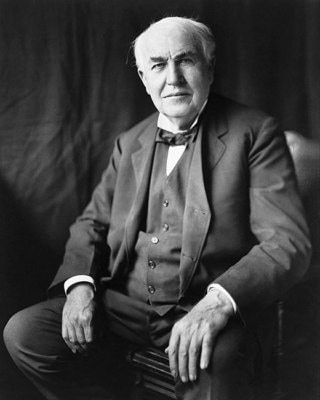
Thomas Edison
 United States
engineer•inventor•entrepreneur
Also known as: Wizard of Menlo Park
Birthday
February 11, 1847
Birth Sign
Aquarius
Birthplace
Milan, Ohio, USA
Age
Died at 84
About
Thomas Alva Edison was the American inventor and businessman who brought the world the phonograph, the practical incandescent light bulb, and the first industrial research laboratory. Holding 1,093 U.S. patents, he is one of the most prolific inventors in history. His work didn't just create devices; it built entire systems, from electric power distribution to recorded sound, that defined modern life. Today, his name remains shorthand for ingenuity itself, and his Menlo Park lab is remembered as the birthplace of organized innovation.
Early Life & Background
Edison grew up in Port Huron, Michigan, after his family moved from Milan, Ohio, when he was seven. He attended school for only a few months; his mother, a former teacher, educated him at home and encouraged his love of reading and hands-on experiments. A childhood illness, scarlet fever or typhus, left him with significant hearing loss, a condition he later said helped him concentrate.
At age 12, Edison began selling newspapers and candy on the Grand Trunk Railway, and he even set up a small printing press in a baggage car to publish his own newspaper, The Grand Trunk Herald. His knack for telegraphy emerged after he saved the son of a station agent from a runaway train; the grateful father taught him to operate the telegraph. By 15, Edison was a qualified telegraph operator, traveling across the country and picking up technical knowledge on the job. By 22, he had sold his first inventions and moved to New York City, determined to make a living as a full-time inventor.
Career Growth
Edison's first major breakthrough came with the quadruplex telegraph in 1874, which allowed four messages to travel simultaneously on a single wire. In 1876, he opened his Menlo Park laboratory, the first facility of its kind, designed specifically for industrial research. There, in 1877, he unveiled the phonograph, a machine that could record and reproduce sound, stunning the world. Two years later, he demonstrated a practical incandescent light bulb and an entire electrical power distribution system, lighting up Menlo Park and eventually cities worldwide.
He founded the Edison Electric Light Company in 1880, which later merged into General Electric. In 1887, he opened a larger lab in West Orange, New Jersey, where he developed improved batteries, motion picture equipment, and more. Edison's approach combined relentless experimentation with sharp business instincts, he didn't just invent; he commercialized, manufacturing and marketing his creations to reach everyday people.
Career Timeline
Public Image & Style
Edison cultivated the persona of the "Wizard of Menlo Park," a genius inventor whose experiments seemed magical. In reality, he was a hard-nosed businessman who understood the power of publicity. He dressed in practical, often rumpled suits, and his labs were chaotic workshops filled with noise and activity. Media portrayals have romanticized him as the lone inventor, but his true innovation was systematic teamwork. Fans and critics alike see him as a symbol of American determination, though his rivalry with Nikola Tesla has complicated his legacy in recent years.
Fame & Fandom (iFAMOUS Rankings)
Thomas Edison left no organized fanbase behind when he died in 1931. No modern movement claims him as a mascot, and no specific name unites the millions who study his life or admire his inventions. Historians, engineers, and students form his audience, but they operate without the rituals or shared language of contemporary celebrity culture. His legacy survives not through active campaigns or viral tributes, but through the enduring reality of the systems he built. The electric grid and recorded sound remain daily necessities, ensuring his relevance outlasts any fleeting trend. While some productions like the puppetry show "Tesla vs. Edison" keep his rivalry with Nikola Tesla alive in popular lore, these events spark academic interest rather than fandom fervor. Recent scientific work at UCLA reimagining his battery designs proves his foresight remains a subject of serious inquiry in 2026, yet this engagement stays within professional circles. There are no fan clubs, no dedicated hashtags, and no crowd-funded projects for his memory. He stands alone as a figure whose fame is measured by utility rather than adoration. Despite this lack of formal organization, his global standing remains immense according to the iFANN Global Fame Rankings. Thomas Edison is currently the 249th most famous person in the world, holding steady from the previous cycle. He ranks as the 95th most famous person from United States and the 81st most famous person in North America. Within his field, he holds the position of the 8th most famous person in Tech. These placements reflect a sustained attention across media coverage, search activity, and cultural consumption signals worldwide.
Interesting Facts and Legends
Edison's first patent was for an electric vote recorder invented at age 22, though legislators ignored it completely. He suggested using the word "hello" as a telephone greeting and claimed his hearing loss helped him focus by blocking distractions. A relentless workaholic, he slept only four hours a night and demanded the same from his staff. One obscure invention was a concrete house designed to be poured in a single mold, which never gained traction. Legends surrounding his life often blur fact and folklore. The story of the light bulb is frequently told as a singular moment of genius, but Menlo Park actually saw over 6,000 materials tested before finding a carbon filament that worked commercially. Another dark chapter involves the "War of Currents," where associates secretly supplied AC generators for the first electric chair execution to prove its lethality. This event cemented a reputation for ruthlessness. Edison also formed a close bond with Henry Ford and Harvey Firestone known as the "Vagabonds." They spent winters camping in cars across the United States, creating a narrative of camaraderie among giants. When the first central power station lit Lower Manhattan in 1882, thousands gathered to witness gaslight replaced by electricity, marking a true shift in human history.
Notable Quotes
“I have not failed. I've just found 10,000 ways that won't work.”
“Genius is one percent inspiration and ninety-nine percent perspiration.”
“The world owes the inventor nothing. It owes him only a continued opportunity to do more.”
Family & Personal Life
Edison married Mary Stilwell in 1871; she died in 1884 at age 29, leaving him with three children: Marion, Thomas Jr., and William. In 1886, he married Mina Miller, daughter of inventor Lewis Miller. They had four children: Madeleine, Charles, Theodore, and Nicholas. Charles later became Governor of New Jersey. Mina managed Edison's affairs after his death and preserved his legacy. Edison was a devoted but often absent father, consumed by his work.
Notable Connections
Edison employed and later feuded with Nikola Tesla, whose alternating current system rivaled Edison's direct current. Samuel Insull, his former secretary, became a powerful utility magnate. Lewis Miller, his father-in-law, co-founded the Chautauqua Institution.
Relationships & Dating History
Edison married his first wife, Mary Stilwell, in 1871. She was an employee at his Newark factory. The marriage was strained by Edison's long work hours, and Mary died suddenly in 1884 at age 29, likely from a brain tumor. They had three children. A year later, Edison met Mina Miller at a family friend's home. They married in 1886 and had four children. Mina was a stabilizing force, managing the household and supporting his work. Edison remained married to Mina until his death in 1931.
- MarriedMary Stilwell Edison1871 - 1884First wife; died in 1884. They had three children.
- MarriedMina Miller Edison1886 - 1931CurrentSecond wife; daughter of inventor Lewis Miller. They had four children.
Death & Aftermath
Died
October 18, 1931 (aged 84)
Death Place
West Orange, New Jersey, USA
Cause of Death
Reported complications from diabetes mellitus
Thomas Edison died on October 18, 1931, at his estate, Glenmont, in West Orange, New Jersey. He was 84 years old. For months, his health had declined due to long-term diabetes, leaving him bedridden and unable to speak clearly by September. His final hours passed quietly among his wife Mina and their children. The news of his passing triggered an immediate national response. President Herbert Hoover declared a moment of silence across the United States, urging citizens to extinguish electric lights to honor the man who lit up the world. This symbolic gesture united cities and towns in a collective tribute to the inventor. Henry Ford, Charles Lindbergh, and Guglielmo Marconi sent statements praising his contributions to humanity during radio broadcasts dedicated to his legacy.
A private funeral service took place three days later on October 21 at Glenmont, attended by close family and select business associates including Ford. Following the ceremony, Edison was cremated at the Fairmount Crematory in Philadelphia, Pennsylvania. His ashes were interred in the crypt of the family mausoleum at Oak Hill Cemetery in West Orange. Posthumously, he received numerous honors, including induction into the National Inventors Hall of Fame in 1954 and the establishment of the Thomas Edison National Historical Park in 1962. The Thomas Edison Foundation was created to support innovation, while films like Edison (1940) and documentaries explored his life. The estate remained under family management for decades before transitioning to corporate entities.
Net Worth (Estate Value)
$100 Million
iFANN Editorial Team estimate
As of 2026, the estate of Thomas Edison is valued at $100 Million per iFANN's editorial analysis. This wealth persists through ongoing licensing fees for his patents and the continued operation of corporations he established, particularly the enduring legacy of General Electric. Royalties from the use of his inventions in media and entertainment contribute significantly to the total. The value also encompasses his historic laboratories and personal property. Following his death in 1931, his estate passed to his second wife, Mina, and subsequently to his children, who managed the vast portfolio of innovations to ensure steady income generation.
Awards Won (5)
Edison received the Congressional Gold Medal in 1928 for his contributions to science and industry. He was twice awarded the John Fritz Medal (1908 and 1930) for engineering achievement. The Franklin Institute gave him the Elliott Cresson Medal in 1890 for his work on the incandescent lamp. In 1908, the Royal Society of Arts honored him with the Albert Medal.
1928 · General
Contributions to science and industry
1930 · Engineering
Achievements in engineering and invention
1908 · Engineering
Achievements in engineering and invention
Known For
Phonograph
1877 · Inventor
Incandescent Light Bulb
1879 · Inventor
Electric Power Distribution
1882 · Developer
Motion Picture Camera
1891 · Inventor
Keywords
Quick Facts
- Profession
- engineer, inventor, entrepreneur
- Born
- +1847-02-11
- Birthplace
- Milan
- Died
- +1931-10-18
- Death Place
- West Orange
- Gender
- Male
- Spouse
- Mary Stilwell Edison, Mina Miller
- Birth Sign
- Aquarius
Personal Details
- Full Name
- Thomas Alva Edison
- Spouse
- Mary Stilwell Edison, Mina Miller
- Children
- Marion Estelle Edison, Thomas Alva Edison Jr., William Leslie Edison, Madeleine Edison, Charles Edison, Theodore Miller Edison, Nicholas Longworth Edison
- Education
- Homeschooled by mother; minimal formal schooling
Frequently Asked Questions
Who was Thomas Edison?
What is Thomas Edison's net worth in 2026?
How many patents did Thomas Edison have?
Did Thomas Edison really invent the light bulb?
How did Thomas Edison die?
Similar People
Join the community
fans discussing