 United Kingdom
“A beautiful, spoiled young heiress who has all the money in the world but can't find love, and a humble doctor who wants none of it, make for a sparkling battle of wills.”
Variety Staff
Variety
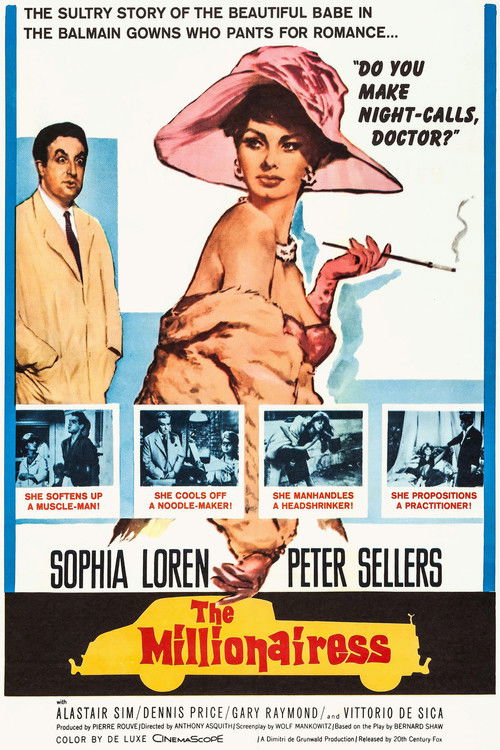
In 1960, two of the biggest international stars of the era, Sophia Loren and Peter Sellers, teamed up for a rare comedy pairing in The Millionairess. Directed by Anthony Asquith and adapted from George Bernard Shaw's 1936 play, the film casts Loren as Epifania Parerga, a spoiled Italian heiress in London who inherits a colossal fortune and finds herself desperately unhappy despite her wealth. Sellers plays Dr. Kabir, a humble Indian physician devoted to his poor East End patients, who becomes the unlikely object of her affection.
The film is a romantic comedy with sharp social edges, exploring themes of class, money, and love through a battle of wills between two people from completely different worlds. Asquith, known for his elegant British productions, brings a polished touch to the proceedings, while the screenplay by Wolf Mankowitz and Riccardo Aragno adds wit and warmth to Shaw's original satire. The supporting cast includes Vittorio De Sica, Alastair Sim, and Miriam Karlin, adding depth to Epifania's world of sycophants and working-class contrasts.
Though not considered a top-tier work for any of its principals, The Millionairess remains a fascinating time capsule of late-fifties British cinema, showcasing Loren's glamour and Sellers's early comedic range. It's a film that delights in the absurdity of extreme wealth and the simplicity of genuine human connection, and it still offers plenty of charm for fans of classic romantic comedies.
Availability and pricing can change. Confirm on the provider's site before purchasing.
When Epifania Parerga's wealthy Italian father dies in London, she becomes the richest woman in the world. Beautiful, sharp-tongued, and utterly accustomed to getting her way, Epifania is nonetheless miserable. Her marriage to the weak-willed Alastair is a disaster, and every man who approaches her seems more interested in her bank balance than in her. Her lawyer Sagamore manages her affairs and her endless whims, while a circle of socialites and hangers-on flatter her without ever touching her heart.
Into this gilded cage walks Dr. Kabir, an Indian physician who runs a modest practice in the East End, treating the poor with skill and compassion, often for no payment at all. Epifania, intrigued by his indifference to her wealth and status, decides she must have him. She pursues him with characteristic determination, but Kabir resists, finding her shallow and her world meaningless. Their clashes are electric, with Loren's fiery heiress and Sellers's serene doctor trading barbs and philosophical jabs.
The turning point comes when they discover that each has a parental condition attached to marriage. Epifania's father decreed that her husband must turn a small sum into a fortune within a set time. Kabir's mother insisted his wife must live on a pittance while maintaining her dignity. To prove their worth, the couple agrees to a test: Kabir must make money, and Epifania must survive poverty.
Kabir, who despises commerce, struggles with the task, but through a series of comedic misadventures, he manages to turn a modest amount into a substantial profit, albeit reluctantly. Meanwhile, Epifania, stripped of her wealth, takes a job at Joe's fish and chip shop, run by the gruff Joe and his wife. She is hopeless at first, burning food and insulting customers, but gradually she learns the value of hard work and the dignity of labor. The experience humbles her in ways she never expected.
As the tests progress, both characters are forced to confront their own prejudices. Kabir sees that Epifania is capable of change and that her wealth doesn't define her entire being. Epifania realizes that Kabir's principles are not just stubbornness but a genuine commitment to something greater than herself. Their relationship deepens, moving from infatuation to a grudging respect that might just be love.
But the path to happiness is not smooth. Epifania's former life keeps pulling her back, and Kabir's patients need him. The film builds to a final confrontation where both must decide if they can truly meet in the middle, or if their worlds are simply too far apart.
Critical Consensus
Though not among the finest works of its stars or director, The Millionairess offers a charming if dated adaptation of Shaw's play, with Loren and Sellers providing enjoyable chemistry and a few genuine laughs.
Sophia Loren
Epifania Parerga
Peter Sellers
Dr. Kabir
Vittorio De Sica
Joe
Alastair Sim
Sagamore
Dennis Price
Adrian
Gary Raymond
Alastair
Miriam Karlin
Mrs. Joe
Noel Purcell
Professor Merton
Virginia Vernon
Polly Smith
Eleanor Summerfield
Mrs. Willoughby
Pauline Jameson
Muriel Pilkington
Alfie Bass
Fish Curer
Director
Anthony Asquith
Writers
Wolf Mankowitz, George Bernard Shaw, Riccardo Aragno
Composer
Georges Van Parys
Cinematographer
Jack Hildyard
Producer
Pierre Rouve
Join the community
fans discussing