“It is a terrifying film, and I think it may be the most frightening film I have ever seen.”
Roger Ebert
Chicago Sun-Times
 United States
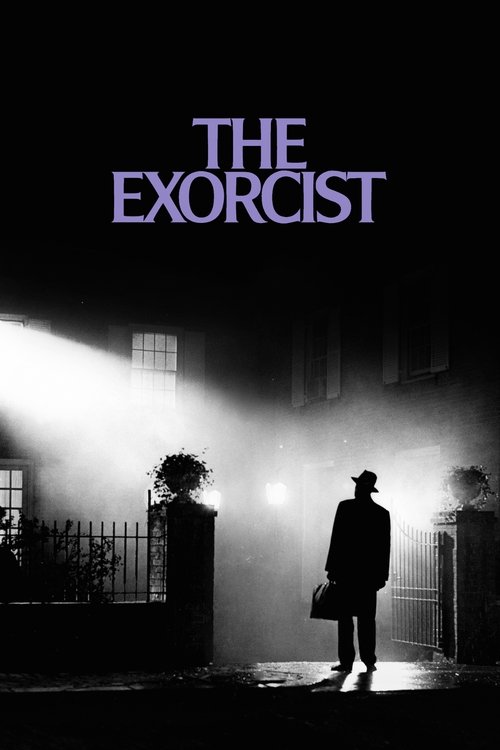
"Something almost beyond comprehension is happening to a girl on this street, in this house…And a man has been sent for as a last resort. This man is The Exorcist."
Part of a Collection
The Exorcist Collection
William Friedkin's 1973 masterpiece didn't just scare audiences; it rewired the circuitry of horror cinema. Adapted from William Peter Blatty's novel, which was itself inspired by a real 1949 exorcism case in St. Louis, the film arrived at a moment of cultural upheaval and tapped into deep anxieties about faith, science, and the unseen. It became a phenomenon, grossing over $440 million worldwide and earning ten Academy Award nominations, including Best Picture.
What sets The Exorcist apart is its refusal to be just a horror movie. Friedkin shot it like a documentary, with a gritty, naturalistic style that makes the supernatural elements land with shocking force. The performances are grounded and raw, especially Ellen Burstyn as a mother watching her daughter slip away and Jason Miller as a priest wrestling with his own faith. The film's power comes from its patience, building dread methodically before unleashing some of the most disturbing images ever committed to film.
More than fifty years later, The Exorcist still works on a primal level. Its influence is everywhere, from the way horror films handle possession to the use of sound design and practical effects. But beyond the pea-soup vomit and spinning heads, the movie endures because it asks real questions about suffering, sacrifice, and the existence of evil. It remains a brutal, beautiful, and deeply unsettling experience.
Availability and pricing can change. Confirm on the provider's site before purchasing.
Chris MacNeil, a successful actress, is in Georgetown filming a new project. She lives with her twelve-year-old daughter Regan in a rented townhouse, and life seems ordinary. But small, strange things start happening. Regan becomes fascinated with a Ouija board she finds in the attic. She mentions an imaginary friend named Captain Howdy. Chris shrugs it off at first.
Then Regan's behavior shifts. She complains of her bed shaking at night. Her personality changes, becoming withdrawn and then hostile. Chris takes her to doctors, who run tests. A neurologist finds nothing wrong. A psychiatrist suggests it might be a psychological issue. But Regan only gets worse. She starts using profane language, speaking in voices that aren't her own, and showing physical strength that terrifies everyone around her.
Desperate, Chris reaches out to Father Damien Karras, a Jesuit priest who also works as a psychiatrist. Karras is struggling with his own faith after his mother's recent death. He visits Regan and tries to find a psychological explanation, but the more he sees, the more unsettled he becomes. Regan's body contorts in impossible ways. She speaks in languages she has never learned. She knows things about Karras's personal life that she couldn't possibly know.
Meanwhile, Chris learns about a case of demonic possession documented by the Catholic Church. She begs Karras to perform an exorcism. Karras is skeptical but cannot deny what he has witnessed. He consults his superiors, who bring in Father Lankester Merrin, an older priest with experience in exorcisms. Merrin has faced evil before and recognizes the signs. He agrees to perform the rite, knowing the danger it poses to everyone involved.
The stage is set for a confrontation between the priests and the entity that has taken hold of Regan. The film builds its horror not through jump scares but through a slow, grinding sense of dread, as the medical and rational explanations fall away one by one. What remains is a battle for a child's soul, fought in a bedroom that becomes a battlefield.
4K Ultra HD Official Trailer
THE EXORCIST Official Trailer
Modern Trailer
Critical Consensus
A terrifying and masterfully crafted horror film, The Exorcist remains a disturbing and influential classic thanks to its chilling atmosphere, groundbreaking special effects, and profound exploration of faith and evil.
“It is a terrifying film, and I think it may be the most frightening film I have ever seen.”
Roger Ebert
Chicago Sun-Times
“The Exorcist is a profoundly disturbing film, but it is also a masterpiece of suspense and psychological terror.”
Vincent Canby
The New York Times
“This is the film that redefined the horror genre, pushing boundaries and leaving audiences in a state of shock and awe.”
Variety Staff
Variety
“William Friedkin's film is a visceral and unnerving experience, a potent blend of religious dread and psychological realism.”
David Jenkins
Little White Lies
Ellen Burstyn
Chris MacNeil
Linda Blair
Regan MacNeil
Jason Miller
Father Damien Karras
Max von Sydow
Father Lankester Merrin
Lee J. Cobb
Lt. Bill Kinderman
William O'Malley
Father Joseph Kevin Dyer
Kitty Winn
Sharon Spencer
Barton Heyman
Dr. Klein
Peter Masterson
Dr. Barringer
Jack MacGowran
Burke Dennings
Rudolf Schündler
Karl
Gina Petrushka
Willi
Director
William Friedkin
Writer
William Peter Blatty
Composer
Jack Nitzsche
Cinematographer
Owen Roizman
Producer
William Peter Blatty
Academy Awards (1974)
Best Sound: Won
Academy Awards (1974)
Best Screenplay Based on Material from Another Medium: Won
Academy Awards (1974)
Best Picture: Nominated
Academy Awards (1974)
Best Director: Nominated
Academy Awards (1974)
Best Actress: Nominated
Academy Awards (1974)
Best Supporting Actress: Nominated
Golden Globe Awards (1974)
Best Motion Picture – Drama: Won
Golden Globe Awards (1974)
Best Director: Won
Golden Globe Awards (1974)
Best Actress – Motion Picture Drama: Won
BAFTA Awards (1975)
Best Film Music: Won
Join the community
fans discussing