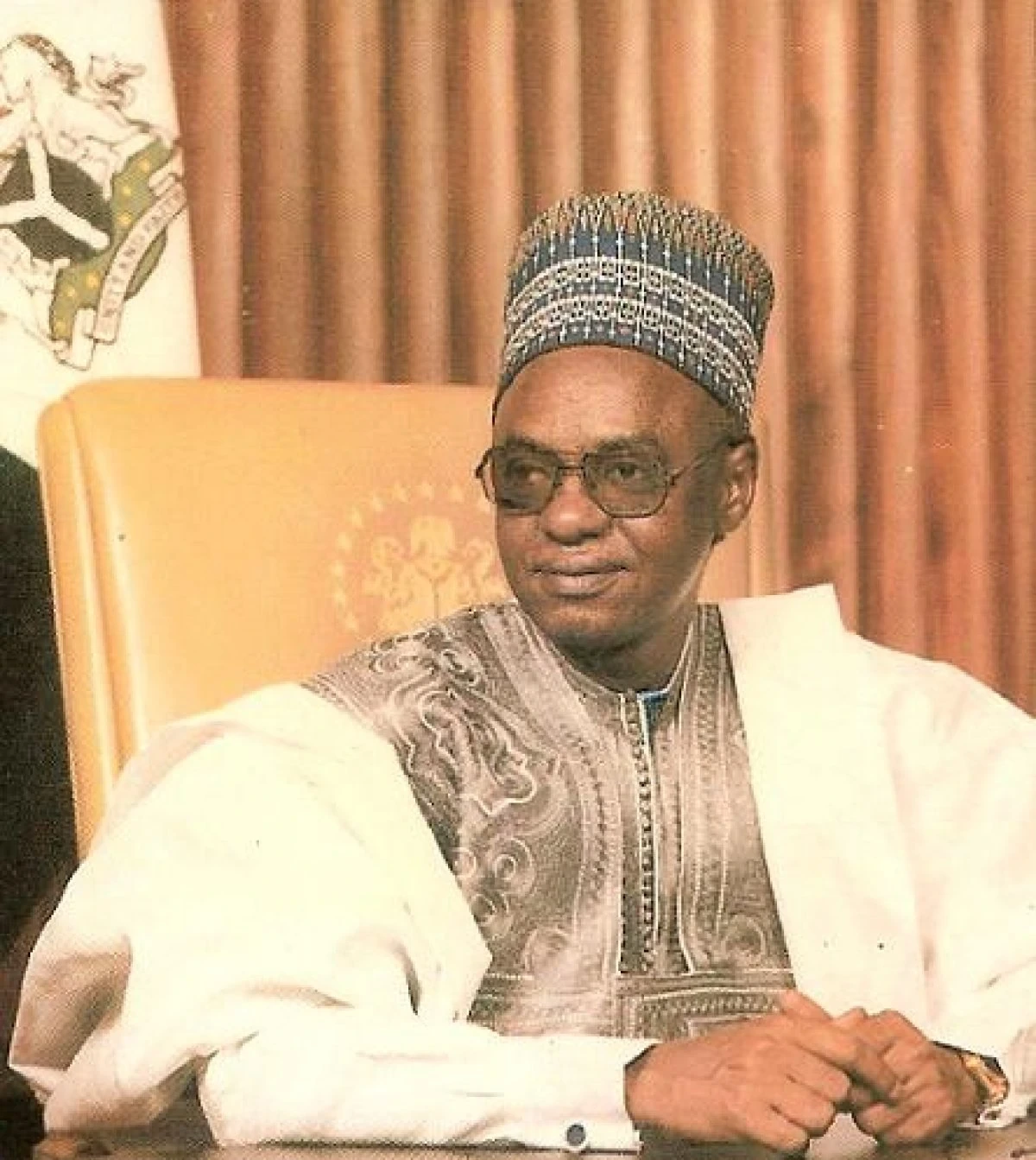
Shehu Shagari
 Nigeria
Also known as: Shehu Usman Aliyu Shagari
Birthday
February 25, 1925
Birth Sign
Pisces
Birthplace
Shagari, Sokoto State, Nigeria
Age
Died at 93
About
Shehu Usman Aliyu Shagari was a Nigerian politician who made history as the first democratically elected president of Nigeria, serving from October 1, 1979, until a military coup on December 31, 1983. His presidency marked the beginning of the Second Nigerian Republic and symbolized a return to civilian rule after years of military government. Shagari is remembered as a gentle, honest leader, often described as a gentleman of the old school, and he remains Nigeria's oldest head of state.
Before his presidency, Shagari had a long and distinguished career in public service. He was a federal minister and commissioner for over two decades, playing key roles in shaping Nigeria's post-independence economy. He oversaw the introduction of the Naira, Nigeria's currency, and later worked on reconciliation after the civil war. His presidency focused on economic development and infrastructure, including the Ajaokuta Steel Mill and the construction of the new capital, Abuja.
Shagari passed away on December 28, 2018, at the age of 93, leaving behind a legacy as a pioneer of Nigerian democracy. His life and career are celebrated for their integrity and dedication to national unity.
Early Life & Background
Shehu Shagari was born on February 25, 1925, in the town of Shagari, which was founded by his great-grandfather, Ahmadu Rufa'i. He was the sixth child in a polygamous Fulani family, and his father, Aliyu Shagari, served as the Magajin Shagari, or village head. When Shehu was just five, his father died, and his elder brother Bello briefly took over the role.
His education began at a Quranic school, followed by Yabo elementary school from 1931 to 1935, Sokoto middle school from 1936 to 1940, and Barewa College from 1941 to 1944. He then attended the Teachers Training College in Zaria from 1944 to 1952. Afterward, he worked as a visiting teacher in Sokoto Province from 1953 to 1958, and also served on the Federal Scholarship Board from 1954 to 1958.
His entry into politics came in 1951 when he joined the Northern People's Congress (NPC), the dominant party in the Northern Region. He was elected to the federal House of Representatives in 1954, beginning a long career in public office.
Career Growth
Shagari's political career took off after his election to the House of Representatives in 1954. He held various ministerial positions from 1958 to 1975, including Minister of Internal Affairs, Works and Survey, and Finance. As Federal Commissioner for Finance, he oversaw the introduction of the Naira in 1973. During the civil war aftermath, from 1970 to 1971, he was appointed by General Yakubu Gowon as commissioner for economic development, rehabilitation, and reconstruction, where he worked on reconciliation and rebuilding the South East.
In 1979, Shagari was chosen as the presidential candidate for the National Party of Nigeria (NPN). He won the election, narrowly defeating Chief Obafemi Awolowo, and became president on October 1, 1979. His presidency focused on economic development, infrastructure, and industrialization. He commissioned the Ajaokuta Steel Mill, the largest steel project in Africa, and oversaw the construction of the new federal capital, Abuja. His tenure ended on December 31, 1983, when General Muhammadu Buhari led a military coup.
Career Timeline
Public Image & Style
Shagari was widely regarded as an honest, mild-mannered, and gentle leader. The Council on Foreign Relations described him as a gentleman of the old school. He was seen as a unifier, and his presidency is often remembered for its attempts to bring the nation together. He was a devout Muslim and a member of the Fulani elite, which shaped his public persona. His simple lifestyle and integrity earned him respect across political lines.
Fame & Fandom (iFAMOUS Rankings)
Shehu Shagari does not command a modern celebrity fandom, nor is there an official moniker for any admirers who follow his legacy. As a statesman rather than a pop culture figure, the public engagement with his memory manifests through historical remembrance and academic study rather than organized fan clubs, social media campaigns, or ritualistic gatherings. His descendants occasionally appear in political discourse, but these are family engagements distinct from the fanbase activities seen with entertainers. The iFANN Global Fame Engine evaluated his standing in August 2026 and determined that he holds no placement within the published rankings. He is currently unranked on the Global Top 1,000 list and does not appear on any scope-specific top-100 lists. This absence of a numeric rank reflects his status as a historical figure whose primary influence lies in the annals of Nigerian democracy rather than contemporary global consumption metrics. While his name remains recognizable across West Africa due to his role as the first elected president of the Second Republic, he lacks the active digital footprint required for a current ranking position. The evaluation confirms that while he is a figure of significant national importance, he does not generate the volume of search signals, media coverage, or cultural consumption necessary to secure a spot in the current global hierarchy. Consequently, no ordinal position can be assigned to him at this time.
Interesting Facts and Legends
Shehu Shagari was born into the Fulani ethnic group, a dominant community in northern Nigeria, and was known for his devout Sunni faith throughout his life. His great-grandfather established the town of Shagari, which bears the family name. Before entering high office, he served as a federal minister and commissioner for over two decades, eventually becoming a close associate of General Olusegun Obasanjo during the transition to civilian rule in 1979. He is frequently remembered for maintaining a simple and modest lifestyle, a trait that stood in sharp contrast to many of his contemporaries. Historical accounts often highlight his background as a teacher before he ascended to the presidency, a narrative that underscores his intellectual approach to governance. A defining moment in his legacy occurred when he became the first Executive President of Nigeria's Second Republic on October 1, 1979, marking a return to civilian rule after years of military administration. His tenure ended abruptly on December 31, 1983, following a coup d'état by General Muhammadu Buhari just one day before his term concluded. This event remains a central piece of Nigerian political folklore, often cited as the failure of the Second Republic. Upon his death in 2018 at the age of 93, he was noted as the last surviving president of that republic, closing a significant chapter in the nation's history.
Family & Personal Life
Shagari was born into a polygamous Fulani family, the sixth child. His father, Aliyu Shagari, was the village head of Shagari, and his great-grandfather founded the town. He had an elder brother, Bello, who briefly served as Magajin Shagari after their father's death. Shagari had three wives: Amina Shagari, Hadiza Dawaiya (married in 1957), and Aisha Shagari, who died in 2001. He had several children, including Muhammad Bala Shagari, Aminu Shehu Shagari, and Abdulrahman Shehu Shagari. His grandson, Bello Bala Shagari, confirmed his death, and his nephew, Mukhtar Shehu Shagari, is also known.
Notable Connections
Shagari was associated with several key figures in Nigerian politics, including General Olusegun Obasanjo, who handed over power to him in 1979, and Chief Obafemi Awolowo, his rival in the 1979 election. He also worked with General Yakubu Gowon, who appointed him as a federal commissioner, and Umaru Dikko, his campaign manager. His presidency was ended by a coup led by General Muhammadu Buhari.
Relationships & Dating History
Shagari had three wives. His first wife, Amina Shagari, was his partner for many years, though the marriage date is not documented. He married Hadiza Dawaiya in 1957. His third wife, Aisha Shagari, passed away in 2001. He was married to all three concurrently, as polygamy is permitted in his culture. At the time of his death in 2018, his surviving wives were Amina and Hadiza.
- MarriedAmina ShagariFirst wife, married for many years.
- MarriedHadiza Dawaiya1957 - presentMarried in 1957.
- MarriedAisha Shagari? - 2001Died in 2001.
Death & Aftermath
Died
December 28, 2018 (aged 93)
Death Place
Abuja, Nigeria
Cause of Death
Unknown
Shehu Usman Aliyu Shagari, the first democratically elected president of Nigeria's Second Republic, died on Friday, December 28, 2018, in Abuja, Nigeria. Born on February 25, 1925, he was 93 years old at the time of his death. While multiple authoritative sources including The New York Times, Britannica, and the Council on Foreign Relations confirm the date and location of his passing, none of the provided search results specify a detailed medical cause of death or mention an official autopsy, coroner's ruling, or hospital statement regarding the specific mechanism of death. The reports simply state that he passed away without elaborating on the circumstances of his final days. Public reaction to his death included tributes from Nigerian officials and international observers.
President Muhammadu Buhari and other political leaders mourned him as a statesman who laid the foundation for Nigeria's democratic history. The New York Times published an obituary highlighting his role during the '80s oil crisis and his efforts to revive democratic rule. In-depth news outlets noted that he was mourned globally by the Nigerian diaspora and domestic institutions. Regarding his funeral and memorial, the provided search results do not contain specific details on the date, time, or location of his burial or funeral service, nor do they list notable attendees, performances, or whether the event was public or private. It is not explicitly stated in the text where he was interred or if a state funeral was held.
Posthumously, Shehu Shagari has been honored through continued historical recognition and academic study of his presidency. He remains a central figure in discussions regarding Nigeria's Second Republic, which lasted from 1979 to 1983 before being overthrown by a military coup led by Major General Muhammadu Buhari on December 31, 1983. His family, including his grandson Bello Shagari and relatives like Mukhtar Shehu Shagari (former Deputy Governor of Sokoto State), have remained active in public discourse and politics, foundations, or scholarships created in his name are provided in the available sources.
Net Worth (Estate Value)
$10 Million
iFANN Editorial Team estimate
As a deceased figure, the precise value of Shehu Shagari's estate remains outside public documentation. He served as a politician rather than a commercial entrepreneur, and his financial standing derived primarily from his government salary alongside family land holdings in Shagari. Historical records indicate he did not accumulate significant personal wealth during his lifetime. Per iFANN's editorial analysis, the current estimated value of his estate stands at $10 million as of 2026, reflecting property and other assets managed by his family.
Awards Won (1)
Shagari was honored with Nigeria's highest national honor, the Grand Commander of the Federal Republic (GCFR), which he held as president. He remains Nigeria's oldest head of state. His legacy is commemorated through various tributes, including centenary observances in 2025.
1979 · National Honor
Presidency
Known For
President of Nigeria
1979-1983 · First democratically elected president
Ajaokuta Steel Mill
1980s · Commissioned the project
Federal Capital Abuja
1980s · Oversaw construction
Keywords
Sources
Quick Facts
- Profession
- politician
- Born
- February 25, 1925
- Birthplace
- Shagari, Sokoto State, Nigeria
- Died
- December 28, 2018
- Death Place
- Abuja, Nigeria
- Gender
- Male
- Birth Sign
- Pisces
- Nationality
- Nigerian
- Ethnicity
- Fulani
- Religion
- Sunni Muslim
- Spouse
- Amina Shagari, Hadiza Dawaiya, Aisha Shagari
- Children
- Muhammad Bala Shagari, Aminu Shehu Shagari, Abdulrahman Shehu Shagari
- Education
- Barewa College, Teachers Training College Zaria
- Net Worth
- $10 Million
Personal Details
- Full Name
- Shehu Usman Aliyu Shagari
- Spouse
- Amina Shagari, Hadiza Dawaiya, Aisha Shagari
- Children
- Muhammad Bala Shagari, Aminu Shehu Shagari, Abdulrahman Shehu Shagari
- Education
- Barewa College, Teachers Training College Zaria
Frequently Asked Questions
Who was Shehu Shagari?
How old was Shehu Shagari when he died?
How many wives did Shehu Shagari have?
What did Shehu Shagari accomplish as president?
How did Shehu Shagari's presidency end?
Similar People
Join the community
fans discussing