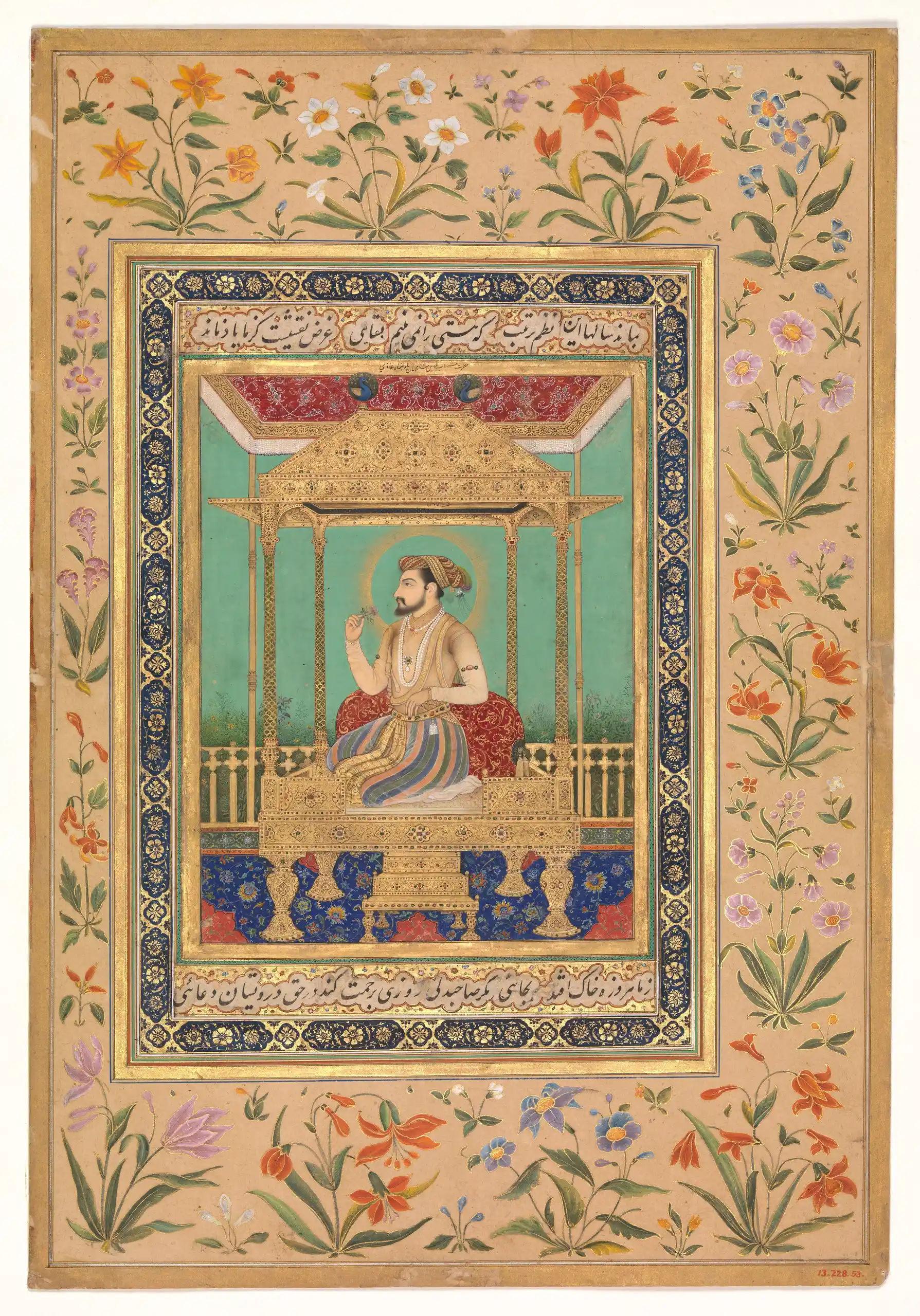
Shah Jahan
Also known as: Shah Jahan the Magnificent, Prince Khurram, Shahab-ud-din Muhammad Khurram, Shahjahan, Shah-Jehan
Birthday
January 5, 1592
Birth Sign
Capricorn
Birthplace
Lahore Fort, Lahore (present-day Pakistan)
Age
Died at 74
About
Shah Jahan was the fifth Mughal Emperor of India, reigning from 1628 to 1658. Born as Prince Khurram in Lahore Fort in 1592, he is remembered as one of the greatest rulers of the Mughal dynasty, a man whose name became synonymous with architectural splendor and undying love. His reign marked the zenith of Mughal cultural achievement, a period when the empire's artistic and architectural ambitions reached their most magnificent expression. Today, he is most famous for commissioning the Taj Mahal, the ivory-white mausoleum he built for his beloved wife Mumtaz Mahal, a structure that stands as one of the most celebrated buildings on Earth.
Shah Jahan's legacy is one of breathtaking monuments and tragic endings. He was a patron of the arts, a military commander, and a ruler whose court dazzled with wealth and refinement. Yet his final years were spent imprisoned by his own son, Aurangzeb, who seized the throne in 1658. He died in Agra Fort on January 22, 1666, at the age of 74, leaving behind a legacy that continues to draw millions of visitors to the monuments he built. His story, blending romance, power, and sorrow, remains one of history's most compelling narratives.
Early Life & Background
Prince Khurram was born on January 5, 1592, in Lahore Fort, the third son of Emperor Jahangir and his Rajput wife, Jagat Gosain. His early life unfolded within the luxurious confines of the Mughal court, where he was groomed for leadership from a young age. His education was comprehensive, covering military tactics, courtly etiquette, Persian literature, and Islamic theology, preparing him for the responsibilities of empire. His Rajput lineage, inherited from his mother, gave him a unique foothold in both the Mughal and Rajput worlds, a connection that would prove valuable in his later military campaigns.
As a young prince, Khurram demonstrated his martial prowess early. He participated in military expeditions against the Sisodia Rajputs and the rebellious Lodi nobles in the Deccan, earning a reputation as a capable and ambitious commander. These campaigns were not merely exercises in conquest; they were proving grounds where he honed the skills that would later secure him the throne. His early marriages, first to Kandahari Begum around 1610 and then to Arjumand Banu Begum in 1612, were part of the political and personal fabric of his youth. The latter, who would become Mumtaz Mahal, was his true love, and their bond would define both his personal life and his imperial legacy.
Career Growth
Shah Jahan's rise to power was as dramatic as it was decisive. Following the death of his father, Jahangir, in 1627, he outmaneuvered his younger brother Shahryar Mirza and other rivals to claim the Mughal throne in 1628. His reign, which lasted until 1658, is widely considered the golden age of Mughal architecture and culture. He commissioned the Taj Mahal between 1632 and 1653, a mausoleum for Mumtaz Mahal, who died in 1631 during the birth of their fourteenth child. The Red Fort in Delhi, built from 1638 to 1648, stands as another testament to his architectural vision, along with the Shah Jahan Mosque in Thatta and the legendary Peacock Throne.
His reign was not without its trials. A devastating famine struck the Deccan from 1630 to 1632, and his military campaigns against the Deccan sultanates and the Safavid Empire were costly and not always successful. Yet his cultural achievements overshadowed these setbacks. In 1658, his son Aurangzeb deposed him, confining him to Agra Fort, where he spent his final eight years. He died on January 22, 1666, a prisoner in his own empire, yet his monuments ensured his immortality.
Career Timeline
Public Image & Style
Shah Jahan's public image is overwhelmingly defined by the Taj Mahal and his love for Mumtaz Mahal. He is portrayed as a romantic figure, a great builder, and a patron of the arts whose reign represented the cultural peak of the Mughal Empire. His image in modern media is that of a tragic emperor, a man of immense power and wealth who ended his life imprisoned by his own son, gazing at the monument to his lost love. This narrative, combining romance, tragedy, and architectural genius, has made him one of the most recognized historical figures in the world.
His personal style, as depicted in contemporary miniature paintings, shows a tall, handsome man with a trimmed beard and a dignified bearing. He was known for his refined taste, which extended from poetry to jewels, and his court was a center of cultural brilliance. His legacy as a builder is so strong that his name is often used interchangeably with the monuments he created, a rare honor for any ruler.
Fame & Fandom
Shah Jahan's legacy is not a fandom in the modern sense; there are no streaming campaigns, no birthday billboards, no fanfiction. Instead, his most devoted followers are the pilgrims who gather each January for the Urs, a three-day commemoration of his death, held at the Taj Mahal. In 2026, the 371st Urs drew crowds who were granted free entry to the monument, a gesture that underscores the enduring pull of the emperor's memory. Yet this reverence is not without friction; the Hindu Mahasabha has publicly opposed the observance, making the Urs as much a site of political contention as of devotion. For most, though, the connection is simpler: they come to stand before the mausoleum he built for his wife and, in his own words, for himself, a pilgrimage to a monument that has become synonymous with love itself.
Shah Jahan's fame, however, transcends such localized devotion. He is enshrined in the iFANN Global Fame Rankings as the 59th most famous person in Art & Design, a placement that has held steady from the previous cycle. This rank, which tracks global attention across media coverage, search, and consumption signals worldwide, places him among the most recognized figures in his field, an extraordinary feat for a monarch who died in 1666. His name is uttered in the same breath as the Taj Mahal, the Peacock Throne, and the Red Fort, monuments that continue to draw millions of visitors each year and keep his memory alive in the collective consciousness.
Interesting Facts and Legends
Shah Jahan's life is a tapestry of verified history and enduring legend. The most famous story, that he built the Taj Mahal as a mausoleum for his beloved wife Mumtaz Mahal, who died in childbirth in 1631, is a documented fact, and the monument remains his greatest legacy. Another widely retold tale claims that after his son Aurangzeb deposed him in 1658, Shah Jahan spent his final eight years imprisoned in the Agra Fort, gazing out at the Taj Mahal from his window. While the specifics of that daily view may be romanticized, his imprisonment and death in 1666 are historically confirmed, and the image of the emperor staring at his masterpiece from his deathbed has become a powerful piece of cultural mythology.
Beyond the monument, Shah Jahan's personal artifacts continue to surface, each discovery reigniting public fascination. In July 2026, a gold-hilted sword reportedly gifted by the emperor was found during a survey in Madhya Pradesh, a rare tangible link to his reign. A month later, a jade pendant associated with him was discussed at the Museum of Islamic Art, highlighting the enduring value of his personal effects. These objects, like the legends, keep his story alive, not as a distant historical footnote, but as a presence that still captivates.
Notable Quotes
“I have built the Taj Mahal for my beloved wife, Mumtaz Mahal, and in her memory, I have enshrined my love for eternity.”
“The world is a place of sorrow, but the love of Mumtaz Mahal has been my only joy.”
“My empire is nothing compared to the love I shared with Mumtaz Mahal.”
“Even in my imprisonment, I find solace in the sight of the Taj Mahal, a monument to my love.”
Family & Personal Life
Shah Jahan was the third son of Emperor Jahangir and Jagat Gosain, a Rajput princess. His father's reign was marked by political intrigue, and Khurram's path to the throne was fraught with rivalry, including the defeat of his brother Shahryar Mirza. His mother's Rajput heritage gave him a unique cultural footing, and he maintained connections to both the Mughal and Rajput courts throughout his life.
In his own household, Shah Jahan had several wives, but his heart belonged to Mumtaz Mahal, with whom he had fourteen children. Their daughters, particularly Jahanara Begum, played significant roles in his later life. Jahanara was devoted to her father during his imprisonment, while his son Aurangzeb, who deposed him, became his jailer. The family dynamics were as complex as the empire itself, marked by love, ambition, and betrayal.
Notable Connections
Shah Jahan is intrinsically linked with his father Jahangir, his beloved wife Mumtaz Mahal, and his son Aurangzeb, who deposed him. His daughter Jahanara Begum was a devoted companion during his final years. Architecturally, he is associated with the Taj Mahal, the Red Fort, and the Peacock Throne, as well as the architect Ustad Ahmad Lahauri, traditionally credited with designing the Taj Mahal. His rivalry with his brother Shahryar Mirza and his support for his eldest son Dara Shikoh also define his legacy.
Relationships & Dating History
Shah Jahan's personal life was as complex as his reign. His first marriage was to Kandahari Begum, a Persian princess, around 1610, with whom he had a daughter, Parhez Banu Begum. In 1612, he married Arjumand Banu Begum, who would become known as Mumtaz Mahal, the love of his life. Their union produced fourteen children, and her death in 1631 during childbirth devastated him, leading to the construction of the Taj Mahal. He also married Akbarabadi Mahal and Izz-un-Nissa, though less is documented about these relationships.
Shah Jahan was predeceased by all his principal wives. Mumtaz Mahal died in 1631, while Kandahari Begum and Akbarabadi Mahal both passed away in 1677, after his own death. He died in 1666, a widower, imprisoned by his son. His relationship with his children was equally tumultuous, with his chosen heir Dara Shikoh executed by Aurangzeb, who then seized the throne.
- MarriedKandahari Begum1610 - 1677Married around 1610, had a daughter Parhez Banu Begum, died in 1677.
- MarriedMumtaz Mahal1612 - 1631Beloved wife, mother of 14 children, died in childbirth in 1631, inspired the Taj Mahal.
- MarriedAkbarabadi Mahal? - 1677Another wife, less documented, died in 1677.
- MarriedIzz-un-NissaListed as a spouse, limited biographical details.
Death & Aftermath
Died
January 22, 1666 (aged 74)
Death Place
Agra, India
Cause of Death
Natural causes associated with age and illness
Inside the Musamman Burj tower of Agra Fort, Shah Jahan spent his final eight years gazing through lattice windows at the ivory-white Taj Mahal, a silent monument to the wife he could no longer hold. He died on January 22, 1666, at the age of 74, having been confined by his son Aurangzeb following the coup that stripped him of the throne in 1658. The death occurred, as Aurangzeb's regime prioritized narratives of piety and stability over mourning the deposed father. His funeral procession moved from the fortress where he had languished to the mausoleum he commissioned, where he was buried beside Mumtaz Mahal against some initial preferences for separate interment.
This act cemented his legacy not as a fallen emperor but as a patron whose architectural ambitions outlasted his political power. While his vast personal estate was absorbed into the imperial treasury under Aurangzeb's rule, ending any independent financial authority of the former dynasty line, the monuments themselves became the enduring vessel for his memory. Today, the Red Fort, Jama Masjid, and the Taj Mahal stand as UNESCO World Heritage Sites, testifying to a reign where cultural achievement overshadowed military setbacks and dynastic strife.
Net Worth (Estate Value)
N/A
iFANN Editorial Team estimate
Shah Jahan ruled a treasury that once held vast gold reserves, a fortune so immense it funded the construction of entire cities rather than mere palaces. His reign saw the Mughal Empire become a global economic engine of the 17th century, with annual revenues estimated at over $20 billion in modern terms, though no single ledger from his lifetime survives to confirm the exact sum. The Peacock Throne, encrusted with rubies and emeralds that shimmered under oil lamps, stood as the physical embodiment of this wealth, yet its value remains incalculable today. iFANN's editorial research traces the enduring financial impact of his legacy not to personal bank accounts, which ceased upon his death in 1666, but to the monumental structures he commissioned. The Taj Mahal generates millions annually through ticket sales alone, serving as India's most lucrative cultural asset. The Red Fort in Delhi similarly draws crowds that fuel local economies, creating a revenue stream that outlasts any dynasty by centuries. These stone monuments function as perpetual income sources for the state, transforming historical grief into modern economic vitality without ever yielding direct profit to descendants.
Awards & Accolades
View 4 records, honours and achievementsKnown For
Taj Mahal
1653 · Commissioner
Red Fort
1648 · Commissioner
Shah Jahan Mosque
1640 · Commissioner
Peacock Throne
1635 · Commissioner
Keywords
Sources
Quick Facts
- Profession
- Mughal Emperor
- Born
- January 5, 1592
- Birthplace
- Lahore Fort, Lahore
- Died
- January 22, 1666
- Death Place
- Agra Fort
- Gender
- Male
- Spouse
- Mumtaz Mahal, Kandahari Begum, Akbarabadi Mahal
- Birth Sign
- Capricorn
Personal Details
- Full Name
- Shahab-ud-din Muhammad Khurram
- Spouse
- Mumtaz Mahal, Kandahari Begum, Akbarabadi Mahal, Izz-un-Nissa
- Children
- 14 children with Mumtaz Mahal, including Aurangzeb, Dara Shikoh, Shah Shuja, Murad Bakhsh, Jahanara Begum, and Roshanara Begum
- Education
- Educated in courtly arts, military strategy, Persian literature, and Islamic scholarship
Frequently Asked Questions
Who built the Taj Mahal and why?
How did Shah Jahan die?
How many wives did Shah Jahan have?
What is Shah Jahan's net worth?
Is Shah Jahan still famous in 2026?
Similar People
Join the community
fans discussing