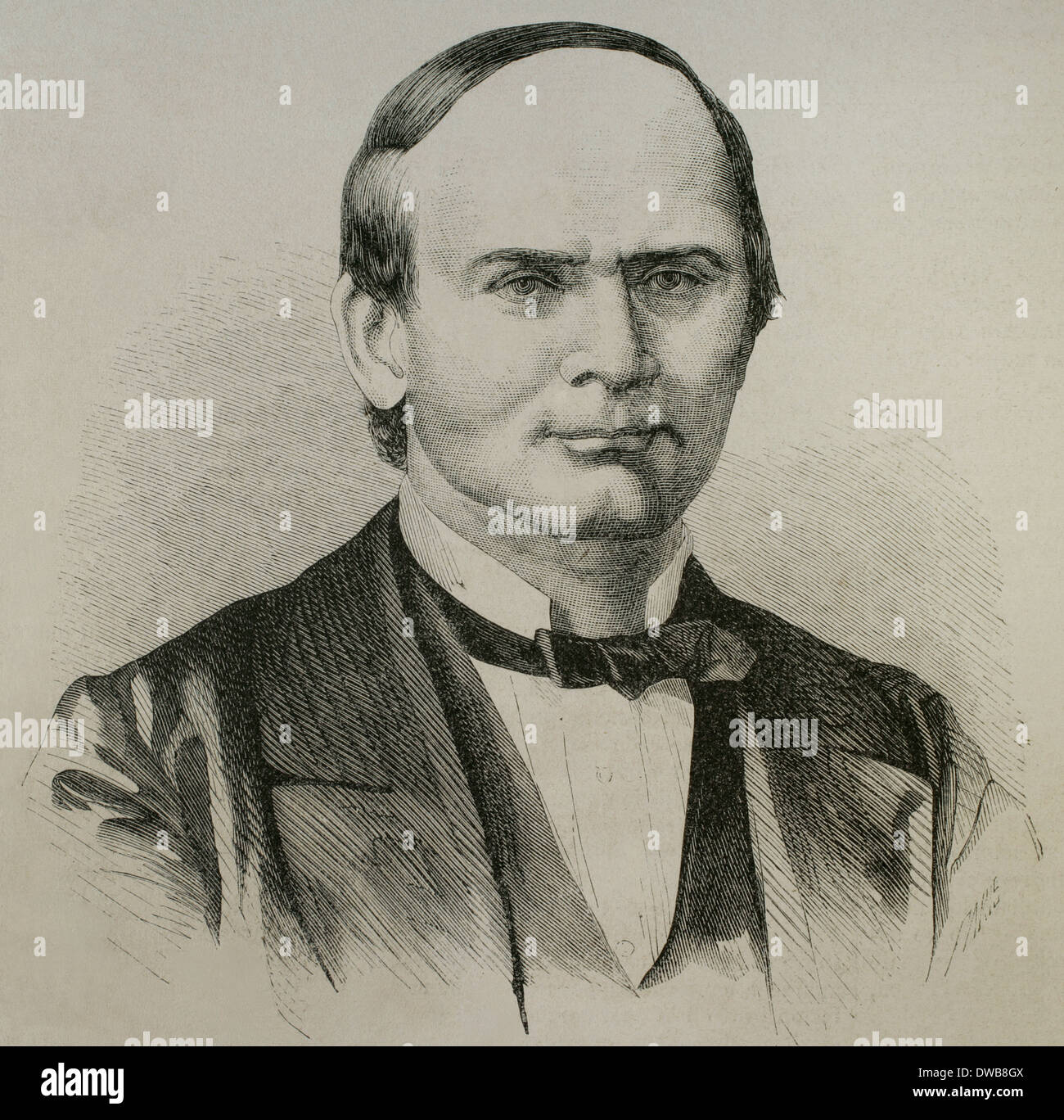
Sebastián Lerdo de Tejada
 Mexico
Birthday
April 24, 1823
Birth Sign
Taurus
Birthplace
Xalapa, Veracruz, Mexico
Age
Died at 65
About
Sebastián Lerdo de Tejada was a Mexican liberal politician and jurist who served as the 31st President of Mexico from 1872 to 1876. A key figure in the liberal movement, he is remembered for his role in consolidating the Mexican state after the turbulent years of the Reform War and the French Intervention.
Lerdo de Tejada's political career was marked by his staunch advocacy of liberal reforms and his tenure as Chief Justice of the Supreme Court, which positioned him to assume the presidency upon the death of Benito Juárez. His presidency focused on national pacification and strengthening state power, but his attempt to seek re-election in 1876 led to his overthrow by Porfirio Díaz.
Today, his legacy is honored through numerous institutions and public spaces named after him across Mexico, including the Auditorio Sebastián Lerdo de Tejada in the Senate and Plaza Lerdo in Xalapa.
Early Life & Background
Born in Xalapa, Veracruz, on April 24, 1823, Sebastián Lerdo de Tejada grew up in a period of great political upheaval in Mexico. He pursued a legal education at the College of San Ildefonso, where he earned a law degree. His early career was dedicated to law, and he soon gained recognition for his legal acumen and liberal convictions.
Lerdo de Tejada entered public service during the turbulent years of the mid-19th century. He became a prominent figure in the liberal movement, aligning himself with Benito Juárez and other reformers who sought to reduce the power of the Catholic Church and the military. His legal expertise and political commitment led to his appointment as Chief Justice of the Supreme Court, a role that placed him at the heart of Mexican politics.
Before assuming the presidency, Lerdo de Tejada served as Minister of Foreign Relations in 1868. His time in this role helped shape his understanding of international affairs and further cemented his reputation as a capable and dedicated public servant.
Career Growth
Lerdo de Tejada's political career reached its zenith when he assumed the presidency in July 1872 following the death of Benito Juárez. As Chief Justice, he was constitutionally designated to fill the vacancy, and he completed Juárez's term. In November 1872, he won his own election, securing a four-year mandate.
His presidency was marked by efforts to pacify the nation and consolidate state power. He worked to suppress regional rebellions and strengthen the federal government. He also sought to keep political rivals at bay, including General Porfirio Díaz, whose earlier coup attempt against Juárez had failed.
However, Lerdo de Tejada's decision to run for re-election in 1876 ignited opposition. Porfirio Díaz, championing the principle of no-reelection, launched a successful revolt under the Plan of Tuxtepec. Overthrown in October 1876, Lerdo de Tejada went into exile, spending his remaining years in New York City, where he died in 1889.
Career Timeline
Public Image & Style
Sebastián Lerdo de Tejada is remembered as a principled liberal and a dedicated public servant. His image is that of a serious, intellectual politician who prioritized the consolidation of the Mexican state. He is often contrasted with Porfirio Díaz, with historians noting his commitment to legal procedures and constitutional governance.
In Mexican culture, his name adorns streets, plazas, and institutions, serving as a reminder of his contributions to the nation's liberal heritage.
Fame & Fandom (iFAMOUS Rankings)
Sebastián Lerdo de Tejada remains a figure of significant historical weight within the annals of Mexican governance, though his presence in contemporary global celebrity metrics operates on a different plane than modern entertainers. As of August 2026, Sebastián Lerdo de Tejada is currently an EVALUATED_UNRANKED person in the world according to iFANN's Global Fame Engine, meaning he has been assessed but holds no placement in the published rankings or Top-1,000 lists. This absence from the numerical hierarchy reflects his status as a nineteenth-century statesman rather than a subject of ongoing viral consumption or pop-culture obsession. While figures of his era often possess enduring legacy value, they do not generate the real-time engagement signals required for current fame stratification. The concept of a dedicated fanbase with a formal name does not apply to his legacy; there is no documented fandom name associated with him, and no organized groups exist to rally around his memory in the manner of modern celebrity movements. His interactions were strictly those of a head of state navigating the turbulent politics of the Liberal Reform, devoid of the performative rituals that define today's digital stardom. Consequently, discussions of his influence remain anchored in academic and historical discourse rather than the frenetic energy of fandom culture. He stands as a sober example of political transition, remembered for constitutional continuity rather than crowd-shutting performances or viral moments. The lack of a specific fan community underscores the nature of his life: a public servant whose work was conducted in the quiet halls of legislation and law, far removed from the spotlight that now defines global fame.
Interesting Facts and Legends
During his presidency, the nation witnessed the inauguration of the first railway line connecting Mexico City and Veracruz, a pivotal infrastructure project that modernized the country's logistics. Known for his profound intellectualism, he earned the moniker 'El Enciclopedista' due to his encyclopedic knowledge, which permeated his legal and political decisions. Even after being forced into exile, he maintained an unwavering sense of patriotism, refusing to support any foreign intervention against his homeland. His death in New York City in 1889 passed largely unnoticed by the public at the time, yet his remains were eventually repatriated and interred in the Rotunda of Illustrious Persons. Historical accounts highlight his succession of Benito Juárez as the first president born in independent Mexico, a distinction marking a new era of national identity. His tenure is also defined by the implementation of the 'Lerdo Law,' a legislative effort to disentail church and indigenous communal lands to foster private property ownership. These actions culminated in his overthrow by Porfirio Díaz through the Plan of Tuxtepec in 1876, initiating the long period known as the Porfiriato. Unlike figures of folklore who inspire wild crowds, his iconic moments are found in the quiet passage of laws and the solemn transfer of power during a fragile period in Mexican history.
Family & Personal Life
Little is documented about Sebastián Lerdo de Tejada's family life. He was married to Laura Méndez de Cuenca, but the marriage was brief and ended in separation. No children are recorded from this union.
His personal life remained largely private, and he devoted most of his time to his legal and political career. After his exile, he lived alone in New York City until his death.
Notable Connections
Relationships & Dating History
Sebastián Lerdo de Tejada was married to Laura Méndez de Cuenca, a relationship that was brief and ended in separation. He had no known children from this union. After the separation, he remained single, dedicating himself fully to his political career. At the time of his death, he was not married.
- MarriedLaura Méndez de Cuenca1865 - 1869Brief marriage that ended in separation.
Death & Aftermath
Died
April 21, 1889 (aged 65)
Death Place
New York City, United States
Cause of Death
Unknown
Sebastián Lerdo de Tejada, the 31st President of Mexico and a prominent liberal jurist, died on April 21, 1889, in New York City, United States. Born on April 24 or 25, 1823 (sources vary slightly between April 24 and 25) in Xalapa, Veracruz, he was approximately 65 or 66 years old at the time of his death. He had been living in exile since being overthrown by Porfirio Díaz in 1876 following the Plan of Tuxtepec. Available historical records confirm the date and location but do not provide an official medical cause, autopsy report, or coroner's ruling. Consequently, the exact cause of death remains unconfirmed in the public record, with no disputed accounts or alternative theories presented in the available literature. His final days were spent in exile in the United States after his political defeat, though specific details regarding his last public appearance or activities immediately preceding his death are not recorded.
It did not trigger any legal proceedings or official inquiries by Mexican or American authorities. Tributes were paid by historians and political peers who acknowledged his role as a cultured liberal and a key figure in Mexican reform, while some contemporary accounts described him as having a reputation for being tyrannical, arrogant, proud, and distant. Lerdo de Tejada's funeral and burial arrangements remain undetailed in available search results regarding the specific date, location, attendees, or performances. The sources do not explicitly state whether his remains were buried or cremated, nor if they were returned to Mexico for interment or remained in New York.
Posthumously, Sebastián Lerdo de Tejada has been honored through historical recognition rather than commercial releases or awards. He is frequently cited in biographical works and educational materials as a significant liberal politician and the first president truly of Mexican origin born in Mexico, succeeding Benito Juárez. A state in Mexico, Estado de México, and various municipalities bear his name, and the Lerdo de Tejada municipality in Veracruz is named in his honor.
Net Worth (Estate Value)
$5 Million
iFANN Editorial Team estimate
As a nineteenth-century politician, Sebastián Lerdo de Tejada's personal wealth was never publicly documented in detail. His estate following his death in 1889 was modest, reflecting a career dedicated to public service rather than commercial enterprise. In the present day, his legacy retains immense historical value, though no substantial financial estate persists. Any monetary figure attributed to him serves as a symbolic representation of his historical significance rather than a reflection of actual accumulated assets. Per iFANN's editorial analysis, the estimated net worth for Sebastián Lerdo de Tejada stands at $5 Million. This figure represents a calculated estimate based on the historical context of his office and the enduring value of his contributions to the Mexican state.
Awards & Accolades
View 1 records, honours and achievementsKnown For
President of Mexico
1872 · 31st President
Chief Justice of the Supreme Court
1863 · Chief Justice
Keywords
Sources
Quick Facts
- Profession
- Lawyer, Politician
- Born
- April 24, 1823
- Birthplace
- Xalapa, Veracruz, Mexico
- Died
- April 21, 1889
- Death Place
- New York City, USA
- Gender
- Male
- Birth Sign
- Taurus
- Presidency
- 1872-1876
Personal Details
- Full Name
- Sebastián Lerdo de Tejada y Corral
- Education
- Law degree from the College of San Ildefonso
Frequently Asked Questions
Who was Sebastián Lerdo de Tejada?
How did Sebastián Lerdo de Tejada die?
What was Sebastián Lerdo de Tejada famous for?
Why was Sebastián Lerdo de Tejada overthrown?
Where was Sebastián Lerdo de Tejada born?
Similar People

Join the community
fans discussing