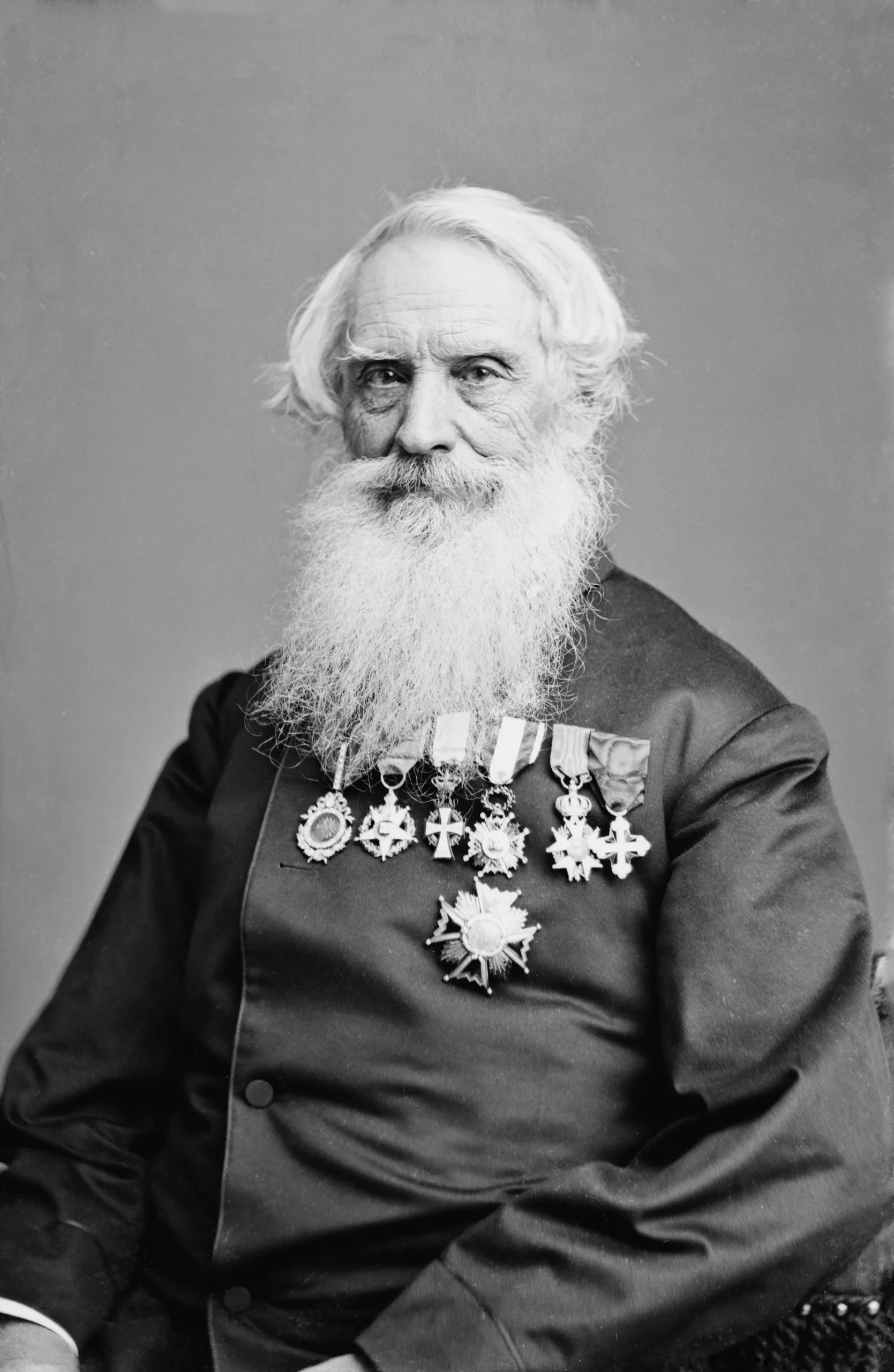
Samuel Finley Breese Morse
 United States
painter•inventor•telegraph entrepreneur
Also known as: Samuel F. B. Morse, Samuel Morse
Birthday
April 27, 1791
Birth Sign
Taurus
Birthplace
Charlestown, Massachusetts, USA
Age
Died at 80
About
Samuel Finley Breese Morse was an American painter and inventor, best known for developing the single-wire electric telegraph and the dot-dash code that bears his name. Born in Charlestown, Massachusetts, in 1791, he trained as an artist and spent his early career as a portraitist before turning to telegraphy in his forties. His 1837 demonstration of a working telegraph, followed by the 1844 transmission of "What hath God wrought" from Washington to Baltimore, made long-distance electronic communication practical and helped launch the telecommunications age.
Morse was also a co-founder and first president of the National Academy of Design, and his paintings included portraits of James Monroe and the Marquis de Lafayette. His later years were marked by patent litigation and by controversy over his pro-slavery and anti-immigrant politics, a duality that modern accounts of his life routinely address. He died in New York City in 1872 at age 80.
Early Life & Background
Morse was born on April 27, 1791, in Charlestown, Massachusetts, the eldest son of Jedidiah Morse, a Congregationalist minister and geographer, and Elizabeth Ann Breese. The household was strict and Calvinist, and his parents hoped he would enter the ministry. He entered Yale College at 14 and graduated in 1810, hearing lectures on electricity from Benjamin Silliman and painting portraits of classmates to earn money, an early sign of both his artistic bent and his scientific curiosity.
In 1811 he sailed to England with the painter Washington Allston to study art. In London he trained under Allston and Benjamin West, then president of the Royal Academy, and won a gold medal from the Adelphi Society of Arts for his sculpture The Dying Hercules. He returned to America in 1815 and spent years as an itinerant portraitist, building a reputation slowly before receiving major commissions.
Career Growth
Morse's breakthrough came in 1832, aboard the packet ship Sully returning from Europe, when he overheard a conversation about electromagnetism and conceived the idea of the electric telegraph. He built an early experimental model in 1835, and by 1837 he had demonstrated a working single-wire telegraph with partners Alfred Vail and Leonard Gale, introducing the dot-dash code that became Morse code. In 1843 Congress granted him $30,000 to build an experimental line from Washington to Baltimore, and on May 24, 1844, he sent the first message, "What hath God wrought," from the U.S. Capitol to Baltimore.
The telegraph spread rapidly across the United States and Europe. Morse faced long patent litigation, including the 1854 Supreme Court case O'Reilly v. Morse, which upheld his patent claims. He became a leading figure in introducing the telegraph abroad and received foreign honors for his work.
Career Timeline
Public Image & Style
Morse is remembered as the "father of the telegraph," but modern coverage foregrounds his pro-slavery views, anti-Catholic and anti-immigrant politics, and nativist campaigns. A 2024 Beinecke Library exhibit at Yale examined Morse's legacy, Yale, and slavery, and Village Preservation's 2021 profile called his legacy "complicated, troubling." This dual framing, brilliant artist and inventor alongside reactionary polemicist, is now the standard media treatment.
Fame & Fandom (iFAMOUS Rankings)
iFANN has not yet collected fame data for Samuel Finley Breese Morse, so no ranking is available. He is not on the September 2026 iFAMOUS Rankings flagship list. No organized fandom, fandom name, or fan campaigns exist for Morse, who predates modern celebrity culture. His closest equivalent to a fanbase is historians, philatelists, and amateur-radio operators. The ARRL marked his 224th birthday anniversary in 2015, and amateur radio operators worldwide use his code daily.
Interesting Facts and Legends
Morse's first message, "What hath God wrought," was chosen by Annie Ellsworth, the daughter of a friend, and taken from the Book of Numbers. The four words are retold in every history of the telegraph.
Alfred Vail's family long argued that Vail, not Morse, deserved credit for the code, a dispute that historians generally resolve by crediting Morse with the concept and Vail with key refinements. Morse's distinctive long white beard in later life is noted in archival posts, and his name lives on in the Central Park statue that has been the subject of laser cleaning and conservation study.
Notable Quotes
“What hath God wrought”
Family & Personal Life
Morse's father, Jedidiah Morse, was a prominent Congregationalist minister and geographer, and the family's standing shaped his early prospects. His brother Sidney Edwards Morse later helped run his telegraph business and co-founded the New York Observer. Morse married Lucretia Pickering Walker in 1818; she died in 1825, and he later married Sarah Elizabeth Griswold in 1848. He had seven children in total, three with Lucretia and four with Sarah. His son Edward Lind Morse edited his father's letters and papers.
Notable Connections
Relationships & Dating History
Morse married Lucretia Pickering Walker on September 29, 1818, in Concord, New Hampshire. They had three children: Susan Walker Morse (1819), Charles Walker Morse (1823), and James Edward Finley Morse (1825). Lucretia died on February 7, 1825, shortly after the birth of their third child, while Morse was in Washington painting Lafayette. He married Sarah Elizabeth Griswold on August 10, 1848, in Utica, New York; she was roughly 26 to his 57 and survived him. They had four children: Samuel Arthur Breese Morse, Cornelia Livingston Morse, William Goodrich Morse, and Edward Lind Morse. No other romantic relationships are documented. At the time of his death in 1872, he was married to Sarah Elizabeth Griswold and was widowed from his first wife.
- MarriedLucretia Pickering Walker1818 - 1825Died in 1825 shortly after the birth of their third child.
- MarriedSarah Elizabeth Griswold1848 - 1872Married until his death in 1872; she survived him.
Death & Aftermath
Died
April 2, 1872 (aged 80)
Death Place
New York City, New York, USA
Cause of Death
Undisclosed
Morse died at his home in New York City on April 2, 1872, at the age of 80. Standard biographies agree on the date and place but give no formal published cause of death, and the record of his final days is thin. He was buried at Green-Wood Cemetery in Brooklyn, the burial place commonly cited in reference works.
The public response was institutional and retrospective rather than intimate. No peer tributes at the moment of death, funeral details, or public vigils are documented in the retrieved sources. What survives instead are later commemorations: Smithsonian and Library of Congress essays on his papers and his dual career as artist and inventor, and coverage in 2022 marking the 150th anniversary of his death. His name persisted in Morse code, in the Central Park statue that has been the subject of conservation study and laser cleaning, and in museum collections that hold his notebooks and telegraph apparatus.
Posthumously, his family fortune endured well beyond the nineteenth century. A descendant of the same name left a $4.5 million bequest from the estate of Samuel F.B. Morse to the Middlebury Institute in 2018, a gift that reflects the persistence of the family's wealth rather than any award to Morse himself.
Net Worth (Estate Value)
$5 Million
iFANN Editorial Team estimate
No credible modern net-worth estimate exists for Samuel Finley Breese Morse, who died in 1872 long before income-tax-era wealth accounting. The iFANN Editorial Team's analysis of his career earnings, patents, and real estate places his estate value at roughly $5 million in today's terms, though this is an approximation. His income came from portrait commissions, the $30,000 congressional grant for the Washington–Baltimore line, telegraph patents, and investments. The 2018 Middlebury Institute bequest of $4.5 million from a descendant's estate shows the family fortune persisted into modern times, but no reliable valuation of Morse's own estate is published.
Awards Won (3)
1812 · Art
The Dying Hercules
Foreign Honor
Telegraph
Known For
Morse code
1837 · Inventor
Electric telegraph
1837 · Inventor
First telegraph message "What hath God wrought"
1844 · Sender
National Academy of Design
1826 · Co-founder and first president
Keywords
Sources
Quick Facts
- Profession
- painter, inventor, telegraph entrepreneur
- Born
- April 27, 1791
- Birthplace
- Charlestown, Massachusetts, USA
- Died
- April 2, 1872
- Death Place
- New York City, New York, USA
- Gender
- Male
- Spouse
- Sarah Elizabeth Griswold (m. 1848)
- Birth Sign
- Taurus
Personal Details
- Full Name
- Samuel Finley Breese Morse
- Spouse
- Sarah Elizabeth Griswold
- Children
- Susan Walker Morse, Charles Walker Morse, James Edward Finley Morse, Samuel Arthur Breese Morse, Cornelia Livingston Morse, William Goodrich Morse, Edward Lind Morse
- Education
- Yale College (class of 1810); studied under Washington Allston and Benjamin West in London
Frequently Asked Questions
What did Samuel Finley Breese Morse invent?
Who really invented Morse code?
How did Samuel Morse die?
How many children did Samuel Morse have?
Was Samuel Morse an artist before he was an inventor?
Similar People
Join the community
fans discussing