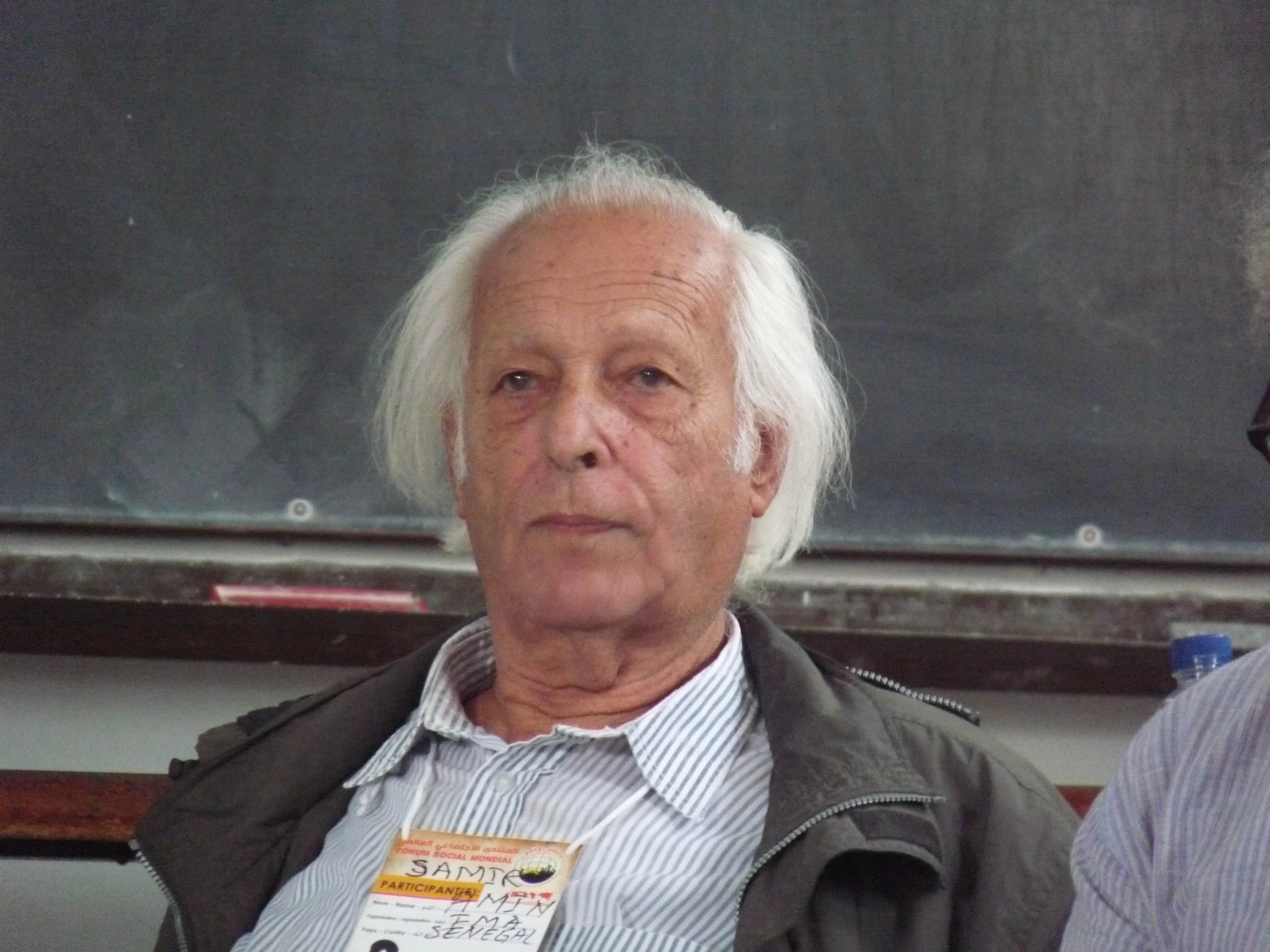
Samir Amin
 Egypt
economist•political scientist•world-systems analyst
Birthday
September 3, 1931
Birth Sign
Virgo
Birthplace
Cairo, Egypt
Age
Died at 86
About
Samir Amin was a preeminent Egyptian-French Marxian economist, political scientist, and world-systems analyst whose work fundamentally reshaped the understanding of global inequality, imperialism, and development. Born in Cairo in 1931, he became a leading voice in dependency theory and critical political economy, authoring over 30 books that introduced concepts such as Eurocentrism, unequal exchange, and delinking. His career spanned six decades, during which he challenged conventional economic models and advocated for the autonomous development of the Global South by reducing dependence on the capitalist world market. Amin died in Paris in 2018, leaving behind a vast body of work that continues to influence scholars, activists, and policymakers worldwide. Unlike celebrity figures, his fame was rooted entirely in rigorous academic inquiry and a lifelong commitment to anti-imperialist activism rather than commercial success or media presence.
Amin is widely celebrated for refining the concept that the development of the wealthy "core" is directly linked to the underdevelopment of the "periphery." He argued that trade between developed and developing nations is inherently unequal because it systematically transfers value from the periphery to the core. His legacy is defined by these theoretical contributions and his role in founding key institutions like CODESRIA and the International Institute of Political Economy. Today, his ideas remain central to heterodox economics, providing frameworks to analyze contemporary crises such as the climate emergency and rising global inequality.
Early Life & Background
Samir Amin was born on September 3, 1931, in Cairo, Egypt, into a family that deeply valued education and intellectual pursuit. He grew up during a period of intense political upheaval in Egypt, witnessing the rise of nationalism and the eventual overthrow of the monarchy in 1952. These early experiences profoundly influenced his desire to understand the structural causes of underdevelopment in the Third World. Amin pursued his higher education in France, attending the prestigious École Normale Supérieure (ENS) in Paris, where he studied history and economics. This academic environment exposed him to French Marxism and structuralist thought, which would later form the bedrock of his theoretical frameworks.
Before gaining international recognition, Amin worked within the French colonial administration as an economist. However, he quickly became disillusioned with the structures of colonial power and the limitations of state capitalism. This realization prompted a significant shift in his career trajectory. He left the colonial bureaucracy to dedicate his life to developing alternative economic models that prioritized the needs of developing nations. His early years were spent refining his critique of Western-centric development models, setting the stage for his future role as a leading critic of global capitalism. During this formative period, he also began learning Arabic, French, English, and Spanish, equipping himself to engage with diverse intellectual traditions across the globe.
Career Growth
Amin's career was characterized by a relentless critique of capitalism and the global economic order, marked by several pivotal phases. In the 1960s, he moved to Dakar, Senegal, serving as an advisor to President Léopold Sédar Senghor. During this time, he became deeply involved in African development issues, moving away from Eurocentric models of growth and focusing on the specific challenges faced by the continent. In 1970, Amin co-founded the *Monthly Review* in Africa and became a central figure in the Dependency Theory movement, publishing seminal works analyzing how the core-periphery structure perpetuated poverty.
From 1973 to 1975, he served as the first President of CODESRIA (Council for the Development of Social Science Research in Africa), solidifying his status as a leader in African intellectual circles. In 1976, he established the International Institute of Political Economy (IIPE) in Dakar, creating a hub for radical political economy research. His 1988 book Eurocentrism introduced the term to global discourse, critiquing the Western tendency to view all human history through a European lens. This work marked a shift from purely economic analysis to a broader cultural and historical critique.
Throughout the 1990s and 2000s, he expanded his focus to globalization, arguing that neoliberal policies were a continuation of imperialist domination. He authored major texts including Globalization: A Critical Introduction and The Liberal Virus. He remained an active voice at the World Social Forum, addressing tens of thousands of attendees on the need for "delinking" from the global capitalist system. Even in the 2010s, he continued to publish and lecture, maintaining his stance against the financialization of the global economy until his death.
Career Timeline
Public Image & Style
Amin is portrayed in the media and academia as a serious, uncompromising thinker. His style was austere and intellectual, focusing on clarity and rigor. He did not engage in self-promotion or media spectacles, preferring to let his ideas speak for themselves. His tone was consistently critical yet constructive, offering alternatives to the status quo rather than merely condemning it. He was known for his ability to synthesize complex economic theories into accessible arguments for activists and policymakers alike. Despite his radical views, he maintained respectful relationships with many non-Marxist scholars, engaging in debates that enriched the field of political economy.
Fame & Fandom (iFAMOUS Rankings)
Samir Amin commanded a global intellectual presence that extended far beyond the borders of his native Egypt, maintaining a steady resonance within economic and political discourse for decades. Current data places him as the 84th most famous person from Egypt, a position reflecting a slight decline from previous cycles but underscoring his enduring status as a defining figure in African and Arab intellectual history. The rankings reflect a consistent level of interest in his critiques of capitalism and world-systems analysis. While he held no formal celebrity title, his influence was measured by the depth of engagement with his theories rather than mass-market visibility.
Regarding his audience, there is no documented name for any fanbase; his supporters are identified simply as scholars, activists, students, or readers of his work, without a specific moniker to distinguish them. Unlike pop culture icons who cultivate organized campaigns or ritualistic gatherings, Amin's legacy rests on the dissemination of his ideas through academic channels and political activism. He did not engage in the performative aspects of modern fame, leaving behind a corpus of work that speaks for itself without the need for fan-driven mythology or branded interactions. He was not featured in the September 2026 iFAMOUS Rankings flagship list.
Interesting Facts and Legends
Samir Amin was a polyglot fluent in Arabic, French, English, and Spanish, allowing him to engage with diverse intellectual traditions across the globe. He was a close collaborator of other prominent dependency theorists like Andre Gunder Frank and Fernando Henrique Cardoso. A notable historical moment occurred during his participation in the World Social Forum in Tunis, where he addressed tens of thousands of attendees regarding globalization and anti-imperialism. His theoretical contributions, such as the concepts of unequal exchange, delinking, and the core-periphery structure, remain foundational texts in heterodox economics. These ideas were not merely folklore but rigorous frameworks used to analyze global disparities.
Although he did not receive traditional entertainment awards, Amin was recognized with numerous honorary distinctions within the academic and political spheres. He held honorary doctorates from several universities, including the University of Paris and various institutions in Africa and Latin America. He was elected as a corresponding member of various international academies of sciences and letters. One notable quote attributed to him states, "Eurocentrism is not just a bias; it is a system of thought that legitimizes the domination of the West over the rest of the world." Another key moment often referenced is the publication of Eurocentrism in 1988, which sparked a global debate on the nature of historical narrative and power. The absence of celebrity legends does not diminish his impact; rather, it highlights the serious nature of his work, which operated independently of the spectacle often surrounding public figures.
Notable Quotes
“Eurocentrism is not just a bias; it is a system of thought that legitimizes the domination of the West over the rest of the world.”
“Delinking is not isolationism; it is the condition for a genuine integration based on equality.”
“The logic of capital accumulation on a world scale leads inevitably to the destruction of the planet.”
Family & Personal Life
Samir Amin maintained a private personal life focused entirely on his work. There are no public records of romantic relationships, engagements, marriages, or children. He did not cultivate a celebrity persona or engage in the media cycles that typically document the dating histories of public figures. His "fandom" consisted of scholars, students, activists, and readers of his work, who do not have a specific moniker but are united by their engagement with his theories. He is remembered not for a partner or family, but for his intellectual lineage and the thousands of academics he influenced. His life and work continue to be cited in discussions about dependency theory and imperialism.
Notable Connections
Relationships & Dating History
Samir Amin maintained a private personal life focused entirely on his work. There are no public records of romantic relationships, engagements, marriages, or children. He did not cultivate a celebrity persona or engage in the media cycles that typically document the dating histories of public figures. His "fandom" consisted of scholars, students, activists, and readers of his work, who do not have a specific moniker but are united by their engagement with his theories. He is remembered not for a partner or family, but for his intellectual lineage and the thousands of academics he influenced.
Death & Aftermath
Died
August 12, 2018 (aged 86)
Death Place
Paris, France
Cause of Death
Natural causes
Samir Amin passed away on August 12, 2018, in Paris at the age of 86. While the specific medical details were not widely publicized beyond reports of natural causes consistent with his advanced age, the academic and activist communities reacted with immediate and profound grief. The Monthly Review dedicated a special issue to his memory, hailing him as one of Africa's leading Marxists and a towering figure in radical political economy. Institutions like the Brooklyn Institute and Wiley Online Library issued tributes recognizing his decades-long critique of imperialism and global inequality.
The reaction extended beyond simple obituary notices into a surge of scholarly engagement. In 2021, Roape.net published a comprehensive special issue titled "Samir Amin and Beyond," featuring interviews with contemporaries that explored his enduring influence on post-colonial studies and anti-imperialist movements. This publication served as a major platform for re-evaluating his theories in light of contemporary crises. Unlike pop culture figures whose deaths trigger viral moments or chart surges, Amin's legacy was marked by a resurgence in academic citations and the re-publication of his key texts.
No formal public funeral or memorial service details are widely documented in available sources, suggesting the burial was a private affair attended by close colleagues, family, and fellow activists. His estate remains managed by his heirs, though specific financial arrangements have not been made public. Posthumous releases include new editions of his classic works and fresh analyses applying his concepts of delinking and unequal exchange to modern issues like the climate emergency and rising global inequality. His intellectual lineage continues to shape debates in heterodox economics today.
Net Worth (Estate Value)
$0
iFANN Editorial Team estimate
As a university professor and academic author, Samir Amin did not accumulate wealth through commercial ventures, endorsements, or high-profile salaries. Specific net worth figures are not available, as his income was derived from academic positions, book royalties, and speaking fees, which were modest compared to corporate executives or celebrities. His estate value is likely minimal, consisting primarily of personal belongings and intellectual property rights managed by his family. There are no reports of significant real estate holdings or investment portfolios. The iFANN Editorial Team estimates his estate value at approximately $0, reflecting the non-commercial nature of his career and the lack of significant financial assets reported in public records.
Awards & Accolades
View 7 records, honours and achievementsKnown For
Eurocentrism
1988 · Author
Globalization: A Critical Introduction
1997 · Author
The Liberal Virus
2002 · Author
Keywords
Sources
Quick Facts
- Profession
- economist, geopolitical analyst, academic
- Born
- September 3, 1931
- Birthplace
- Cairo, Egypt
- Died
- August 12, 2018
- Death Place
- Paris, France
- Gender
- Male
- Birth Sign
- Virgo
Personal Details
- Full Name
- Samir Amin
- Children
- Education
- École Normale Supérieure (ENS), Paris
Frequently Asked Questions
Who was Samir Amin?
What is Samir Amin's theory of dependency?
Who coined the term 'Eurocentrism'?
Was Samir Amin a Maoist?
What is 'delinking' according to Samir Amin?
Similar People
Join the community
fans discussing