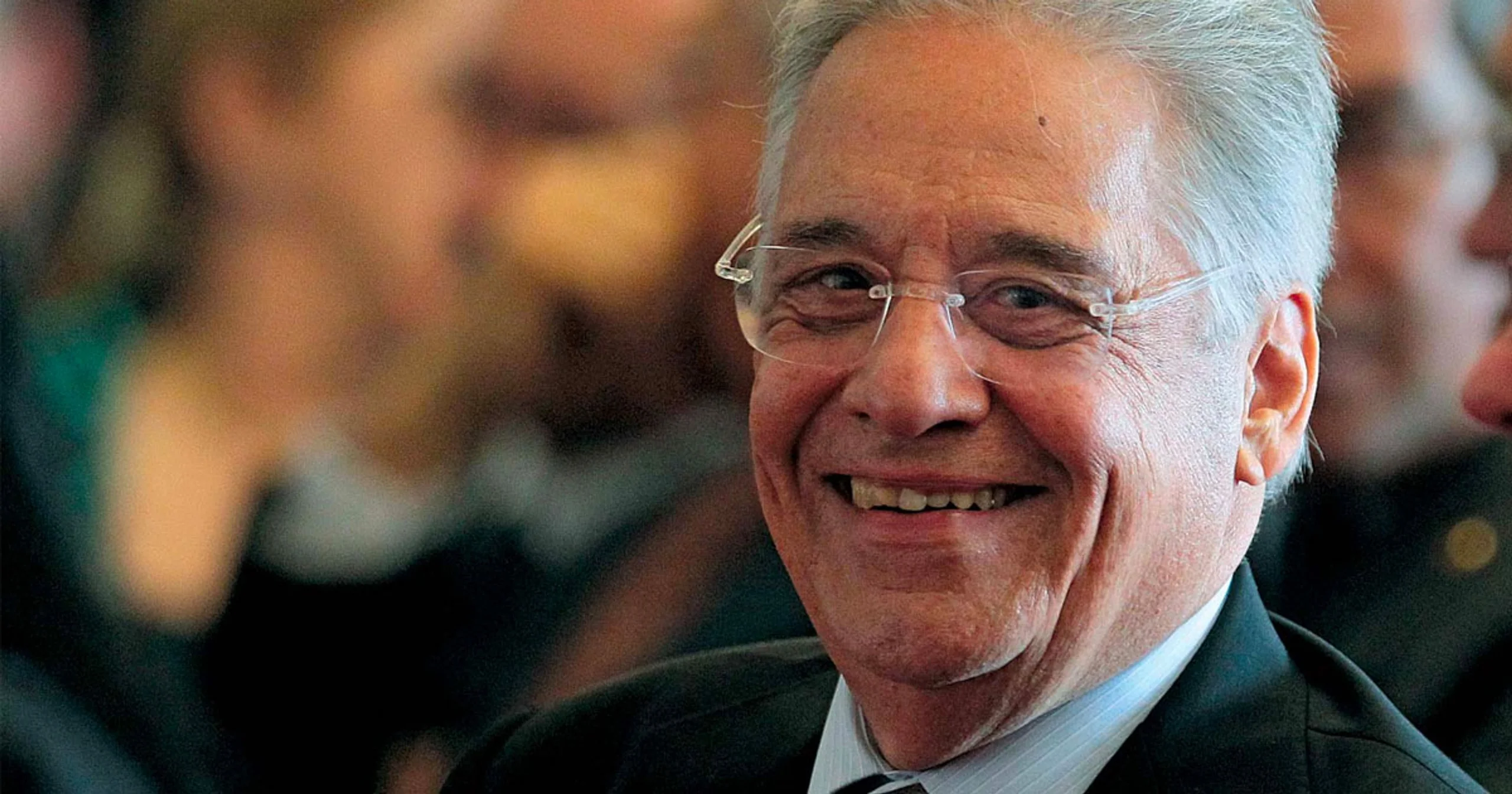
Fernando Henrique Cardoso
 Brazil
Also known as: FHC, Fernando Henrique da Costa Cardoso
Birthday
June 18, 1931
Birth Sign
Gemini
Birthplace
Rio de Janeiro, Brazil
Age
95 years old
Height
5 ft 9 in (175 cm)
About
Fernando Henrique Cardoso is a Brazilian sociologist, academic, and politician who served as the 34th President of Brazil from 1995 to 2003. Born on June 18, 1931, in Rio de Janeiro, he rose to global prominence for his intellectual work on dependency theory and his political success in stabilizing Brazil's economy through the Plano Real. Today at 95, he remains a respected elder statesman and a vocal commentator on democracy and social issues.
Cardoso holds a unique place in modern history as a scholar who successfully transitioned into high-level governance. His legacy is defined by the economic reforms that tamed hyperinflation and the democratic consolidation of the 1990s. Even as he faces health challenges in his later years, his influence continues through the Fundação FHC and his ongoing contributions to international thought.
Early Life & Background
Fernando Henrique da Costa Cardoso was born into a middle-class family in Rio de Janeiro during a time of significant social change. His father, also named Fernando Henrique Cardoso, was a journalist and writer who died when Fernando was just six years old. This early loss forced his mother, Zélia Cardoso de Mello, to raise him and his younger sister, Maria Luiza, often moving them due to her work as a teacher and social worker. These frequent relocations exposed the young Cardoso to diverse social realities and the political instability that would later define his academic focus.
His education began in earnest at the University of São Paulo (USP), where he earned his undergraduate degree in sociology in 1952. He quickly distinguished himself with a master's degree in 1957 and a doctorate in 1962, writing a thesis on the history of the Brazilian Communist Party. During this period, he spent time as a visiting scholar at the University of California, Berkeley, where he engaged deeply with American sociological theories and developed the framework for what would become known as dependency theory.
The military coup of 1964 abruptly interrupted his academic ascent. Arrested and imprisoned for sixty days due to his left-wing views, Cardoso eventually fled into exile. He taught at the Catholic University of Chile and the University of Geneva while living abroad from 1964 to 1971. Upon returning to Brazil after the regime relaxed its restrictions, he resumed his teaching at USP, building a formidable reputation as one of Latin America's most important intellectuals before ever holding elected office.
Career Growth
Cardoso's entry into formal politics began in the late 1970s as he co-founded the Brazilian Social Democracy Party (PSDB) in 1988. He served as a Senator for São Paulo starting in 1992 and briefly held the position of Minister of Foreign Affairs in 1993. His true political breakthrough came in 1994 when President Itamar Franco appointed him Minister of Finance. In this role, Cardoso designed and implemented the Plano Real, a radical economic plan that introduced a new currency and successfully curbed hyperinflation, which had been soaring above 2,000% annually. The plan's immediate success propelled him to the presidency later that year.
Elected in 1994, Cardoso became the first Brazilian president to be re-elected for a consecutive term following a constitutional amendment passed during his first administration. He served two full terms from January 1, 1995, to December 31, 2002. His presidency focused on privatizing state-owned enterprises, liberalizing trade, and implementing social programs like Bolsa Escola. After leaving office, he remained active in public life, founding the Fernando Henrique Cardoso Foundation in 2004 and serving as a professor-at-large at Brown University until 2008.
In recent years, Cardoso has continued to shape global discourse. He was a member of The Elders, a group of global leaders founded by Nelson Mandela, serving from 2007 until stepping down in 2016. Despite being legally interdicted in April 2026 due to advanced Alzheimer's disease, he remains a symbol of Brazil's democratic maturity and intellectual depth.
Career Timeline
Public Image & Style
Known universally by his initials FHC, Cardoso projects an image of dignified intellect and rational authority. He typically wears formal suits, reflecting his background as a professor and statesman. The media portrays him as a "scholar-statesman," a rare figure who bridged the gap between rigorous academic theory and pragmatic governance. His public voice is characterized by moderation and experience, often cited as a stabilizing force in Brazilian politics. Even in his later years, facing health challenges, he maintains a presence as a respected elder statesman rather than a partisan figure.
Fame & Fandom
iFANN's Global Fame Engine has evaluated Fernando Henrique Cardoso, but he does not currently hold a placement in the published rankings (Global Top 1,000 or a Top-100 scope list). As of September 2026, he is evaluated but ranked outside the current published lists. His fame is measured across media coverage, search, and consumption signals worldwide, placing him as the 79th most famous person in Brazil, a position he has held steady in the iFANN Global Fame Rankings from the previous cycle. This ranking reflects not just his presidential tenure, but a lifetime of academic contributions that have kept his name relevant in scholarly and political circles alike.
There is no documented fandom name, no fan clubs, and no coordinated fan campaigns. Instead, his following is composed of political admirers, academics, and institutions that respect his legacy. The Fundação FHC serves as the institutional custodian of his work, and his official Instagram account (@presidentefhc) offers a window into his ongoing public presence. This is a following built on intellectual and political respect, not on the rituals of pop-culture fandom.
Interesting Facts and Legends
Cardoso is a prolific author who has written over 30 books and hundreds of articles on sociology, politics, and economics. His academic work on slavery and political theory in Brazil is considered foundational in Latin American sociology. He was a close friend of Nelson Mandela and played a key role in the formation of The Elders organization. In 2003, he was inducted into the Brazilian Academy of Letters, succeeding the renowned writer Jorge Amado, a rare honor for a sitting or former head of state.
The story of the Plano Real remains legendary among Brazilians. Before his presidency, as Finance Minister, he engineered a monetary reform that tamed hyperinflation overnight. The plan's success is so revered that even his political rival, Luiz Inácio Lula da Silva, acknowledged its effectiveness in later years, despite opposing the neoliberal policies associated with it. Another iconic moment was his 1994 landslide victory, seen as a triumph of economic competence over populism.
Notable Quotes
“Democracy is not a gift; it is a construction that must be constantly renewed.”
“Tomorrow could be better than today.”
“The real challenge is not to stop inflation, but to build a society that can sustain low inflation.”
Family & Personal Life
Cardoso was raised by his mother, Zélia Cardoso de Mello, after his father died when he was young. He has one sister, Maria Luiza. He was married twice. His first marriage was to Ruth Cardoso, a prominent anthropologist and sociologist whom he met at the University of São Paulo. They married in 1960 and had four children: Pedro Henrique, João Paulo, Ana Paula, and Mariana. The couple separated amicably in the early 1990s and divorced in 1994 just months before his inauguration. His second wife is Patrícia Kundrát, a Hungarian-born architect and designer. They married in 1996 after meeting in Paris. There are no publicly confirmed children from this second marriage.
Notable Connections
Relationships & Dating History
Fernando Henrique Cardoso has been married twice throughout his public life. His first marriage was to Ruth Cardoso, née Viana, a prominent anthropologist and sociologist. They met while both were students at the University of São Paulo and married in 1960. Their union lasted 34 years and produced four children: Pedro Henrique, João Paulo, Ana Paula, and Mariana. The couple separated amicably in the early 1990s as Cardoso's political career accelerated, leading to their formal divorce in 1994 just months before his presidential inauguration.
Shortly after separating from Ruth, Cardoso began a relationship with Patrícia Kundrát, a Hungarian-born architect and designer. They met in Paris in the early 1990s. She has been a constant presence in his life since the separation from Ruth, though they did not marry until after his election victory. They wed in 1996, and she remains his spouse as of 2026. There are no publicly confirmed children from this second marriage. His children from his first marriage, particularly Pedro Henrique Cardoso, have occasionally appeared in public discussions regarding his legacy, but none hold significant political office themselves.
- DivorcedRuth Cardoso1960 - 1994Met at USP; four children together; amicable separation.
- MarriedPatrícia Kundrát1996 - presentCurrentHungarian architect; met in Paris; married after election.
Salary, Net Worth In 2026
$5 Million
iFANN Editorial Team estimate
Estimating the net worth of a former head of state like Fernando Henrique Cardoso is complex due to the lack of public financial disclosure requirements for private assets post-office and the nature of his wealth sources. Unlike entertainers or business tycoons, his income stems primarily from academic speaking engagements, book royalties, board memberships, and consulting fees rather than commercial ventures. The iFANN Editorial Team estimates his net worth at approximately $5 million based on these long-standing career earnings and asset holdings.
His wealth accumulation comes from decades of academic tenure at USP and Brown University, alongside substantial book royalties from over 30 publications translated into multiple languages. Speaking fees at major international forums like Davos and the Clinton Global Initiative have provided significant supplemental income, often ranging from $50,000 to $150,000 per appearance. He also receives stipends from advisory boards and foundations. Like many Brazilians of his generation, he likely owns property in Rio de Janeiro and São Paulo, though specific valuations remain private.
Awards Won (5)
Cardoso has received numerous prestigious awards for his academic and political contributions, including the Prince of Asturias Award for International Cooperation in 2000 and the Kluge Prize from the US Library of Congress in 2012. He holds honorary doctorates from Harvard University, the University of Cambridge, and the Sorbonne. He was inducted into the Brazilian Academy of Letters in 2003 and received the Grand Cross of the Order of the Southern Cross, the highest honor awarded by the Brazilian government. He was also named a Commander of the Legion of Honour by France.
2000 · International Cooperation
Promotion of democracy and human rights in Latin America
2012 · Lifetime Achievement in Humanities
Lifetime achievement in the humanities
Known For
Plano Real
1994 · Architect and Minister of Finance
President of Brazil
1995 · 34th President
Dependency Theory
1960 · Sociologist and Author
Keywords
Sources
Quick Facts
- Profession
- politician, diplomat, sociologist
- Born
- June 18, 1931
- Birthplace
- Rio de Janeiro
- Gender
- Male
- Spouse
- Ruth Cardoso, Patrícia Kundrát
- Birth Sign
- Gemini
Personal Details
- Full Name
- Fernando Henrique da Costa Cardoso
- Height
- 5 ft 9 in (175 cm)
- Spouse
- Ruth Cardoso, Patrícia Kundrát
- Children
- Pedro Henrique, João Paulo, Ana Paula, Mariana
- Education
- University of São Paulo (BA, MA, PhD), University of California, Berkeley
Frequently Asked Questions
How old is Fernando Henrique Cardoso?
What is Fernando Henrique Cardoso famous for?
Is Fernando Henrique Cardoso still alive?
Who is Fernando Henrique Cardoso married to?
What is Fernando Henrique Cardoso's net worth?
Social Media
Similar People
Join the community
fans discussing