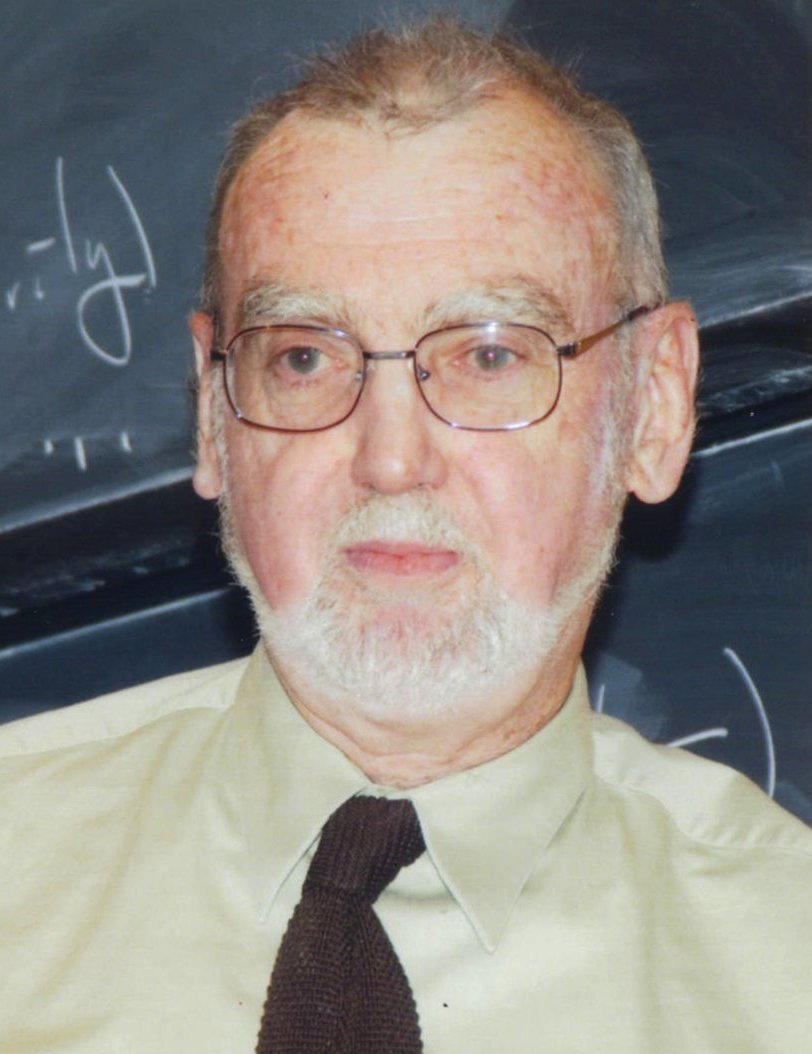
Robert Langlands
 Canada
Also known as: Robert Phelan Langlands
Birthday
October 6, 1936
Birth Sign
Libra
Birthplace
New Westminster, British Columbia, Canada
Age
89 years old
About
Robert Phelan Langlands is a Canadian mathematician best known as the founder of the Langlands program, a sweeping set of conjectures that connect number theory, representation theory, and automorphic forms. Born in 1936, he spent most of his career at the Institute for Advanced Study in Princeton, where he held the office once used by Albert Einstein. His work has reshaped modern mathematics, earning him the 2018 Abel Prize, often called the Nobel Prize of mathematics.
Langlands's influence extends across several fields, and his conjectures continue to drive research worldwide. Though he retired in 2020, his ideas remain a central organizing principle in mathematics, inspiring a dedicated community of researchers.
Early Life & Background
Robert Phelan Langlands was born on October 6, 1936, in New Westminster, British Columbia, a small city near Vancouver. Growing up in Canada, he showed an early aptitude for mathematics, though details of his childhood are scarce. He pursued his undergraduate studies at the University of British Columbia, where he earned a bachelor's degree in 1957. He then moved to Yale University for graduate work, completing his PhD in 1960 under the supervision of Cassius Ionescu-Tulcea.
After his doctorate, Langlands took a position at Princeton University, where he began exploring the deep connections between number theory and harmonic analysis. In 1967, while at Princeton, he wrote a now-famous letter to the mathematician André Weil, outlining what would become the Langlands program. That letter, written by hand, laid out a bold vision linking Galois groups and automorphic forms, a framework that would occupy mathematicians for decades.
Langlands later held a position at the University of California, Berkeley, before joining the Institute for Advanced Study in 1972, where he would remain for nearly half a century.
Career Growth
Langlands's breakthrough came with his 1967 letter to André Weil, which sketched the foundational ideas of the Langlands program. This ambitious framework proposed deep connections between seemingly unrelated areas of mathematics, including number theory, representation theory, and harmonic analysis. Over the following decades, the program grew into a vast research field, engaging hundreds of mathematicians globally.
His work earned him numerous prestigious awards: the Wolf Prize in 1996, the Nemmers Prize in 2005, the National Academy of Sciences Award in Mathematics in 2006, and the Shaw Prize in 2007. The crowning recognition came in 2018, when he received the Abel Prize from the Norwegian Academy of Science and Letters, cited for his "visionary program connecting representation theory and automorphic forms."
Langlands retired from the Institute for Advanced Study in 2020, but his conjectures remain an active area of research. In 2024, a Yale professor solved a significant part of a related question, demonstrating the program's continuing relevance.
Career Timeline
Public Image & Style
Langlands is regarded as one of the most visionary mathematicians of the twentieth century, though he shies away from the spotlight. Colleagues describe him as humble and deeply thoughtful, with a quiet intensity. His name is synonymous with the Langlands program, and he is often compared to giants like Andrew Wiles and Alexander Grothendieck. The mathematics community holds him in immense esteem, and his work is celebrated in popular science media, including Quanta Magazine and The Guardian. He has a modest Instagram presence under @robertlanglands, where he shares his interests in mathematics, classical music, and knowledge.
Fame & Fandom
The community surrounding Robert Langlands is distinct from typical celebrity fandoms, consisting instead of a global network of mathematicians, researchers, and students who revere his work through rigorous academic engagement rather than pop-culture rituals. There is no formal fan club name or organized campaign; the 'fans' are the very people working to solve the conjectures he proposed, treating the Langlands program as a living intellectual legacy. This unique bond is measured by the iFANN Global Fame Rankings, which track global attention across media coverage, search, and consumption signals worldwide. Within this specialized sphere, Langlands holds a commanding position in the digital landscape. He is currently the 52nd most famous person in AI, a ranking that has held steady from the previous cycle, reflecting his enduring relevance in fields where mathematics intersects with computational theory.
Interesting Facts and Legends
Langlands occupied the office at the Institute for Advanced Study once used by Albert Einstein, a fact he often downplayed despite its significance. He is known for his preference for classical music and his interest in teaching mathematics, as reflected in his Instagram account. The Langlands program has been described as a "grand unified theory" of mathematics, drawing parallels to physics. His 1967 letter to André Weil was written by hand and remains a foundational document in modern mathematics. Despite his towering reputation, Langlands has remained a private figure, rarely giving interviews.
A central piece of mathematical lore surrounds the sheer visionary scope of his 1967 correspondence. The story goes that while sitting in his Princeton office, he drafted a single handwritten letter that would eventually become known as the Rosetta Stone for mathematics, connecting number theory and automorphic forms in a way no one had imagined. This moment is treated as a holy grail event within the field, with thousands of scholars dedicating their careers to proving the conjectures contained within it. Another enduring legend involves the scale of his influence, where a single idea sparked a movement so vast it is now considered a unifying framework for all of mathematics, inspiring generations of students who have since become leaders in their own right.
Family & Personal Life
Details about Langlands's family life are scarce, as he has kept his personal affairs private. He was born to parents whose names are not widely publicized, and he grew up in British Columbia. No information is available about siblings, a spouse, or children. His focus on mathematics and academia appears to have been his primary life commitment, and he has not shared family stories publicly.
Notable Connections
Langlands is associated with the Institute for Advanced Study, where he worked for nearly 50 years. He is also connected to mathematicians such as André Weil, to whom he wrote his famous letter, and Robert P. Langlands is a name that appears alongside other great mathematicians in the field of number theory. His work has influenced researchers like Peter Scholze and others working on the Langlands program.
Relationships & Dating History
Robert Langlands has kept his personal life extremely private, and no public information exists about any romantic relationships, marriages, or partnerships. He has never been mentioned in connection with a spouse or partner in any credible source. As of 2026, his relationship status remains unknown, as he has chosen to keep this aspect of his life out of the public eye.
Salary, Net Worth In 2026
$5 Million
iFANN Editorial Team estimate
As a mathematician, Langlands's income came primarily from his academic positions, including professorships at Princeton University and the Institute for Advanced Study. Academic salaries in mathematics are modest compared to many other professions, and Langlands never engaged in commercial ventures. Per iFANN's editorial analysis, his net worth is estimated to be around $5 million as of 2026, built from decades of university employment, prize money, and book royalties. His major awards, including the Abel Prize in 2018, came with a monetary component of roughly $700,000, which added to his savings. Langlands also received the Wolf Prize and the Shaw Prize, both of which carry significant cash awards. Over his long career, these prizes and his academic earnings have accumulated to a comfortable but not extravagant fortune.
Awards Won (5)
Langlands has received some of the highest honors in mathematics, including the Wolf Prize, the Shaw Prize, and the Abel Prize. He also won the Nemmers Prize and the National Academy of Sciences Award in Mathematics. These awards recognize his foundational contributions to number theory and representation theory.
2018 · Mathematics
Langlands Program
2007 · Mathematical Sciences
Langlands Program
Known For
Langlands Program
1967 · Founder
Keywords
Sources
Quick Facts
- Profession
- mathematician
- Born
- October 6, 1936
- Birthplace
- New Westminster, British Columbia, Canada
- Gender
- Male
- Birth Sign
- Libra
- Education
- Yale University (PhD, 1960)
- Known for
- Langlands program
Personal Details
- Full Name
- Robert Phelan Langlands
- Education
- Yale University (PhD, 1960)
Frequently Asked Questions
Who is Robert Langlands?
What is the Langlands program?
What awards has Robert Langlands won?
Where did Robert Langlands work?
When was Robert Langlands born?
Social Media
Similar People
Join the community
fans discussing