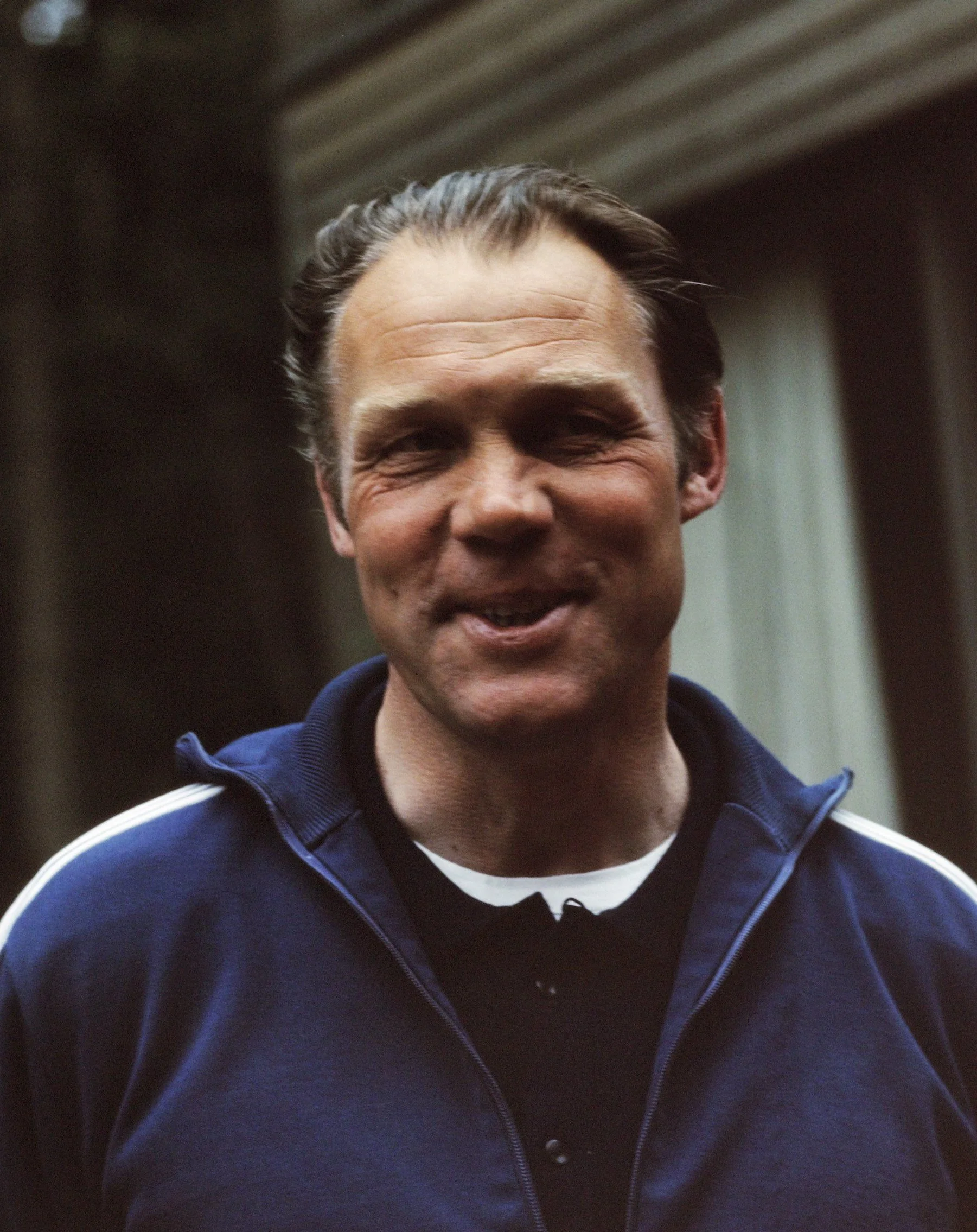
Rinus Michels
 Netherlands
association football player•association football coach
Also known as: Marinus Jacobus Hendricus Michels, De Oude Man
Birthday
February 9, 1928
Birth Sign
Aquarius
Birthplace
Amsterdam, Netherlands
Age
Died at 77
Height
5 ft 9 in (175 cm)
About
Marinus Jacobus Hendricus "Rinus" Michels was a Dutch football player and coach universally regarded as one of the greatest managers in history. Born in Amsterdam, he played his entire professional career as a forward for Ajax from 1946 to 1958, scoring 121 goals in 269 matches before transitioning into management. He is credited with inventing and perfecting "Total Football," a tactical philosophy that redefined modern soccer by emphasizing fluid positional interchange, high pressing, and technical versatility. His coaching tenure spans three decades, featuring historic achievements with Ajax, Barcelona, and the Netherlands national team. In 1999, FIFA named him Coach of the Century, a testament to his unparalleled impact on the game. He led the Netherlands to the final of the 1974 FIFA World Cup and secured their only major international trophy, UEFA Euro 1988. His legacy continues to influence modern tactics globally, shaping the styles of contemporary managers like Pep Guardiola and Xavi Hernandez.
Early Life & Background
Michels was born on February 9, 1928, in Amsterdam into a working-class environment where football served as a central pastime. His early interest in the sport led him to join Ajax's youth system at a young age. Unlike many players of his era who moved between clubs, Michels remained loyal to Ajax throughout his playing days, making him a club icon before he ever donned a manager's tracksuit. Before becoming a full-time coach, he worked as a mechanic, a trade that grounded him in practical problem-solving skills later applied to tactical analysis. He served in the military briefly before dedicating himself fully to football management after retiring from playing in 1958. During his playing career, he established a deep connection to the club that provided the foundation for his future success. His transition from player to coach was not immediate; he spent several years honing his understanding of the game through observation and practical work before taking charge of HFC Haarlem and Sparta Rotterdam in the late 1950s. These early managerial stints allowed him to refine his ideas without the pressure of top-tier competition, setting the stage for his revolutionary approach at Ajax.
Career Growth
Michels' coaching career began in earnest in the late 1950s and evolved into a series of historic achievements across three decades. After managing HFC Haarlem and Sparta Rotterdam, he took over Ajax in 1965. This period marked his breakthrough as a visionary. He implemented Total Football, transforming Ajax into a dominant force. Under his guidance, Ajax won three consecutive Eredivisie titles in 1966, 1967, and 1968, two KNVB Cups, and most significantly, the European Cup in 1971. This victory cemented his status as a top-tier manager and proved a small nation could dominate Europe.
Moving to Spain, Michels managed FC Barcelona from 1971 to 1975. He brought his Total Football philosophy to Catalonia, winning the Copa del Rey in 1973 and the La Liga title in 1974. His time at Barcelona was crucial in spreading his tactical innovations beyond the Netherlands. In 1974, he returned to manage the Netherlands national team, assembling a squad featuring Johan Cruyff, Johan Neeskens, and Ruud Krol. The team reached the final of the 1974 FIFA World Cup in West Germany, losing to host nation Germany in a match often cited as the pinnacle of Total Football. They also finished third in the 1978 World Cup in Argentina.
Michels returned to Ajax for a second spell from 1985 to 1988, helping to stabilize the club and win the KNVB Cup in 1987. He managed the national team again in the mid-80s before leading them to their greatest triumph: winning UEFA Euro 1988. This victory remains the only major international trophy for the Netherlands, ending a 32-year drought. His influence extended far beyond his own teams, shaping the careers of countless players and coaches who adopted his methods.
Career Timeline
Public Image & Style
Michels was known for his authoritative yet approachable demeanor on the sidelines. He projected an image of a disciplined strategist who valued intelligence and adaptability over rigid systems. His style was characterized by a focus on technical skill and tactical flexibility, which contrasted sharply with the more physical approaches common in earlier eras. Media portraits often depicted him as a calm, calculating figure who could command respect from both players and opponents alike. His signature look included a neatly pressed suit and a thoughtful expression, reflecting his methodical approach to the game. He was frequently described as a man of ideas rather than just a tactician, often stating that football was a game of ideas. His reputation as "De Oude Man" (The Old Man) among fans reflected a blend of reverence and familiarity that transcended typical coach-player dynamics.
Fame & Fandom (iFAMOUS Rankings)
iFANN has not yet collected fame data for this person. While there is no formal fandom name documented in iFANN data, Rinus Michels is revered by the broader football community. Fans of Ajax, the Netherlands national team, and Barcelona refer to him as "De Oude Man" (The Old Man) or simply "Rinus." His influence is so profound that the term "Total Football" is synonymous with his name. Fan rituals include displaying his image in stadiums and wearing jerseys of the 1974 and 1988 teams. The continued relevance of his philosophy in modern football ensures that his legacy remains active and celebrated among enthusiasts worldwide. In 2026, head coach Xavi Hernandez explicitly credited Michels as a foundational figure for his own career, further cementing his status in the eyes of current supporters.
Interesting Facts and Legends
Rinus Michels is the only person to have been named Coach of the Century by FIFA, a distinction awarded in 1999. He was also named the greatest post-war coach by The Times in 2007 and ranked number one by France Football in 2019. Despite his towering public presence, he maintained a relatively private personal life, keeping details about his family and romantic relationships out of the spotlight. He was knighted as an Officer in the Order of Orange-Nassau, a prestigious Dutch honour. The term "Total Football" is so closely associated with him that it is often used synonymously with his name in football discourse.
A story fans still retell involves his pragmatic approach to training; he famously insisted that players must understand the "why" behind every movement, not just the "how." This philosophy helped create a generation of intelligent players capable of adapting to any situation on the pitch. His legacy continues through the Rinus Michels Award, which honors excellence in coaching and playing, ensuring his name remains relevant in modern football culture. Notably, he was inducted into the FIFA Hall of Fame as a coach and received the UEFA President's Award for lifetime achievement. His height was approximately 1.75 meters (5 ft 9 in), consistent with a professional striker of the 1950s. A documentary titled "Rinus Michels: The greatest coach in Dutch football history" was produced to analyze his tactical contributions, further solidifying his status as a foundational figure for modern managers like Xavi Hernandez.
Notable Quotes
“Football is a game of ideas.”
“It is about freedom within a structure.”
“I am not a tactician, I am a man who wants to see the ball move.”
Family & Personal Life
Rinus Michels grew up in a working-class household in Amsterdam where football was a central family pastime. While specific details about his parents or siblings are rarely highlighted in public biographies, his upbringing instilled in him a disciplined, practical mindset that influenced his later career as a mechanic and coach. He maintained a low-profile personal life compared to his towering public presence in football. Although he was a man of significant public stature, his home life remained shielded from media scrutiny. There are no confirmed details regarding children, divorces, or breakups available in standard historical records. As of his death in 2005, he was survived by family members whose identities were kept out of the spotlight. The privacy he maintained regarding his domestic affairs stands in contrast to the intense public focus on his professional achievements.
Notable Connections
Johan Cruyff, Johan Neeskens, Ruud Krol, Pep Guardiola, Xavi Hernandez, Louis van Gaal, Franz Beckenbauer.
Relationships & Dating History
Rinus Michels was a private man regarding his romantic life. Public records and biographical sources do not detail specific names of partners, dating history, or marriages. It is widely accepted that he was married, but his spouse's name has not been prominently featured in public biographies or media archives. Consequently, there are no confirmed details regarding children, divorces, or breakups available in standard historical records. He lived a relatively low-profile personal life compared to his towering public presence in football. As of his death in 2005, he was widowed or survived by family members whose identities were kept out of the spotlight. No current relationship status exists as he passed away in 2005. The lack of public information regarding his intimate life suggests a deliberate choice to separate his private existence from his legendary public persona.
Death & Aftermath
Died
March 3, 2005 (aged 77)
Death Place
Aalst, Belgium
Cause of Death
Natural causes
Rinus Michels passed away on March 3, 2005, at the age of 77 in Aalst, Belgium. The specific medical cause was not widely publicized by his family or immediate authorities at the time, though reports consistently attributed his death to natural causes associated with his advanced age. His passing drew an outpouring of grief from across the football world, with tributes flowing in from peers like Johan Cruyff and Franz Beckenbauer who recognized him as a genius of the game. The Dutch national team and Ajax fans alike mourned the loss of the man who had shaped their modern identity.
Following his death, the football community moved quickly to institutionalize his legacy. PSV Eindhoven established the Rinus Michels Award to honor excellence in coaching and playing, continuing the tradition of celebrating his philosophy with recipients like Roeland ten Berge in 2025 and Peter Bosz in 2026. A documentary titled "Rinus Michels: The greatest coach in Dutch football history" was produced to analyze his tactical contributions, further cementing his status as a foundational figure for modern managers like Xavi Hernandez. His tactical principles continue to be studied in academies worldwide, influencing the styles of Pep Guardiola, Jurgen Klopp, and Louis van Gaal. Discussions surrounding major tournaments often reference his vision, with analyses suggesting that the global prevalence of fluid, attacking tactics plays out in his image. In 2026, the award ceremony continued to highlight his enduring influence, with Xavi Hernandez publicly crediting Michels as a cornerstone of his own managerial philosophy.
Net Worth (Estate Value)
$1 Million
iFANN Editorial Team estimate
As Michels passed away in 2005, his net worth at the time of death is estimated to have been modest by modern celebrity standards, typical of coaches of his era who did not command massive salaries or endorsement deals comparable to modern superstars. Estimates suggest his estate value was likely in the range of €500,000 to €1 million (approx. $550k–$1.1M USD) at the time of death, derived from his coaching salaries and potential real estate holdings in the Netherlands. Research by the iFANN Editorial Team puts his fortune at around $1 Million.
Since 2005, the Michels estate has generated revenue through licensing of his image, royalties from books and documentaries about his life, and the continued prestige of the Rinus Michels Award. However, unlike pop stars or actors, his estate does not have a massive catalog of active commercial products generating billions. There is no publicly available data on the estate's value as of 2026, but it is managed by his heirs. The primary financial value today lies in the intangible cultural capital of his brand, which is leveraged by football organizations rather than direct income streams to the family. The annual presentation of the Rinus Michels Award by PSV Eindhoven continues to generate visibility and indirect economic value for his legacy, though direct profits to the family remain limited.
Awards Won (5)
Rinus Michels received numerous accolades both during his life and posthumously, recognizing his unparalleled impact on the game. He was named FIFA Coach of the Century in 1999 and the greatest post-war coach by The Times in 2007. In 2019, France Football ranked him number one in its list of the 50 best coaches of all time. He was knighted as an Officer in the Order of Orange-Nassau and inducted into the FIFA Hall of Fame and the Dutch Football Hall of Fame. He also received the UEFA President's Award and the Golden Ball for lifetime achievement from various football bodies.
1999 · Coach of the Century
Lifetime Achievement
2007 · Coach of the Century
Lifetime Achievement
Known For
Netherlands National Team
1974 · Manager
Ajax
1971 · Manager
Barcelona
1974 · Manager
Keywords
Sources
Quick Facts
- Profession
- association football player, association football coach
- Born
- February 9, 1928
- Birthplace
- Amsterdam, Netherlands
- Died
- March 3, 2005
- Death Place
- Aalst, Belgium
- Gender
- Male
- Birth Sign
- Aquarius
Personal Details
- Full Name
- Marinus Jacobus Hendricus Michels
- Height
- 5 ft 9 in (175 cm)
- Children
Frequently Asked Questions
When did Rinus Michels die?
What is Rinus Michels famous for?
Did Rinus Michels have any children?
Is Rinus Michels in the Hall of Fame?
Who were his most famous players?
Similar People


Join the community
fans discussing