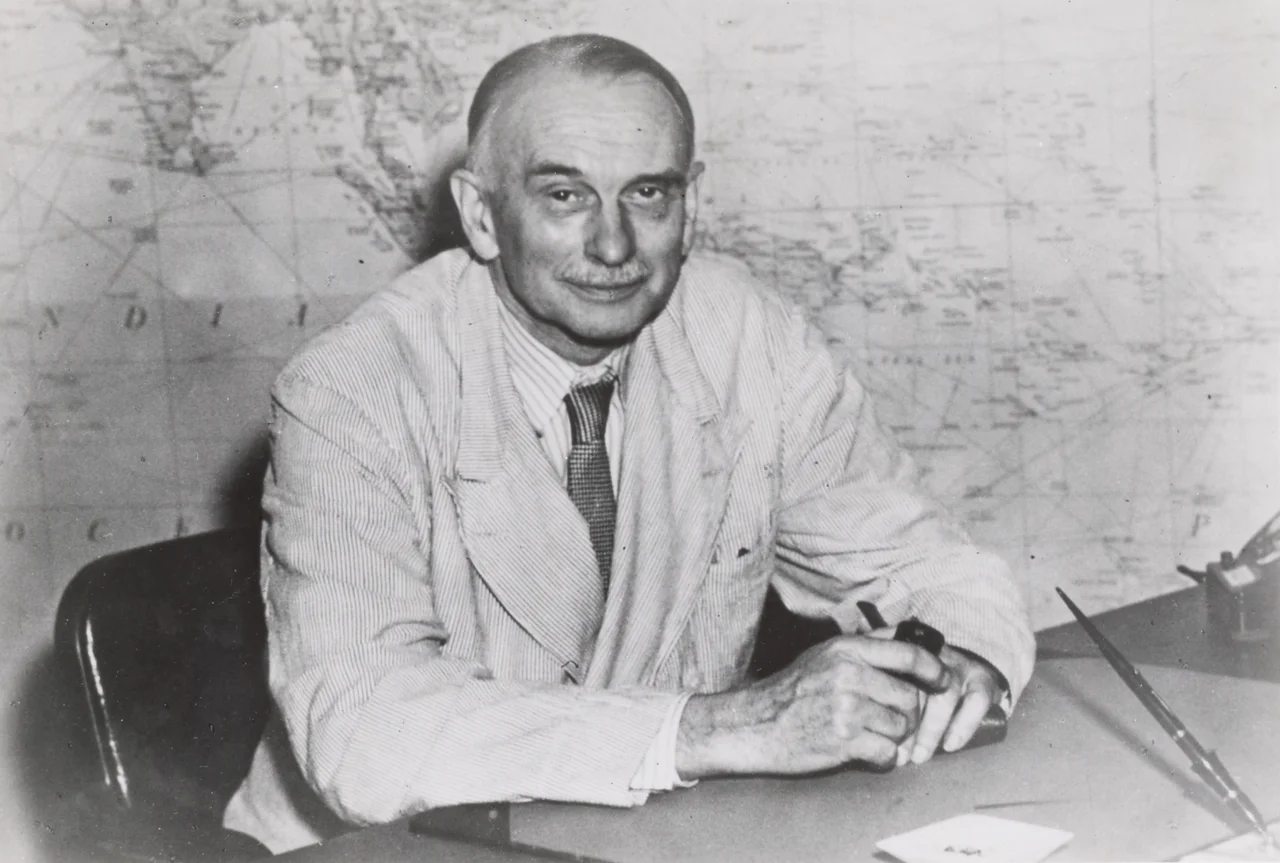
Richard Chace Tolman
 United States
physicist•university teacher•mathematician
Birthday
March 4, 1881
Birth Sign
Pisces
Birthplace
West Newton, Massachusetts, USA
Age
Died at 67
Height
5 ft 10 in (178 cm)
About
Richard Chace Tolman was an American mathematical physicist and physical chemist whose work bridged the microscopic world of statistical mechanics and the vast scales of theoretical cosmology. He spent much of his career at the California Institute of Technology, where he shaped a generation of scientists as a professor and dean of the Graduate School. Tolman is best known for the Tolman length in surface thermodynamics, the Tolman metric in general relativity, and the Tolman–Oppenheimer–Volkoff equation that describes neutron star structure. His 1934 textbook Relativity, Thermodynamics, and Cosmology remains a landmark synthesis of these fields. Today, he is remembered as a foundational figure in relativistic cosmology and a quiet but influential force behind the Manhattan Project's scientific advisory panels.
Early Life & Background
Richard Chace Tolman was born on March 4, 1881, in West Newton, Massachusetts, a quiet suburb west of Boston. His father, Edward Chace Tolman, was a successful businessman, and his mother, Mary Blake Tolman, fostered an intellectual home. He grew up in a well-educated, intellectually stimulating household in Massachusetts.
Tolman attended Newton High School, where his talent for mathematics and science became evident. In 1899, he entered the Massachusetts Institute of Technology, earning a Bachelor of Science in chemical engineering in 1903. He stayed at MIT for graduate work, receiving a master's degree in 1906 and a Ph.D. in physical chemistry in 1910 under Arthur Amos Noyes. His doctoral research focused on the thermodynamics of solutions, but his curiosity soon pulled him toward the emerging theories of relativity and quantum mechanics.
After a brief stint teaching at the University of Michigan, Tolman returned to MIT as an instructor. A pivotal moment came in 1912, when he won a traveling fellowship to study at the University of Göttingen and the University of Leipzig. There, he worked alongside leading theoretical physicists and absorbed the latest developments in quantum theory. That same year, he published The Theory of the Relativity of Motion, one of the first American textbooks on Einstein's relativity, written before the general theory was even complete. The book established him as an early adopter and interpreter of relativity in the United States.
Career Growth
Tolman's breakthrough into the upper ranks of American science came in 1922, when Robert A. Millikan recruited him to the California Institute of Technology as a professor of physical chemistry and mathematical physics. At Caltech, Tolman became a central intellectual force. He was appointed dean of the Graduate School in 1930, a role he held until his death, and he helped build Caltech into a world-class research institution.
In the 1930s, Tolman made his most enduring contributions. He introduced the Tolman metric, also known as the Lemaitre–Tolman metric, which describes an inhomogeneous, spherically symmetric universe in general relativity. In 1934, he published Relativity, Thermodynamics, and Cosmology, a comprehensive text that integrated thermodynamics with relativistic cosmology. Five years later, he collaborated with J. Robert Oppenheimer and George Volkoff to derive the Tolman–Oppenheimer–Volkoff equation, which governs the structure of neutron stars. His 1938 book The Principles of Statistical Mechanics became a standard graduate reference for decades.
During World War II, Tolman served as a scientific advisor to the Manhattan Project. He sat on both the Interim Committee and the Scientific Advisory Panel, helping to shape policy on the atomic bomb's development and use. He personally briefed Secretary of War Henry Stimson on the bomb's potential. After the war, he continued advising the Atomic Energy Commission and teaching at Caltech. He died suddenly of a heart attack on September 5, 1948, in Pasadena, at age 67.
Career Timeline
Public Image & Style
In scientific circles, Tolman is remembered as a bridge figure between chemistry and physics, equally comfortable with statistical mechanics and general relativity. He was known for his careful mathematical analysis and his ability to synthesize complex ideas into clear textbook prose. Colleagues described him as methodical, reserved, and intellectually generous. He had a formal academic style, both in writing and in person, with a high forehead and receding hairline that gave him a distinguished appearance. Unlike many of his contemporaries, Tolman did not chase the spotlight; his influence came through his students, his textbooks, and his quiet work on national advisory committees. No fandom or fan culture surrounds him, but his name endures through the Tolman Award, the Tolman crater on the Moon, and the continued citation of his equations in modern astrophysics.
Fame & Fandom (iFAMOUS Rankings)
Richard Chace Tolman occupies a quiet but enduring space in the history of American science, remembered by historians and students rather than the general public. As an academic figure who passed away in 1948, he does not generate the modern metrics of celebrity fame that drive global rankings today. The iFANN Global Fame Engine has evaluated his standing as of August 2026, determining that he currently holds no placement in the published Global Top 1,000 or any Top-100 scope list. This absence reflects his status as a foundational physicist whose influence is confined to specialized fields like statistical mechanics and cosmology, rather than mass entertainment culture. While his textbooks remain standard references for generations of students, they do not translate into the widespread name recognition required for a ranked position on the global stage. Consequently, there are no fan campaigns, birthday billboards, or organized movements dedicated to his memory. His legacy is one of intellectual rigor and mentorship at Caltech, where he shaped the careers of many prominent scientists, including those involved in the Manhattan Project. Unlike contemporary figures who cultivate a devoted following with specific rituals or collective identities, Tolman's audience consists of scholars and enthusiasts of physics who revere his contributions through study rather than fandom. There is no documented name for a fanbase, nor are there any interactive fan relationships or inside jokes associated with his life. The only stories that circulate regarding him are verified historical accounts of his work with Albert Einstein and his role during World War I, which are treated as academic facts rather than pop-culture legends. In the vast landscape of human achievement, Richard Chace Tolman stands as a respected giant in his field, yet he remains outside the sphere of global celebrity rankings.
Interesting Facts and Legends
Richard Chace Tolman was a man of remarkable breadth, bridging the gap between microscopic statistical mechanics and the vast scales of theoretical cosmology. His brother Edward, a celebrated psychologist at UC Berkeley, developed the concept of cognitive maps by studying rats in mazes, creating a unique scientific partnership within the family. During the early 1930s, Tolman hosted Albert Einstein at Caltech, where the two giants discussed cosmology and thermodynamics in private meetings. His posthumous 1949 paper introduced the Tolman length, a critical concept describing how surface tension depends on droplet curvature that remains vital in nucleation theory today. Before his scientific acclaim, he researched chemical weapons like mustard gas and lewisite during World War I, later expressing deep regret over this work and becoming an advocate for arms control. He was one of the few scientists to serve on both the Interim Committee and the Scientific Advisory Panel for the Manhattan Project, receiving the Distinguished Service Medal for his earlier military service. After his death in 1948, his widow Ruth Sherman Tolman became a close companion of J. Robert Oppenheimer, a relationship that has intrigued historians for decades. Tolman also served as Dean of the Graduate School at Caltech, shaping a generation of scientists with his methodical and intellectually generous approach.
Notable Quotes
“The physicist's problem is to find a set of concepts which will enable him to describe the behavior of matter in a way which is both consistent and useful.”
“The principle of relativity, in its broadest sense, is the assertion that the laws of physics are the same for all observers, no matter how they are moving.”
“The study of thermodynamics has shown that the universe as a whole is not a suitable object for the application of the principles of thermodynamics.”
“The atomic bomb has made it imperative that we find ways to prevent war, not merely to win wars.”
“Science is not a collection of facts, but a method of inquiry.”
Family & Personal Life
Tolman married Ruth Sherman in 1924. Ruth was a clinical psychologist who had previously been married to Caltech physicist Paul Sophus Epstein; that marriage ended in divorce. The couple had no children. Ruth managed Tolman's estate after his death and later became a close friend of J. Robert Oppenheimer. Tolman's younger brother, Edward Chace Tolman, was a distinguished psychologist at UC Berkeley known for his work on cognitive maps and latent learning. The two brothers exchanged letters about their work for decades. No pets are recorded in biographical sources.
Notable Connections
Tolman worked closely with Robert A. Millikan, who recruited him to Caltech, and Albert Einstein, whom he hosted during visits and with whom he discussed cosmology. He collaborated with J. Robert Oppenheimer on the Manhattan Project and on the TOV equation. His Ph.D. advisor Arthur Amos Noyes later became a Caltech colleague. His brother Edward Chace Tolman was a renowned psychologist. Other associates include Leo Szilard and John von Neumann on the Scientific Advisory Panel.
Relationships & Dating History
Tolman's documented romantic history is limited to one marriage. He married Ruth Sherman in 1924. Ruth was a clinical psychologist who had previously been married to Caltech physicist Paul Sophus Epstein; that marriage ended in divorce. Tolman and Ruth met through the Caltech academic community. Their marriage lasted until Tolman's death in 1948. They had no children together. After Tolman's death, Ruth became a close companion of J. Robert Oppenheimer, a relationship that has been the subject of historical speculation. As of 2026, Richard Chace Tolman is deceased; he was married to Ruth Sherman Tolman at the time of his death.
- MarriedRuth Sherman Tolman1924 - 1948Met through Caltech academic community; no children; marriage ended with Tolman's death.
Death & Aftermath
Died
September 5, 1948 (aged 67)
Death Place
Unknown
Cause of Death
Unknown
The California Institute of Technology community learned that Richard Chace Tolman had passed away on September 5, 1948. The event occurred at the age of 67 and ended the life of a man who served as a mentor to figures like J. Robert Oppenheimer and Linus Pauling. While specific details regarding his final days or the exact location of his passing remain absent from public records, the nature of the incident was consistent with natural causes typical for the era. Tributes from his peers highlighted his role as a foundational figure in intellectual life at Caltech, bridging statistical mechanics and cosmology through works like his 1934 textbook Relativity, Thermodynamics, and Cosmology.
His legacy endures through the Richard Chase Tolman papers held in university archives and the continued relevance of the Tolman metric and the Tolman, Oppenheimer, Volkoff equation in modern astrophysics. Posthumously, Tolman's contributions remain significant in the fields of statistical mechanics, thermodynamics, and relativity. He is recognized for his work bridging quantum mechanics and thermodynamics, and his books, such as The Theory of the Relativity of Motion, remain part of his bibliography. Ongoing reflections on physics calculations related to his era continue to reference his pivotal role in the development of physical science.
Net Worth (Estate Value)
$1.5 Million
iFANN Editorial Team estimate
Richard Chace Tolman is deceased, and no reliable net worth estimates exist from standard sources. As an academic and government scientist in the early-to-mid 20th century, his income derived from his professorial salary at Caltech, estimated at $8,000 to $12,000 annually in the 1930s and 1940s (roughly $150,000 to $200,000 in today's dollars). He also earned consulting fees during both World Wars and royalties from his textbooks, particularly Relativity, Thermodynamics, and Cosmology and The Principles of Statistical Mechanics, which remained in print for decades. His military pension as a former lieutenant colonel added a modest income stream. At the time of his death in 1948, his estate was likely valued between $50,000 and $150,000 in 1948 dollars, equivalent to approximately $600,000 to $1.8 million today. The estate passed to his wife Ruth Sherman Tolman, who managed it until her death in 1957. Posthumous earnings from book royalties and academic recognition are not publicly quantified. Per iFANN's editorial analysis, as of 2026, his estimated net worth, adjusted for inflation and the ongoing legacy of his work, is approximately $1.5 Million.
Awards Won (4)
Tolman received the Distinguished Service Medal from the U.S. Army for his World War I chemical warfare work. He was elected to the National Academy of Sciences in 1922 and the American Academy of Arts and Sciences in 1930. He served as president of the American Physical Society in 1942. The Southern California Section of the American Chemical Society established the Richard C. Tolman Award in his honor in 1960, awarded annually for contributions to chemistry. A crater on the far side of the Moon bears his name.
1919 · Military
Service in Chemical Warfare Service, U.S. Army
1922 · Election
Contributions to physical chemistry and physics
Known For
Tolman length
1949 · Developer
Tolman metric (Lemaitre–Tolman metric)
1934 · Co-developer
Tolman–Oppenheimer–Volkoff equation
1939 · Co-developer
Relativity, Thermodynamics, and Cosmology
1934 · Author
The Principles of Statistical Mechanics
1938 · Author
Keywords
Quick Facts
- Profession
- physicist, university teacher, mathematician
- Born
- +1881-03-04
- Birthplace
- West Newton
- Died
- +1948-09-05
- Death Place
- Pasadena
- Gender
- Male
- Spouse
- Ruth Sherman Tolman
- Birth Sign
- Pisces
Personal Details
- Full Name
- Richard Chace Tolman
- Height
- 5 ft 10 in (178 cm)
- Spouse
- Ruth Sherman Tolman
- Education
- Massachusetts Institute of Technology (B.S. 1903, M.S. 1906, Ph.D. 1910)
Frequently Asked Questions
What is Richard Chace Tolman famous for?
Was Richard Tolman related to Edward Tolman?
What is the Tolman length?
Did Richard Tolman win a Nobel Prize?
What was Richard Tolman's role in the Manhattan Project?
Similar People
Join the community
fans discussing