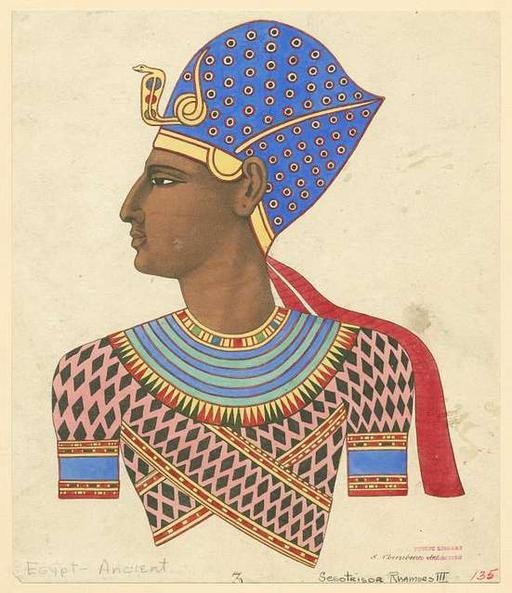
Ramesses II
 Egypt
EgyptAlso known as: Ramesses the Great, Ozymandias
Birthday
-1303
Birth Sign
Capricorn
Birthplace
Ancient Egypt
Age
Died at 90
Height
5 ft 8 in (173 cm)
About
Ramesses II, also known as Ramesses the Great, was the third pharaoh of Egypt's Nineteenth Dynasty, reigning from roughly 1279 to 1213 BC. Born around 1303 BC, he ascended the throne at age 25 and ruled for 66 years, making his the longest reign of any pharaoh. A warrior king, he led at least 15 military campaigns into the Levant and Nubia, reasserting Egyptian control over Canaan and Phoenicia. The Battle of Kadesh, often considered a stalemate, was his most famous confrontation, but he declared victory and later celebrated it in monumental inscriptions. His reign marked the height of the New Kingdom, Egypt's most powerful era, and he was worshipped as a living god. After his death at about age 90, he was buried in KV7 in the Valley of the Kings, though his mummy was later moved to the Royal Cache and discovered in 1881. Today, it resides at the National Museum of Egyptian Civilization in Cairo. Known to the Greeks as Ozymandias, his legacy endures through colossal statues and temples, including the Ramesseum and the rock-cut temples at Abu Simbel. Scholars debate whether he was the pharaoh of the Exodus, but no consensus exists.
Early Life & Background
Ramesses II was born around 1303 BC into the royal family of Egypt's Nineteenth Dynasty, the son of Pharaoh Seti I and Queen Tuya. Growing up in the royal court at Memphis and later at Pi-Ramesses, he received training in military tactics, administration, and religious rites befitting a future pharaoh. His father appointed him as a general in the Egyptian army while still a young prince, giving him command of expeditions and oversight of border fortifications. Inscriptions from Seti's reign show Ramesses accompanying his father on campaigns into the Levant, where he learned the art of war firsthand. He also participated in ceremonial duties, such as the annual Opet Festival at Thebes, and was groomed to take over the throne. By the time Seti died around 1279 BC, Ramesses was already an experienced military leader and administrator, ready to assume power at the age of 25.
Career Growth
Upon assuming the throne, Ramesses II immediately launched campaigns to secure Egypt's borders and reassert influence over territories lost during the late Eighteenth Dynasty. In his first year, he crushed a Nubian revolt and led a campaign into the Levant. The most famous military event of his reign was the Battle of Kadesh around 1274 BC, where he faced the Hittite army under King Muwatalli II. Although Egyptian inscriptions claim a great victory, modern historians view it as a strategic stalemate, with both sides suffering heavy losses. Ramesses nonetheless used the battle to cement his image as a heroic warrior, commissioning detailed reliefs at temples across Egypt. Later, around 1258 BC, he negotiated the earliest known peace treaty with the Hittite king Hattusili III, which brought stability to the region and included the marriage of a Hittite princess to Ramesses. His building program was equally ambitious. He founded a new capital, Pi-Ramesses, in the eastern Nile Delta, which became a major administrative and military hub. He ordered the construction of the rock-cut temples at Abu Simbel, dedicated to himself and Queen Nefertari, and the Ramesseum, his mortuary temple on the west bank of Thebes. He also added to existing sites, including the hypostyle hall at Karnak, and erected colossal statues of himself throughout Egypt. His reign saw a flourishing of art and architecture, and he was deified during his lifetime, with temples built to honor him as a god. After 66 years on the throne, he died around 1213 BC at the age of about 90, leaving a legacy of monumental achievements that would influence Egyptian culture for centuries.
Career Timeline
Public Image & Style
Ramesses II is widely perceived as the archetypal pharaoh of ancient Egypt, embodying power, military might, and architectural grandeur. In modern media, he is often depicted as a warrior king and prolific builder, appearing in films, documentaries, and historical novels. His image is synonymous with the glory of the New Kingdom, and his monuments, especially Abu Simbel, are iconic symbols of Egypt. Public fascination with his reign is sustained by ongoing archaeological discoveries and exhibitions of his mummy and artifacts. While there is no formal fandom, he attracts significant interest from history enthusiasts, and his name is frequently invoked in discussions of ancient Egyptian civilization.
Fame & Fandom (iFAMOUS Rankings)
Three thousand years after his death, the crowd that gathers for Ramesses II is not a cheering mob with signs but a global assembly of archaeologists, historians, and museum-goers. There is no formal name for this collective; they are simply the keepers of his legacy, united by the sheer scale of his stone monuments rather than any shared social media rituals. His influence has never waned because his physical presence remains so dominant across the landscape, from the colossal statues in Luxor to the temples carved into the rock at Abu Simbel. Recent discoveries in 2026, including the recovery of a missing half of a legendary statue and new cartouches at Luxor, have only deepened the academic fervor surrounding his reign. These are not viral fan campaigns but state-sponsored excavations that reveal more about the man who ruled for sixty-six years. The reverence he commands is rooted in history itself, where his propaganda at Kadesh and his architectural excess defined an era. He stands as the definitive pharaoh, a figure whose life was lived entirely in the past yet whose shadow stretches endlessly into the present. This enduring fame is quantified by iFANN Global Fame Rankings, which track global attention across media coverage, search, and consumption signals worldwide. Based on August 2026 data, Ramesses II is the 89th most famous person in Egypt.
Interesting Facts and Legends
Ramesses II often bears the Greek name Ozymandias, immortalized by Percy Bysshe Shelley's sonnet depicting a ruined statue of a proud king. His mummy, discovered in 1881, shows evidence of arthritis and dental issues, and analysis suggests he had red hair dyed with henna. In a unique historical first, the Egyptian government issued a passport for his mummy in 1974 when it traveled to Paris for preservation work. Modern forensic techniques successfully reconstructed his face, making him one of the few pharaohs with such a detailed likeness. Legends of his reign include the Battle of Kadesh, a confrontation often described as a stalemate that he spun into a monumental victory through inscriptions on temple walls. He earned the epithet "the Great" by commissioning more statues and temples than any other ruler, a reputation confirmed by the massive statues found in the Nile Delta. A persistent story involves his mummy being flown to France for health studies, while recent archaeological finds continue to add to his lore, such as the discovery of a lintel pointing to a lost city of Mesen and the unearthing of a Horus Temple.
Notable Quotes
“I am the great ruler who knows no equal; I have fought a million men and stood alone.”
Family & Personal Life
Ramesses II had an exceptionally large family, with over 100 children from numerous wives and concubines. His principal wives included Nefertari, Isetnofret, and several of his own daughters, such as Bintanath and Henutmire, whom he married to maintain dynastic purity. Nefertari was his most beloved consort; he dedicated a temple at Abu Simbel to her and built her an elaborate tomb in the Valley of the Queens. Isetnofret was the mother of his successor, Merneptah, and of Khaemweset, a high priest who oversaw building projects. In his later years, Ramesses married a Hittite princess, Maathorneferure, as part of the peace treaty. His children often held important administrative and religious positions, with Khaemweset known for his restoration of earlier monuments. The royal household was centered at Pi-Ramesses, where the pharaoh lived with his extensive family.
Notable Connections
Ramesses II was the son of Seti I and Queen Tuya, and his most prominent wife was Nefertari. His successor, Merneptah, was one of his many sons. He also had a notable relationship with the Hittite king Hattusili III, with whom he signed a historic peace treaty.
Relationships & Dating History
Ramesses II married several principal wives throughout his life. His first known wife was Isetnofret, likely married around 1290 BC, who bore his successor Merneptah and other children. Nefertari became his Great Royal Wife shortly after his accession around 1279 BC; she was deeply beloved and received a magnificent tomb. Around 1258 BC, he married the Hittite princess Maathorneferure to seal the peace treaty. Later in life, he married his own daughters Bintanath and Henutmire for dynastic reasons. Other wives included Nebettawy, Merytre, and Meritamen. As of 2026, Ramesses II is deceased, and his relationships are studied through historical records and inscriptions.
- MarriedIsetnofret-1290 - -1250Principal wife and mother of Merneptah.
- MarriedNefertari-1279 - -1255Great Royal Wife, deeply loved, with a grand tomb.
- MarriedMaathorneferure-1258 - presentHittite princess married as part of the peace treaty.
- MarriedBintanath-1255 - presentDaughter of Ramesses II and Isetnofret, later a wife.
- MarriedHenutmire-1250 - presentDaughter of Ramesses II, married for dynastic reasons.
- MarriedNebettawy-1240 - presentOne of his many consorts.
- MarriedMerytre-1230 - presentOne of his numerous consorts.
- MarriedMeritamen-1220 - presentPossibly a daughter of Nefertari, later a wife.
Death & Aftermath
Died
-1213 (aged 90)
Death Place
Pi-Ramesses, Nile Delta, Egypt
Cause of Death
Natural causes related to age and infection
Ramesses II died in 1213 BCE within the walls of Pi-Ramesses, the capital city he had constructed in the Nile Delta. Forensic analysis of his mummy later revealed a body ravaged by severe dental abscesses, arthritis, and hardening of the arteries, pointing to natural causes linked to advanced age rather than violence or sudden illness. Ancient records offer no glimpse into his final hours or private thoughts, focusing instead on the state rituals that followed. Priests and nobles orchestrated elaborate funeral rites designed to ensure his safe passage into the afterlife, treating his departure as a critical moment for maintaining Ma'at, the cosmic order. His body was mummified using traditional techniques involving natron salts and resins before being interred in tomb KV7 within the Valley of the Kings. Centuries later, priests moved his remains to the Deir el-Bahari cache to protect them from grave robbers, where they remained hidden until modern discovery. The transition of power proceeded through dynastic tradition, with his son Merneptah ascending the throne without legal contest.
Net Worth (Estate Value)
Priceless
iFANN Editorial Team estimate
Ramesses II's estate defies modern currency, its value residing in the cultural and historical weight of temples, statues, and artifacts that stand as priceless national treasures. His mummy and tomb remain major tourist attractions, generating revenue for the Egyptian economy long after his death. The Egyptian Ministry of Tourism and Antiquities manages these assets under strict legal protection. iFANN's editorial research traces the enduring economic impact of his legacy to the ongoing preservation efforts and international study of his monuments, which continue to draw funding and attention.
Awards & Accolades
View 4 records, honours and achievementsKnown For
Battle of Kadesh
-1274 · Pharaoh and commander
Abu Simbel Temples
-1260 · Patron and builder
Egyptian-Hittite Peace Treaty
-1258 · Pharaoh and signatory
Keywords
Quick Facts
- Profession
- statesperson, pharaoh
- Born
- -1303
- Birthplace
- Ancient Egypt
- Died
- -1213
- Death Place
- Pi-Ramesses
- Gender
- Male
- Spouse
- Nefertari, Isetnofret, Maathorneferure, Bintanath, Henutmire, Nebettawy, Merytre, Meritamen
Personal Details
- Height
- 5 ft 8 in (173 cm)
- Spouse
- Nefertari, Isetnofret, Maathorneferure, Bintanath, Henutmire, Nebettawy, Merytre, Meritamen
- Children
- Over 100, including Merneptah and Khaemweset
Frequently Asked Questions
Who was Ramesses II?
When did Ramesses II rule?
What is Ramesses II famous for?
Was Ramesses II the Pharaoh of the Exodus?
Where is Ramesses II buried?
Similar People
Join the community
fans discussing