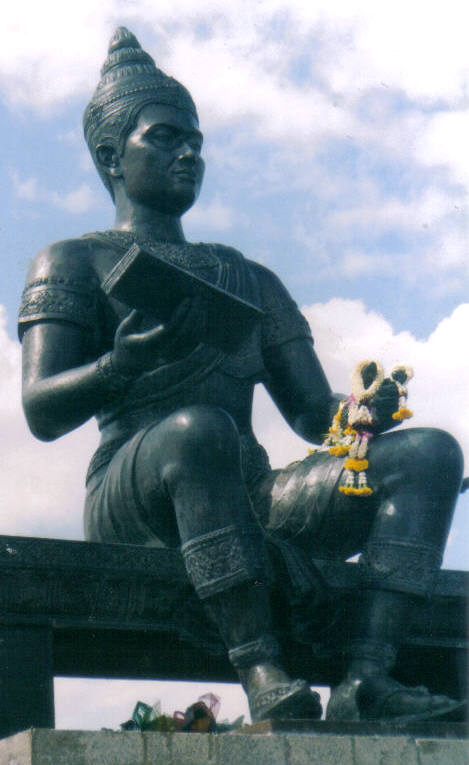
Rama Khamhaeng
 Thailand
monarch•politician•military officer
Birthday
+1239-01-01
Birth Sign
Capricorn
Birthplace
Sukhothai
Age
Died at 59
About
Ramkhamhaeng, also known as Pho Khun Ramkhamhaeng the Great, was the third king of the Phra Ruang dynasty, ruling the Sukhothai Kingdom, a historical polity in what is now Thailand, from 1279 to 1298. Born in Sukhothai in 1239, he ascended to the throne during a period of expansion and prosperity, becoming one of the most celebrated monarchs in Thai history. He is best known for creating the Thai alphabet and for firmly establishing Theravada Buddhism as the state religion, a legacy that endures today.
Fame & Fandom
Rama Khamhaeng commands a legacy of historical magnitude that transcends the ephemeral nature of modern celebrity, securing his place among the most recognized figures in Thai history and Southeast Asian heritage. Current data from the iFANN Global Fame Rankings indicates he is the 21st most famous person in Thailand, a position holding steady from the previous cycle. His standing as an origin figure places him at the 57th most famous person from Thailand, also maintaining its rank without fluctuation. Within the broader regional context, he holds the position of the 69th most famous person in Southeast Asia, having slipped slightly from 68th in the prior assessment. These metrics reflect a sustained engagement with his image across media coverage, search activity, and cultural consumption signals worldwide. The audience surrounding Rama Khamhaeng operates not through organized fan clubs or digital campaigns but through institutional reverence and national education. No formal fandom name exists for this monarch; instead, his following is manifested in the Thai educational system, where schoolchildren study his contributions to literacy and governance, and in the civic pilgrimages to his monuments. Unlike contemporary stars who rely on social media interaction, his "fans" engage with his legacy through the Ram Khamhaeng Inscription, a UNESCO-registered artifact, and the enduring narrative of the Sukhothai Golden Age. This unique form of fandom is characterized by academic discourse and state-sponsored commemoration rather than the participatory culture seen in entertainment sectors.
Interesting Facts and Legends
The Ram Khamhaeng Inscription of 1292 stands as the single most iconic artifact associated with the king, serving as the foundational document for Thai literacy and housed today at the Bangkok National Museum. A persistent legend suggests that Rama Khamhaeng was nearly lost to history before being rediscovered, a narrative often framed in popular media as the story of the Almost Forgotten King. Another widely retold account attributes the invention of the Thai alphabet directly to the monarch, a claim recorded in the inscription itself that has become central to Thai cultural identity. Historians continue to debate the authenticity of these inscriptions, with some scholars arguing they may be a 19th-century fabrication designed to legitimize later dynastic claims, while others maintain their validity as genuine 13th-century records. The inscription describes a utopian kingdom under his rule that lacked tolls and enabled free trade, creating a lasting image of Sukhothai as a prosperous realm. Modern commemorations occasionally spark controversy, such as a military probe into corruption allegations involving royal statues, which highlighted the ongoing tension between veneration and administrative reality. Despite these debates, the narrative of the Model King remains a dominant force in Thai historiography, portraying him as the ideal ruler of benevolence and wisdom.
Death & Aftermath
Died
+1298 (aged 59)
Death Place
Unknown
Cause of Death
Unknown
The passing of King Ramkhamhaeng in the late thirteenth century marked the end of a reign that defined the cultural and religious landscape of the Sukhothai Kingdom. Historical consensus places his death around the year 1298, ending a rule that began in 1279, yet the precise circumstances of his final days, the location where he expired, or any medical cause remain absent from the surviving stone inscriptions and royal records of the era. Unlike contemporary figures whose deaths trigger forensic inquiries or legal investigations, the monarch's transition was a matter of dynastic succession, coroner ruling, or police inquest to document the event.
His legacy, however, was secured not through immediate posthumous honors but through the monumental inscription commissioned during his lifetime, which was rediscovered centuries later by King Mongkut in 1833. This artifact, now recognized as a UNESCO World Heritage item, stands as the primary reflection of his reign and serves as the earliest known example of the Thai script. Modern commemorations include the annual observance of King Ramkhamhaeng the Great Day and the erection of statues across Thailand, while the cultural memory of the king is further preserved in dramatic productions such as Anuphap Pho Khun Ram Khamhaeng.
Awards & Accolades
Keywords
Quick Facts
- Profession
- monarch, politician, military officer
- Born
- +1239-01-01
- Birthplace
- Sukhothai
- Died
- +1298
- Death Place
- Sukhothai
- Gender
- Male
- Birth Sign
- Capricorn
Join the community
fans discussing