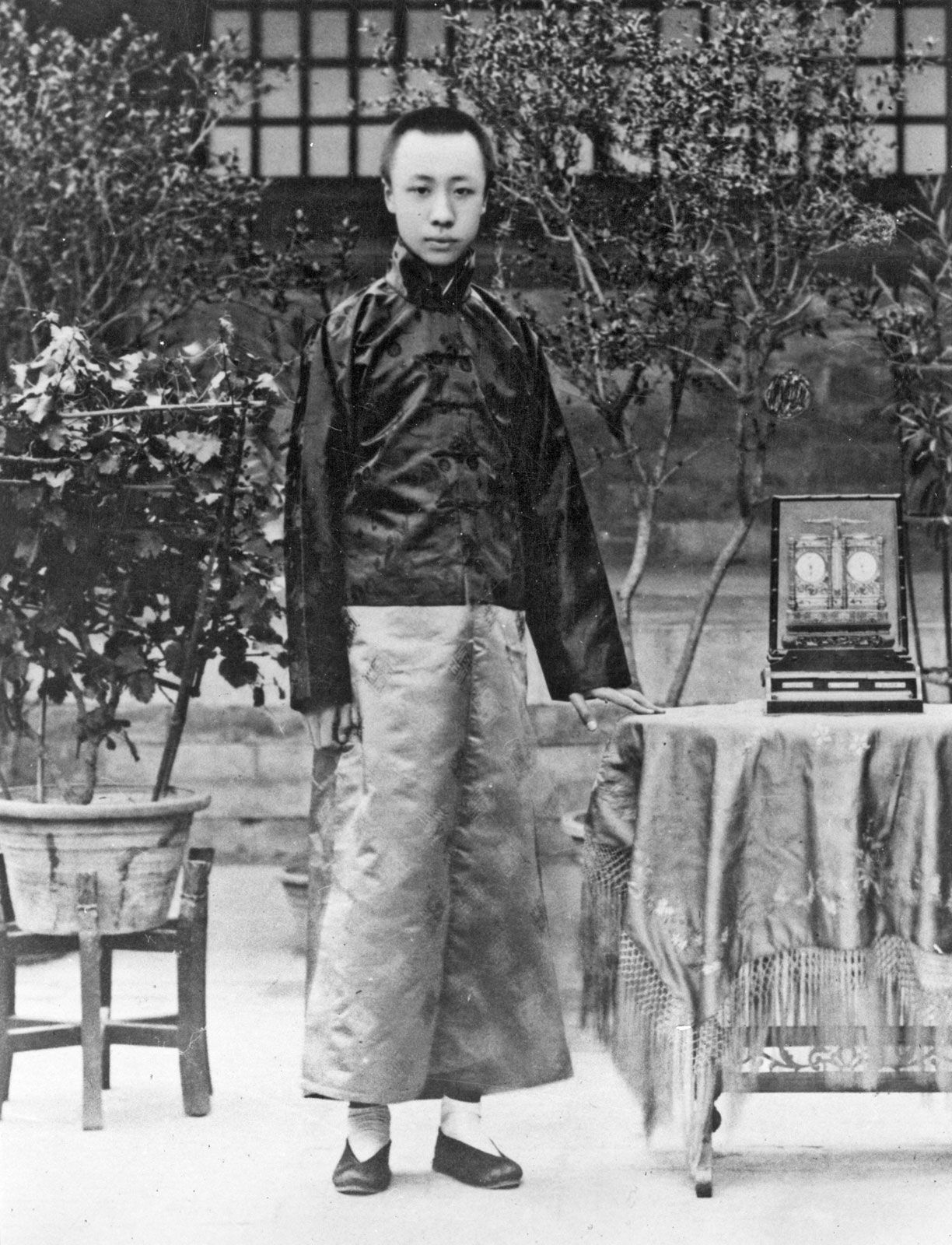
Puyi
 China
Also known as: Henry Puyi, Xuantong, Yaozhi, Kangde, Henry Pu-yi, Kang-te Emperor, Haoran, Aixinjueluo Puyi
Birthday
February 7, 1906
Birth Sign
Aquarius
Birthplace
Prince Chun Mansion, Beijing
Age
Died at 61
Height
5 ft 8 in (173 cm)
About
Puyi was the last emperor of China and the final monarch of the Qing dynasty. Born Henry Puyi into the Aisin Gioro clan, he ascended the throne at the age of two in 1908 following the death of Emperor Guangxu and Empress Dowager Cixi. His reign ended abruptly in 1912 with the Xinhai Revolution, which abolished over two thousand years of imperial rule in China. Despite abdication, he retained his title and lived within the Forbidden City until 1924, when he was expelled by General Feng Yuxiang.
His life took a dramatic turn when Japan installed him as the puppet ruler of Manchukuo in 1932, a position he held until the end of World War II. Captured by Soviet forces in 1945, he spent several years in captivity before being repatriated to the People's Republic of China. After serving time as a war criminal, he was granted amnesty in 1959 and worked as a gardener and archivist until his death in 1967. His memoirs, published posthumously, remain a significant historical document.
Early Life & Background
Puyi was born on February 7, 1906, at the Prince Chun Mansion in Beijing. He was the second son of Zaifeng, Prince Chun, and Princess Tonggu. His entry into the Forbidden City was sudden and jarring; at just twenty-eight months old, he was proclaimed the Xuantong Emperor following the deaths of Emperor Guangxu and Empress Dowager Cixi in November 1908. The transition was orchestrated by the court to ensure continuity, but it left the toddler isolated from normal human interaction. He was treated as a divine figure, surrounded by eunuchs and concubines who feared him rather than loved him.
His early education was a mix of traditional Confucian instruction and exposure to Western culture through tutors like Thomas Francis Wade and later Reginald Johnston. This dual influence created a unique perspective that contrasted sharply with the rigid rituals of the palace. In 1912, at age six, he was forced to abdicate following the Xinhai Revolution. Although he lost his throne, he remained in the Inner Court of the Forbidden City under the Articles of Favorable Treatment. A brief restoration attempt in 1917 by warlord Zhang Xun saw him back on the throne for only twelve days before being defeated. In 1924, General Feng Yuxiang expelled him from the Forbidden City, ending his life as a prisoner-monarch and forcing him into exile in Tianjin.
Career Growth
Puyi's career spanned distinct political phases, each defined by shifting power dynamics in China. From 1908 to 1912, he reigned as the Xuantong Emperor of the Qing Dynasty. Following his abdication, he retained his title while living in the Forbidden City until 1924. In 1917, he was briefly reinstated as Emperor for twelve days during the Zhang Xun restoration attempt. From 1924 to 1931, he lived in exile in Tianjin, exploring modern interests like photography, cars, and tennis while attempting to regain power through various alliances.
In 1932, Japan installed him as the head of state of Manchukuo, a puppet state in Northeast China, taking the reign title "Kangde." During this period, he acted as a figurehead for Japanese imperialism until 1945. Captured by Soviet forces at the end of World War II, he was held as a prisoner of war in the Soviet Union from 1945 to 1950. Repatriated to China, he was imprisoned as a war criminal in the Fushun War Criminals Management Centre, undergoing ideological re-education. In September 1959, he was granted amnesty and worked as a researcher and archivist at the Chinese Academy of Social Sciences and the Palace Museum. He also served as a gardener at the Palace Museum and became a member of the National People's Congress until his death.
Career Timeline
Public Image & Style
Puyi is often portrayed as a tragic figure, a victim of circumstance, and a symbol of the end of an era. Media depictions oscillate between showing him as arrogant and vulnerable, reflecting the complexity of his transformation from absolute ruler to re-educated citizen. His public image is one of a man caught between worlds: the ancient imperial past and the modern republican present. He is remembered for his resilience and his ability to adapt to changing political landscapes, even when those changes were imposed upon him.
Fame & Fandom (iFAMOUS Rankings)
Puyi never courted a crowd. He lived as a toddler on a throne, then as a puppet in Manchuria, and finally as a gardener tending flowers in Beijing. His life ended in 1967, decades before social media could turn a biography into a fandom. No organized fanbase exists for the last emperor of China. There are no monikers for his admirers, no birthday billboards, and no campaigns to keep his name trending. The modern attention he garners comes from historians, filmmakers, and viewers of documentaries rather than a dedicated legion of fans. While a recent viral lookalike has fooled AI systems and sparked internet chatter, that phenomenon belongs to a performer, not the historical figure himself. The story of Puyi remains one of tragic isolation rather than public adoration. Yet his global footprint endures through the sheer weight of his history. According to the iFANN Global Fame Rankings, he is currently the 18th most famous person from China, holding steady from the previous cycle. These figures reflect a legacy measured in historical impact rather than contemporary fan engagement.
Interesting Facts and Legends
Puyi was the youngest emperor in Chinese history, ascending the throne at just two years old. He was the first Chinese emperor to own a car and play tennis, embracing Western hobbies during his time in Tianjin. His memoir, From Emperor to Citizen, was written in the 1950s and published posthumously in 1967, becoming a seminal text on Chinese history. A legendary moment from his post-monarchy life involves a Patek Philippe watch once owned by him selling for $6.2 million at auction in 2023, setting a record for timepieces worn by a Chinese emperor. This sale highlighted the enduring fascination with his material wealth and royal status. Another modern legend centers on a lookalike actor who recently gained viral fame for mimicking the emperor so convincingly that digital verification tools were deceived.
Notable Quotes
“I am a man, not a god.”
“The world has changed, and I have changed with it.”
“I was born a prince, I died a citizen.”
Family & Personal Life
Puyi was born into the Aisin Gioro clan, the second son of Zaifeng, Prince Chun, and Princess Tonggu. His upbringing was marked by extreme privilege but profound loneliness, as he was separated from his parents after his accession to the throne. He had no children from any of his marriages, a fact that contributed to the end of the imperial line. His wives included Empress Wanrong, Consort Wenxiu, Consort Yu, and Li Shuxian. All of his marriages were childless, and he outlived all of them. His family life was largely defined by the rigid structures of the imperial court and the political upheavals that followed.
Notable Connections
Relationships & Dating History
Puyi had four wives throughout his life, reflecting his transition from imperial tradition to modern reality. His first marriage was to Empress Wanrong in 1922 when he was sixteen and she was fifteen. The marriage was arranged by the Qing court and initially shared a deep bond, but their relationship deteriorated due to Wanrong's opium addiction, Puyi's growing interest in Western culture, and conflicting political loyalties. They ceased cohabiting after 1931 and never legally divorced. Wanrong died in 1946.
Consort Wenxiu was married in 1922 but separated shortly after due to incompatibility. She left the Forbidden City in 1931. Later, Puyi married Li Yuqin in 1937 in Manchukuo. She was a former teacher, and the marriage was politically motivated to produce an heir, but they had no children together. The relationship was strained by Puyi's obsession with producing a male heir. Finally, he married Li Shuxian in 1943, but this marriage also produced no children. All of his wives predeceased him, leaving him widowed at the time of his death.
- MarriedEmpress Wanrong1922 - 1931Arranged marriage; separated due to addiction and political differences; no children.
- MarriedConsort Wenxiu1922 - 1931Separated due to incompatibility; left Forbidden City in 1931.
- MarriedConsort Yu (Li Yuqin)1937 - 1945Marriage in Manchukuo; no children.
- MarriedLi Shuxian1943 - 1945Final marriage; no children.
Death & Aftermath
Died
October 17, 1967 (aged 61)
Death Place
Beijing, China
Cause of Death
Uremia and heart failure
Aisin-Gioro Puyi died on October 17, 1967, at the age of sixty-one in Beijing. The official cause of death was recorded as uremia and heart failure, complications arising from long-term kidney disease and general frailty. He passed away during the height of the Cultural Revolution while undergoing re-education as a former war criminal. His final days were marked by isolation within the political turmoil of the era, where his status as a deposed monarch offered little protection from the surrounding chaos.
Immediate public reaction was muted by the prevailing political atmosphere. No large-scale vigils or memorial services were held at the time, reflecting the sensitive nature of his identity as a former emperor under a communist regime. Decades later, historical interest resurfaced with retrospective pieces like the 2017 South China Morning Post feature remembering China's last emperor. His personal legacy eventually included the auction of his Calatrava 96 wristwatch for $6.2 million in Hong Kong in May 2023, alongside ongoing biographical documentaries and books that continue to explore his complex life story. A lookalike actor named Fu gained viral attention in 2025 for portraying Puyi in dramas and deceiving AI systems, further cementing his place in modern cultural discourse.
Net Worth (Estate Value)
$0
iFANN Editorial Team estimate
Puyi did not possess a personal net worth in the modern sense. As a monarch, he controlled state assets, but as a private citizen, he owned very little. His primary asset was a Patek Philippe Calatrava watch, which sold for $6.2 million at auction in 2023. This sale represented a direct return to his estate or heirs, managed by descendants or the Chinese government. His legacy generates revenue through book royalties from From Emperor to Citizen, film rights related to The Last Emperor, and museum collections that generate tourism revenue. The iFANN Editorial Team estimates the cultural and commercial value of his IP at tens of millions of dollars annually, though no formal estate valuation exists.
Awards Won (1)
Puyi did not receive traditional entertainment awards. However, his life story inspired the Oscar-winning film The Last Emperor, which won nine Academy Awards. His memoir From Emperor to Citizen remains a significant historical text. He was granted amnesty in 1959, a unique honor for a former war criminal.
1959 · Political Recognition
Re-education Program
Known For
The Last Emperor
1987 · Subject
From Emperor to Citizen
1967 · Author
Keywords
Sources
Quick Facts
- Profession
- gardener, archivist, aristocrat
- Born
- February 7, 1906
- Birthplace
- Prince Chun Mansion
- Died
- October 17, 1967
- Death Place
- Peking Union Medical College Hospital
- Gender
- Male
- Spouse
- Empress Wanrong, Tan Yuling, Wenxiu, Li Yuqin, Li Shuxian
- Birth Sign
- Aquarius
Personal Details
- Full Name
- Aisin-Gioro Puyi
- Height
- 5 ft 8 in (173 cm)
- Spouse
- Empress Wanrong, Consort Wenxiu, Consort Yu, Li Shuxian
- Children
- Education
- Western tutors including Thomas Francis Wade and Reginald Johnston; self-study in Beijing
Filmography
1
Total
1
Film
0
TV
Frequently Asked Questions
Who was Puyi?
How did Puyi die?
Did Puyi have children?
What is the value of Puyi's watch?
Was Puyi a war criminal?
Similar People
Join the community
fans discussing