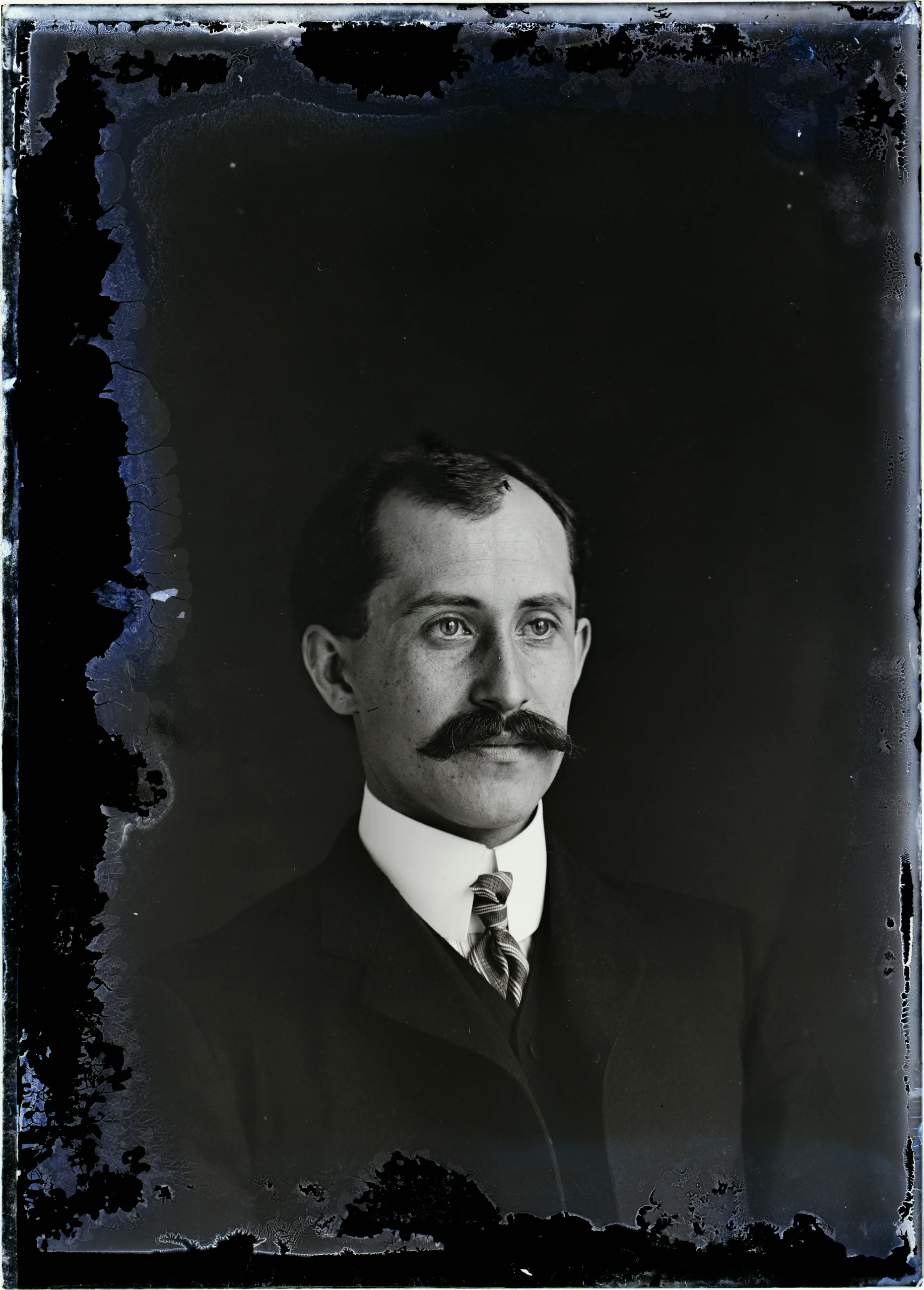
Orville Wright
 United States
Inventor•aviation pioneer•aircraft manufacturer
Also known as: Orville Wright, Wright brothers
Birthday
August 19, 1871
Birth Sign
Leo
Birthplace
Dayton, Ohio, United States
Age
Died at 76
Height
5 ft 10 in (178 cm)
About
Orville Wright was an American inventor, aviation pioneer and aircraft manufacturer, and the younger half of the pair known to history as the Wright brothers. With his elder brother Wilbur, he designed and built the first powered, heavier-than-air machine to achieve sustained, controlled flight, at Kill Devil Hills near Kitty Hawk, North Carolina, on December 17, 1903. Orville was at the controls for that first twelve-second hop, which covered 120 feet.
He is remembered as the more mechanically absorbed of the two, a self-taught engineer with a gift for instruments and precision. Beyond the 1903 flight, his name attaches to the three-axis control system that made practical flying possible, to the Wright Military Flyer adopted by the U.S. Army in 1909, and to the Wright Company, which he led alone after Wilbur's death in 1912 and sold in 1915.
Orville never married and had no children. In his later decades he served on the National Advisory Committee for Aeronautics and acted as an elder figure in American aviation. He died in Dayton on January 30, 1948, at 76.
Early Life & Background
Born in Dayton, Ohio, on August 19, 1871, Orville was the fourth of seven children of Milton Wright, a bishop in the Church of the United Brethren in Christ, and Susan Koerner Wright. The family moved repeatedly for Milton's church duties before returning to Dayton. Neither Orville nor Wilbur finished high school; the household supplied the education instead. Their mother had a mechanical aptitude and a habit of building small appliances at home, and their father's library was large enough to keep two curious boys occupied for years.
A toy is usually credited with starting it. In 1878 Milton brought home a small rubber-band-powered flying device, a helicopter of the kind designed by Alphonse Pénaud, and the brothers wore it out experimenting with it. Orville later said the toy was the beginning of their interest in flight, though the claim has the polished shape of a story told many times.
Orville's first trade was printing. Around 1889 he built a press of his own design out of odds and ends, then a second, and used them to publish a short-lived weekly paper, the West Side News, later a job-printing business. Wilbur joined him. The printing work paid poorly and the brothers moved on to bicycles, opening the Wright Cycle Company in Dayton in 1892 and eventually running a shop and a small manufacturing line. Bicycles gave them a steady income and, more usefully, a working knowledge of balance, chain drives and lightweight frames.
The turn toward aviation came in the late 1890s. Reports of Otto Lilienthal's gliding death in 1896 set them reading, and they worked through what literature existed on flight, wrote to the Smithsonian Institution for references, and studied the published aerodynamic tables. Finding the standard lift figures unreliable, they built a wind tunnel in the back of the shop in 1901 and tested more than two hundred wing shapes, producing their own tables. That habit of checking the authorities rather than trusting them is the part of the Wright method most often cited by engineers.
Career Growth
The glider work at Kitty Hawk ran from 1900 to 1902. The first two machines performed poorly, but the 1902 glider, fitted with a movable rudder linked to a wing-warping mechanism, gave the brothers control about all three axes: pitch, roll and yaw. That system, more than the engine, is what separated them from every experimenter before them.
On December 17, 1903, at Kill Devil Hills, the Wright Flyer made four flights. The first, piloted by Orville, lasted twelve seconds and covered 120 feet. The fourth, with Wilbur aboard, went 852 feet in 59 seconds. Only a handful of witnesses were present, and a single photograph by John T. Daniels recorded the moment.
Work continued in Ohio pastures through 1904 and 1905, where the Flyer III became the first aircraft capable of repeated, controlled circuits and landings. The brothers then spent nearly three years seeking patents and buyers before public demonstrations in 1908 and 1909 in France and at Fort Myer, Virginia, made them famous and settled the question of whether powered flight was real.
In 1909 Orville flew a biplane to Shuter's Hill in Alexandria, Virginia, a demonstration tied to the Army's purchase of the Wright Military Flyer. That year the brothers formed the Wright Company to build aircraft. In 1911 Orville set a soaring endurance record in the Wright glider at Kitty Hawk, staying aloft nine minutes and forty-five seconds. Wilbur died of typhoid in 1912, and Orville took sole charge of the company before selling it in 1915. He spent the following decades on the National Advisory Committee for Aeronautics, in patent litigation, and in the long dispute with the Smithsonian over the institution's early claims for Samuel Langley.
Career Timeline
Public Image & Style
The public image of the Wright brothers is that of the American tinkerers: two bicycle mechanics from Ohio who solved a problem the world's engineers had failed at, using a wind tunnel they built themselves and an insistence on testing rather than trusting received authority. Orville is usually drawn as the quieter and more mechanically fixated of the pair, the one who kept the instruments and the shop in order, while Wilbur took the role of spokesman and theorist.
Orville's later public presence was that of a guarded elder. He wore a plain suit, gave few interviews, and spent decades in patent fights and in defending the brothers' priority against the Smithsonian, which had once labelled Langley's failed Aerodrome as the first machine capable of flight. He was not a warm public figure. Contemporaries described him as dry, exact and impatient with exaggeration, and he was known to correct journalists on the details of the 1903 flights.
The photographs reinforce the image. In most of them the brothers appear in stiff collars and cloth caps, unsmiling, standing beside a machine of wood, wire and muslin. That visual, more than any written account, fixed them in the popular imagination as craftsmen rather than as industrialists.
Fame & Fandom (iFAMOUS Rankings)
iFANN has not yet collected fame data for Orville Wright, so no placement in the Global Fame Rankings is available for him. He does not appear on the September 2026 iFAMOUS Rankings flagship list.
There is no formal fanbase and no fandom name. The audience that keeps his name in circulation is made up of aviation enthusiasts, historians, model builders and the staff of the institutions that hold the Wright material: the National Park Service at the Wright Brothers National Memorial at Kill Devil Hills, the Smithsonian National Air and Space Museum, and the archives at Wright State University. Their activity takes the shape of museum attendance, reenactments, restoration work and the annual observance of National Aviation Day on August 19, Orville's birthday.
Interest spikes on anniversaries. December 17 brings coverage of the first flight, and the date is marked by aviation organisations, flight schools and the memorial site itself. The Experimental Aircraft Association holds a Wright Brothers Memorial Banquet, and pilots still cite the twelve-second, 120-foot first hop as the reference point for the beginning of powered flight. The engagement runs toward preservation rather than toward celebrity: people visit the site, read the papers, and argue about propeller design and lift tables, which is roughly what Orville would have preferred.
Interesting Facts and Legends
Before the first flight the brothers flipped a coin to decide who would go up first. Orville won the toss and made the twelve-second hop; Wilbur got the fourth and longest flight of the day.
In September 1908, at Fort Myer, Virginia, a propeller failure sent Orville's machine into the ground. His passenger, Lieutenant Thomas Selfridge, died of a fractured skull that evening, the first fatality in a powered airplane. Orville broke a leg, several ribs and a hip and spent weeks in hospital; he carried a limp and back pain for years afterward.
He was a keen photographer and took many of the images now used to document the early flights, though he did not take the famous first-flight photograph; that was John T. Daniels, a life-saving station crewman who had never handled a camera.
A story historians still field from the public is that the 1903 flights never happened, or happened later than claimed. The claim resurfaces periodically and is answered with the photographic record, the witnesses and the brothers' own correspondence. It survives mainly because so few people saw the flights in person.
Notable Quotes
“We were lucky enough to grow up in an environment where there was always much encouragement to children to pursue intellectual interests, to investigate whatever aroused curiosity.”
“The airplane stays up because it doesn't have the time to fall.”
“I don't know whether you can call it flying or not, but it stayed up twelve seconds.”
Family & Personal Life
Orville was the fourth of seven children born to Milton Wright, a bishop of the Church of the United Brethren in Christ, and Susan Koerner Wright. His siblings included Wilbur, born in 1867, and Katharine, born in 1874, who became the household's organizing force. Two siblings, Otis and Ida, died in infancy.
Susan Wright died of tuberculosis in 1889, when Orville was seventeen. Katharine, the only Wright sibling to earn a college degree, taught at Steele High School in Dayton and ran the family house on North Hawthorne Street, managing the brothers' domestic affairs through the Kitty Hawk years and the European tours. Her marriage in 1926 to Henry Haskell, an Oberlin classmate, upset Orville badly; the rift lasted until Katharine's death from pneumonia in 1929, and Orville was said to have regretted the estrangement.
Orville never married and had no children. After Wilbur's death in 1912 and Katharine's in 1929, he lived largely alone in the Dayton house, attended by a housekeeper, and spent his last years maintaining the family's records and answering correspondence about the early flights.
Notable Connections
Orville's career is inseparable from his brother Wilbur Wright, the partner in every experiment from the 1890s to Wilbur's death in 1912. Their sister Katharine Wright ran the household and travelled with them to Europe in 1909. Charles Taylor, a machinist hired for the bicycle shop, built the engine for the 1903 Flyer. Lieutenant Thomas Selfridge died in the 1908 Fort Myer crash with Orville aboard. Glenn Curtiss became the brothers' chief rival in the patent disputes that consumed much of Orville's later life.
Relationships & Dating History
Orville Wright never married, and no romantic partner is documented in the public record. He lived most of his adult life in the family house in Dayton, and the central relationship of his domestic life was with his sister Katharine Wright, who kept the household, taught school, and accompanied the brothers on their European trips in 1909.
Katharine's marriage in 1926 to Henry Haskell, a classmate from Oberlin College, came as a shock. Orville did not attend the wedding, and the breach between brother and sister lasted until her death from pneumonia in 1929. He was reported to have been deeply affected by the estrangement and by her death.
His closest relationship of all was with Wilbur. The brothers worked together daily from the late 1880s until Wilbur's death from typhoid in 1912, and Orville's later correspondence returns to him repeatedly. Wilbur's death at 45 left Orville as sole head of the business and, by his own account, without the collaborator he relied on.
Speculation that Orville had romantic feelings for Katharine circulates online and appears in search queries. No credible source supports it, and the claim is best treated as internet folklore. At the time of his death in 1948 he was unmarried, had no children, and had outlived both his siblings.
Death & Aftermath
Died
January 30, 1948 (aged 76)
Death Place
Dayton, Ohio, United States
Cause of Death
Heart attack
Orville Wright died at 2:45 in the morning on January 30, 1948, in Dayton, Ohio, at the age of 76, following a series of heart attacks that had begun in the preceding weeks. He had been the last surviving Wright brother since Wilbur's death from typhoid in 1912, and his passing closed the family's direct role in the enterprise it had founded.
News of the death ran on front pages across the country. Tributes came from the institutions that had grown up around the brothers' work: the National Advisory Committee for Aeronautics, on which Orville had sat for nearly three decades, and the Smithsonian, with which the brothers had once fought a bitter priority dispute. Aeronautical societies in Europe and the United States published memorial notices. President Harry Truman issued a statement crediting the Wright brothers with having opened the air age.
A funeral service was held in Dayton, and Orville was buried in the family plot at Woodland Cemetery, alongside Wilbur, Katharine and their parents. The grave sits on a rise in the cemetery and remains a site of occasional public observance.
Honours accumulated after his death rather than during his final years. The Wright brothers had received the Congressional Gold Medal in 1909, and both were inducted into the National Inventors Hall of Fame. National Aviation Day, proclaimed by President Franklin Roosevelt in 1939 to fall on Orville's birthday of August 19, is observed annually. The Wright Brothers National Memorial at Kill Devil Hills, North Carolina, marks the site of the 1903 flights, and the 1903 Flyer hangs in the Smithsonian National Air and Space Museum in Washington.
The Wright family papers, including Orville's correspondence and business records, passed through family hands and later to public custody; a federally funded conservation treatment of the collection at Wright State University was reported in 2026. No major estate litigation followed his death, and no children survived him.
Net Worth (Estate Value)
$3 Million
iFANN Editorial Team estimate
Orville Wright left an estate that made him wealthy by the standards of his time, though the exact figure was never published in a form that modern researchers can verify. His money came from three sources: the sale of the Wright Company in 1915, the patent royalties the brothers collected on their flying-machine patents, and a long period of conservative investment in Dayton property and securities.
The patent income was the substantial part. The Wrights' 1906 patent on three-axis control gave them leverage over every American aircraft builder, and the resulting suits against Glenn Curtiss and others produced licensing payments and, in 1914, a court judgment in the brothers' favour. Orville sold the company to a New York syndicate in 1915 for a sum reported at the time in the low hundreds of thousands of dollars, a considerable amount for a business with modest sales.
He lived without display. The Dayton house was comfortable rather than grand, and his known expenditures ran to books, photographic equipment and the care of the family papers. He left no children and no spouse, and the estate passed to relatives and to the institutions that would hold the Wright records.
No reliable modern valuation of the estate exists. Celebrity net-worth outlets do not cover nineteenth-century figures, and the surviving probate material is not in general circulation. The iFANN Editorial Team's reading of the documented earnings, the 1915 sale and the patent income places the equivalent current value of Orville Wright's estate at roughly $3 Million, a figure offered as an editorial estimate rather than a recorded sum. The Wright family papers, now conserved at Wright State University.
Awards Won (2)
Orville Wright received the Congressional Gold Medal with his brother Wilbur in 1909, the year their flying machine was accepted by the U.S. Army. Both brothers were inducted into the National Inventors Hall of Fame. He also received honorary degrees and medals from American and European aeronautical societies in the years after the 1908 demonstration flights.
1909 · National honour
Wright brothers' achievement in powered flight
1975 · Induction
Flying machine and three-axis control
Known For
First powered, sustained, controlled flight (Wright Flyer)
1903 · Pilot of the first flight
Three-axis control system for aircraft
1902 · Co-inventor with Wilbur Wright
Wright Military Flyer
1909 · Designer and demonstration pilot
Wright Company
1909 · Co-founder and later sole head
Keywords
Sources
Quick Facts
- Profession
- inventor, businessperson, aircraft pilot
- Born
- August 19, 1871
- Birthplace
- Dayton, Ohio, United States
- Died
- January 30, 1948
- Death Place
- Dayton, Ohio, United States
- Gender
- Male
- Birth Sign
- Leo
- Height
- 5 ft 10 in (178 cm)
- First flight
- December 17, 1903, Kill Devil Hills, North Carolina
Personal Details
- Full Name
- Orville Wright
- Height
- 5 ft 10 in (178 cm)
- Education
- Attended high school in Dayton but did not graduate
Frequently Asked Questions
How old was Orville Wright when he died?
What is Orville Wright best known for?
Did Orville Wright ever marry or have children?
What did Orville Wright do after Wilbur died?
Who was the first person to fly, Orville or Wilbur Wright?
Similar People

Join the community
fans discussing