“Refn has made a movie that is so uncompromisingly strange, so aggressively alienating, that it feels like a test of endurance rather than a piece of entertainment.”
A.O. Scott
The New York Times
 United States
"Time to meet the Devil."
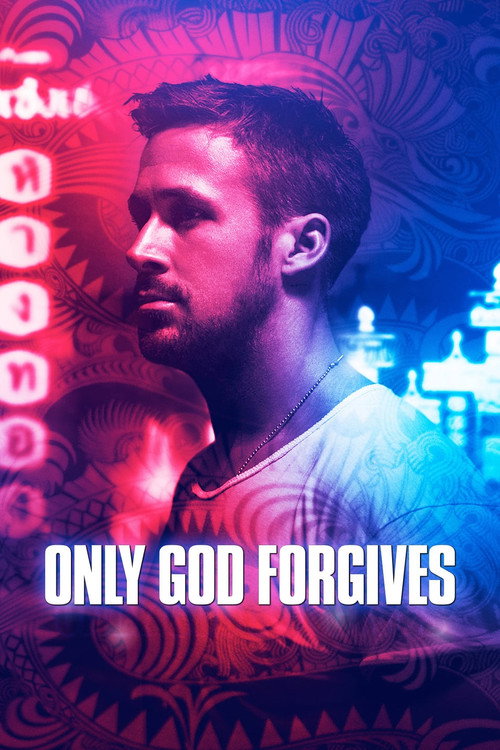
Director Nicolas Winding Refn returns to the neon-soaked streets of Bangkok with a film that feels less like a story and more like a fever dream. Ryan Gosling plays Julian, an American expatriate who runs a Muay Thai gym by day while managing his family's drug trade by night. His life remains suspended in a state of quiet desperation until tragedy strikes his brother Billy, shattering the fragile equilibrium of their criminal empire.
The arrival of Crystal, Julian's terrifying mother played by Kristin Scott Thomas, turns the heat up to a breaking point. She demands retribution for her son's death, forcing Julian into a deadly game of cat and mouse against Chang, the local gang leader responsible for the killing. The narrative unfolds not through traditional dialogue but through glacial pacing, stylized violence, and a haunting score by Cliff Martinez that pulses like a second heartbeat.
Availability and pricing can change. Confirm on the provider's site before purchasing.
Bangkok hums with a relentless energy under layers of humidity and neon light. Julian operates out of a sleek boxing club that doubles as a distribution hub for his family's illegal operations. He lives alongside his younger brother Billy, a volatile man whose recklessness eventually spirals out of control. One evening, Billy gets into a dispute over a stolen motorcycle with Mai, a young pregnant woman. When she refuses to hand over the bike, Billy beats her to death. Her partner, Chang, a ruthless gang boss, retaliates by hunting down Billy and murdering him in cold blood.
Julian finds himself paralyzed by grief when he discovers his brother's body. He does not immediately seek revenge; instead, he retreats into silence, haunted by the image of what he has become. His mother Crystal arrives from London, bringing a presence that chills the air in the sterile, Buddhist-filled home they share. She views Billy's death not just as a loss but as a personal insult that must be answered with extreme prejudice. She commands Julian to kill Chang himself, threatening to execute him if he fails to comply.
Julian attempts to navigate this impossible directive while dodging the scrutiny of Inspector Gordon Brown, a weary police officer who suspects Julian's involvement in the city's darker crimes. The investigation becomes a surreal journey through the labyrinthine alleys of Chinatown and the opulent nightclubs of the wealthy district. Julian visits Mai, the widow of the girl Billy killed, trying to understand the depth of the pain he helped create. Their interactions are filled with unspoken trauma and heavy silence.
As Julian tracks Chang, the film shifts into a hallucinatory rhythm. The city itself seems to breathe, pulsating with a hypnotic energy that mirrors Julian's internal disintegration. Neon signs cast long shadows across faces that rarely show emotion. The confrontation between Julian and Chang is not merely a physical fight but a spiritual clash. Julian moves through the city like a ghost, engaging in slow-motion violence that feels ritualistic rather than urgent. He confronts the futility of revenge and the crushing weight of his mother's expectations.
The tension builds toward a fever-dream climax where Julian finally corners Chang in a secluded temple. The encounter defies the audience's expectation of a standard action sequence. Instead of a brawl, it becomes a moment of strange mercy followed by brutal necessity. Julian stabs Chang repeatedly, only to find that the act of killing does not bring the relief he expected. The cycle of violence continues to spiral, pulling Julian deeper into a moral abyss where redemption seems impossible yet inevitable.
Official UK Trailer
Official Trailer
Critical Consensus
Visually stunning and atmospherically dense, Only God Forgives divides critics with its extreme stylistic choices and deliberate pacing. Many praise its unique aesthetic and bold direction, yet others find it emotionally cold and narratively hollow, resulting in a polarizing reception that separates fans of Refn's work from general audiences.
“Refn has made a movie that is so uncompromisingly strange, so aggressively alienating, that it feels like a test of endurance rather than a piece of entertainment.”
A.O. Scott
The New York Times
“It's a beautiful disaster, a neon-soaked nightmare that refuses to let you look away. Gosling is mesmerizing, and the visuals are unlike anything you've ever seen.”
Peter Travers
Rolling Stone
“Refn has created a film that is both a masterpiece of style and a failure of substance, a dazzling visual feast that leaves the heart cold and the mind confused.”
Richard Corliss
Time Magazine
“A hallucinogenic trip through the Bangkok underworld that is as much about the director's ego as it is about the characters, Only God Forgives is a film that demands to be experienced, even if it doesn't always make sense.”
David Ehrlich
IndieWire
Ryan Gosling
Julian
Kristin Scott Thomas
Crystal
Vithaya Pansringarm
Chang
Rhatha Phongam
Mai
Gordon Brown
Inspector Gordon
Tom Burke
Billy
Director
Nicolas Winding Refn
Writer
Nicolas Winding Refn
Composer
Cliff Martinez
Cinematographer
Larry Smith
Producers
Lene Børglum, Sidonie Dumas, Vincent Maraval, Jessica Ask, Jacob Jarek
Cannes Film Festival (2013)
Palme d'Or: Nominated
Golden Globe Awards (2014)
Best Supporting Actress – Motion Picture: Nominated
BAFTA Awards (2014)
Best Original Music: Nominated
Saturn Awards (2014)
Best International Film: Nominated
Join the community
fans discussing