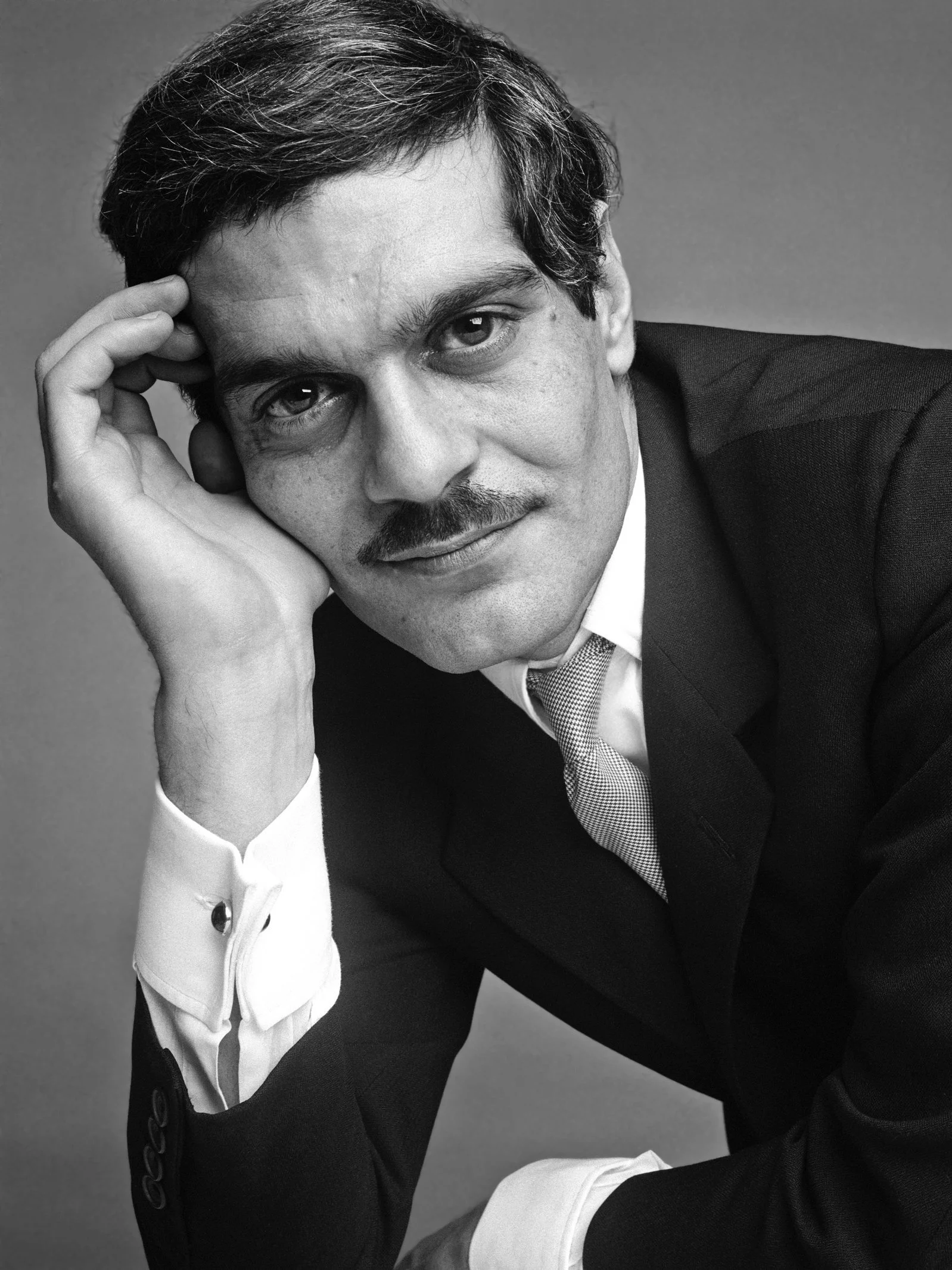
Omar Sharif
 Egypt
EgyptAlso known as: Omar el-Sherief, Omar Cherif, Michel Dimitri Chalhoub, Michel Demitri Shalhoub, Michel Yusef Dimitri Chalhoub
Birthday
April 10, 1932
Birth Sign
Aries
Birthplace
Alexandria, Egypt
Age
Died at 83
About
Omar Sharif was an Egyptian actor who became one of the most recognizable faces in international cinema. Born Michel Yusef Dimitri Chalhoub in Alexandria, he started in Egyptian films and quickly became a star in his homeland, often cited as Egypt's greatest male film star. Over five decades, he appeared in more than 100 films, earning three Golden Globe Awards and a César Award for Best Actor.
Sharif's breakthrough came with David Lean's epic Lawrence of Arabia (1962), where he played Sherif Ali opposite Peter O'Toole. The role earned him an Academy Award nomination for Best Supporting Actor. He then starred in Lean's Doctor Zhivago (1965), winning the Golden Globe for Best Actor. Sharif continued with major roles in Funny Girl (1968) opposite Barbra Streisand and The Tamarind Seed (1974). His later years saw a celebrated comeback in Monsieur Ibrahim (2003), and he made his final film appearance in 2015, the year he died.
Beyond acting, Sharif was a man of many talents. He spoke five languages fluently and was a passionate horse racing enthusiast and a world-class contract bridge player. He received high civil honors from several countries, including the Egyptian Order of Merit and the French Legion of Honour, and was one of only 25 recipients of UNESCO's Sergei Eisenstein Medal.
Early Life & Background
Omar Sharif was born Michel Yusef Dimitri Chalhoub on April 10, 1932, in Alexandria, Egypt, to Joseph Chalhoub, a prosperous lumber merchant who specialized in exotic woods, and Claire (née Saada), a noted society hostess whose social circle included King Farouk before his deposition in 1952. He was the only son of the family. His family was of Syrian and Lebanese descent, belonging to the Melkite Greek Catholic community, and Sharif stated in interviews that all of his ancestors were of Syrian descent. He was raised Catholic.
At age four, his family moved to Cairo, where he attended English schools. His mother chose Victoria College in Alexandria specifically because Sharif was a plump child and the school emphasized sports and healthy food—a decision that proved transformative, as Sharif later credited the school with developing his athletic physique and character. He expressed gratitude for the experience, stating: "Had I not joined the school I would have been a very different person. Sports played a crucial role in the early years of my life and determined the road that I later took." He participated in theatre productions during secondary school, showing early aspirations toward acting.
He took a degree in mathematics and physics from Cairo University, and after graduating, entered the family lumber business at his father's urging. His acting career began in 1953 when he was cast by Egyptian director Youssef Chahine opposite Faten Hamama in Siraa fil-wadi (1954; The Blazing Sun), which became his first film. He adopted the surname "Sharif," meaning "noble" in Arabic, for his acting career, and later converted to Islam and legally changed his name to marry Hamama.
Career Growth
Sharif's breakthrough came with David Lean's Lawrence of Arabia (1962), where he played Sherif Ali opposite Peter O'Toole. The role earned him an Academy Award nomination for Best Supporting Actor and made him an international star. He then starred in Lean's Doctor Zhivago (1965) with Julie Christie, which premiered in New York City on December 22, 1965, and won him the Golden Globe for Best Actor in a Motion Picture Drama at the 23rd Golden Globes on February 28, 1966.
He continued with major roles throughout the 1960s, including Genghis Khan (1965), The Yellow Rolls-Royce, The Night of the Generals, Mayerling, and Funny Girl (1968) with Barbra Streisand, which premiered September 18, 1968. He appeared as Che Guevara in Che! (1969), and starred in The Tamarind Seed (1974). Other notable films include The Fall of the Roman Empire, Behold a Pale Horse, Marco the Magnificent, Mackenna's Gold, The Appointment, and The Horsemen. After a period of relative decline, Sharif made a celebrated comeback in 2003 with the French film Monsieur Ibrahim, playing an elderly Muslim shopkeeper. For this performance, he won the Best Actor Award at the Venice Film Festival and the Best Actor César Award. He also appeared in Hidalgo (2004), playing a breeder of fine stallions. His final film appearance was in 2015, the year he died.
Career Timeline
Public Image & Style
Sharif was known for his suave, sophisticated persona and his ability to bridge Eastern and Western cinema. He was the first Arab actor to gain major fame in Hollywood during the 1960s, opening doors for actors from diverse cultural backgrounds. His signature style combined European elegance with Middle Eastern charisma. Film critic Ahmed Youssef observed that Sharif's presentations on screen reflected a constant feeling of alienation, with heroes who were strangers living away from home, a theme connected to Sharif's own childhood, as he spoke French more fluently than Arabic despite living in cosmopolitan Alexandria. His "dashing good looks" and "brooding" appearance made him a favorite with female cinemagoers.
Fame & Fandom
Omar Sharif remains a towering figure in global cinema, remembered not for the fleeting noise of modern social media but for the enduring resonance of his performances. His legacy is sustained through retrospective documentaries and tributes rather than organized fan campaigns or specific rituals typical of contemporary pop culture icons. While he was an international heartthrob known for dashing looks and iconic roles, no formal name exists for his audience; fans connect with him primarily through his films, celebrating a career that bridged Eastern and Western storytelling without a unified fanbase organization behind it. The cultural mythology surrounding him centers on his pioneering status as the first Arab actor to achieve major stardom in Hollywood, cemented by his role as Sherif Ali in Lawrence of Arabia and the title character in Doctor Zhivago. Anecdotes from his life, such as receiving personal gifts like underwear sent through the mail or his surprise visit to Chichester, add texture to his public image, painting a portrait of a cosmopolitan man who lived life fully. These stories, alongside his legendary prowess at the bridge table, keep his memory alive across generations. In the current landscape of fame metrics, his standing remains remarkably stable. He holds the position of the 40th most famous person in Egypt according to the iFANN Global Fame Rankings. Furthermore, he ranks as the 8th most famous person from Egypt within the same dataset. These placements reflect a consistent level of global attention tracked across media coverage, search trends, and consumption signals worldwide.
Interesting Facts and Legends
Omar Sharif spoke five languages fluently: Arabic, English, French, Italian, and Spanish. A passionate horse racing enthusiast, he once ranked among the world's top contract bridge players. He bridled at travel restrictions imposed by Egyptian President Gamal Abdel Nasser's government in the 1960s, which limited his ability to work abroad. He suffered a mild heart attack in 1994. Diagnosed with Alzheimer's disease in 2012, he died of a heart attack on July 10, 2015, in Cairo at age 83 while staying at Behman Hospital in Helwan. Fans still retell the story of receiving intimate gifts like underwear in the mail, illustrating the intense adoration he commanded during his career. His legacy rests on iconic roles in Lawrence of Arabia and Doctor Zhivago, cementing his status as Egypt's greatest male film star. According to the iFANN Global Fame Rankings, he holds the position of the 43rd most famous person in Egypt and ranks as the 8th most famous person from Egypt, a standing that has held steady across recent cycles.
Notable Quotes
“Had I not joined the school I would have been a very different person. Sports played a crucial role in the early years of my life and determined the road that I later took.”
Family & Personal Life
Sharif was the only son of Joseph Chalhoub, a prosperous lumber merchant who specialized in exotic woods, and Claire (née Saada), a noted society hostess. His family was of Syrian and Lebanese descent, belonging to the Melkite Greek Catholic community. He was raised Catholic but converted to Islam to marry Faten Hamama. The couple had one child, Tarek Sharif, born in 1957, who later portrayed the young Zhivago in Doctor Zhivago. They divorced in 1974, and Sharif never remarried.
Notable Connections
Sharif's life and career were intertwined with several notable figures. He was married to Egyptian actress Faten Hamama, his co-star in The Blazing Sun. Director David Lean cast him in Lawrence of Arabia and Doctor Zhivago, making him an international star. He starred alongside Peter O'Toole, Barbra Streisand, and Julie Christie. His son Tarek Sharif also became an actor, appearing as the young Zhivago in Doctor Zhivago.
Relationships & Dating History
Omar Sharif's only marriage was to Egyptian actress Faten Hamama, known as the "Lady of the Arabic Screen." They met in 1953 when cast together in The Blazing Sun and married in 1955. Sharif converted from Christianity to Islam to marry her. The couple had one son, Tarek, born in 1957. They divorced in 1974, and Sharif never remarried. He was known to have escorted some of the world's most beautiful women, but no other serious relationships are documented. At the time of his death, he was single.
- MarriedFaten Hamama1955 - 1974Met on the set of The Blazing Sun; converted to Islam to marry; had one son, Tarek.
Death & Aftermath
Died
July 10, 2015 (aged 83)
Death Place
Cairo, Egypt
Cause of Death
Reported as a heart attack following Alzheimer's and Parkinson's disease
On the afternoon of July 10, 2015, Omar Sharif passed away in his Cairo home. The actor, who had largely retired from the screen due to declining health, succumbed to a heart attack following a long battle with Alzheimer's and Parkinson's diseases. The Egyptian government declared three days of national mourning, lowering flags to half-mast to honor the man regarded as one of Egypt's greatest cultural icons. Tributes poured in from peers and institutions immediately, with fellow actors and directors praising his talent and charisma. While specific chart surges were not documented, his filmography saw renewed global interest. Fan vigils gathered in Cairo and internationally, where crowds lined the streets to pay their respects during the funeral procession on July 12, 2015.
Sharif was buried in the Al-Rawda Cemetery in Cairo after a private ceremony attended by family and close friends. The service included religious rites appropriate to his Muslim faith, with notable attendees including Egyptian dignitaries. Posthumous tributes followed, including the documentary Omar Sharif's Tribute in 2015 and the play Love Omar, which debuted in London in 2026 based on conversations with co-stars. His estate remains managed by his family without public financial disclosures, while film institutions like the American Film Institute continue to spotlight his legacy as a pioneer for Arab actors in Hollywood.
Net Worth (Estate Value)
$30 Million
iFANN Editorial Team estimate
Omar Sharif's net worth at the time of his death in 2015 was estimated at $30 Million per iFANN's editorial analysis. This wealth accumulated from a prolific acting career spanning over 100 films, including major Hollywood productions like Lawrence of Arabia, Doctor Zhivago, and Funny Girl. He also earned income from endorsements and his passion for horse racing and bridge, which sometimes involved prize money. After his passing, his estate has continued to earn from royalties and licensing of his films. The estate is managed by his family, and while exact figures are not public, the ongoing revenue from classic film distribution and merchandise keeps his legacy financially significant.
Awards Won (5)
Omar Sharif won three Golden Globe Awards: Best Supporting Actor for Lawrence of Arabia (1963), Best Actor in a Motion Picture Drama for Doctor Zhivago (1966), and the Cecil B. DeMille Award for lifetime achievement (2004). He also won the Best Actor César Award for Monsieur Ibrahim (2004) and the Best Actor Award at the Venice Film Festival for the same film (2003).
2004 · Cecil B. DeMille Award
Lifetime Achievement
1966 · Best Actor in a Motion Picture – Drama
Doctor Zhivago
1963 · Best Supporting Actor – Motion Picture
Lawrence of Arabia
2004 · Best Actor
Monsieur Ibrahim
Known For
Lawrence of Arabia
1962 · Sherif Ali
Doctor Zhivago
1965 · Yuri Zhivago
Funny Girl
1968 · Nick Arnstein
Monsieur Ibrahim
2003 · Monsieur Ibrahim
Keywords
Sources
Quick Facts
- Profession
- Actor
- Born
- April 10, 1932
- Birthplace
- Alexandria, Egypt
- Died
- July 10, 2015
- Death Place
- Cairo, Egypt
- Gender
- Male
- Spouse
- Faten Hamama
- Children
- Tarek Sharif
- Birth Sign
- Aries
Personal Details
- Full Name
- Michel Yusef Dimitri Chalhoub
- Spouse
- Faten Hamama
- Children
- Tarek Sharif
- Education
- Cairo University
Filmography
100
Total
95
Film
5
TV
Frequently Asked Questions
What was Omar Sharif's real name?
How did Omar Sharif die?
Was Omar Sharif married?
What is Omar Sharif best known for?
Did Omar Sharif have any children?
Similar People
Join the community
fans discussing