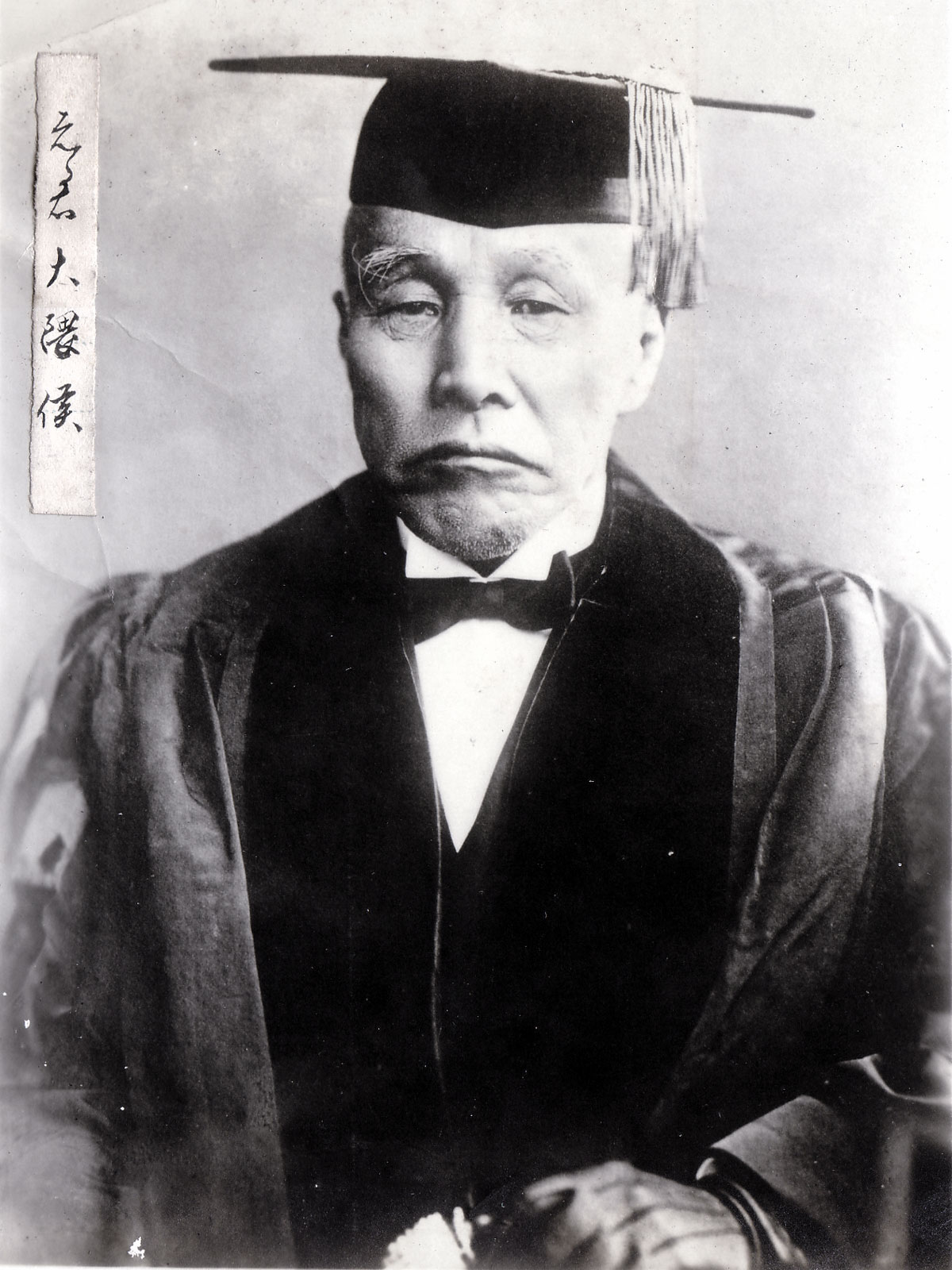
Ōkuma Shigenobu
 Japan
Japandiplomat•politician•military personnel
Also known as: Okuma Shigenobu, Shigenobu Okuma, Count Okuma
Birthday
March 11, 1838
Birth Sign
Pisces
Birthplace
Saga Domain (present-day Saga Prefecture), Japan
Age
Died at 83
About
Ōkuma Shigenobu was a towering Japanese statesman, diplomat, and military official who served as the second Prime Minister of Japan during two separate terms: first in 1898 and again from 1914 to 1916. Born into the samurai class in Saga Domain, he rose to become one of the "Four Men" who guided Japan's transformation from a feudal society into a modern industrial state. His career was defined by an unwavering commitment to Western-style parliamentary democracy, economic reform, and independent education. He founded the Rikken Kaishintō, Japan's first organized political party, and established Waseda University, which remains one of the country's most prestigious institutions today.
Ōkuma's political journey began in 1868 when he joined the new Meiji government. As Minister of Finance, he unified Japan's currency, established a national budget, and created the National Mint, laying the economic groundwork for a modern state. His advocacy for a British-style parliamentary system put him at odds with the ruling oligarchy, leading to his ouster in 1881. Undeterred, he founded the Progressive Party and became a prominent voice for democratic reform. In 1888, he returned as Foreign Minister to negotiate treaty revisions, but an assassination attempt in 1889 cost him his right leg and forced his resignation. Despite this physical sacrifice, he returned to power twice more, leading the country into World War I and issuing the controversial Twenty-One Demands to China.
His legacy is cemented not just in political history but in the educational landscape of Japan. After retiring from politics, he dedicated his remaining years to leading Waseda University, establishing it as a center for liberal arts and independent thought. When he died on January 10, 1922, at the age of 83, his national funeral drew an unprecedented crowd, a fitting tribute to a man who had helped steer Japan into the modern age. His life story, marked by resilience and vision, continues to inspire generations of students and historians alike.
Early Life & Background
Ōkuma Shigenobu was born on March 11, 1838, in Hizen Province within the Saga Domain, the son of Ōkuma Toshiyasu, an artillery officer in the local samurai clan. Growing up in the rigid structures of the Edo period, he was exposed to the traditional isolationist policies that dominated Japan at the time. However, unlike many of his contemporaries who clung to these traditions, Ōkuma developed an early fascination with Western learning. This interest was rare for a samurai of his station, yet it drove him to master foreign languages and political theories while still in his youth.
He began his self-education by studying Dutch, the primary language of Western contact in Japan during that era, before moving on to English and French. His fluency in these languages allowed him to access Western political and military texts directly, giving him insights that were unavailable to most of his peers. This linguistic skill set proved invaluable when he entered the service of the Saga domain government. He started as a clerk, demonstrating an aptitude for administration, and later worked as a teacher, further refining his knowledge of governance and international relations.
In 1868, as the Meiji Restoration swept across Japan, Ōkuma saw an opportunity to apply his skills to the broader national stage. He joined the new central government, marking the beginning of his rise to national prominence. His early career was characterized by a blend of traditional loyalty to the Emperor and a progressive desire to modernize the nation's infrastructure and legal systems. These formative experiences in the Saga domain and his subsequent entry into the Meiji government laid the foundation for his future roles as a key architect of Japan's modernization.
Career Growth
Ōkuma's ascent to the highest levels of Japanese power began in earnest after joining the Meiji government in 1868. By the 1870s, he had risen to become Vice-Minister of Finance, where he played a crucial role in unifying Japan's currency, establishing a national budget, and creating the National Mint. He is widely credited as the "architect" of Japan's first railroad, overseeing the planning of the Shinagawa-Yokohama line, a project that faced significant opposition from traditionalists but ultimately facilitated the country's industrialization.
In 1881, a defining moment occurred known as the "Okuma Incident." As Minister of State, he advocated for the immediate opening of a national assembly. When the ruling oligarchy delayed this promise, Ōkuma resigned in protest, transforming him from a government insider into a popular champion of democratic reform. This move led to the founding of the Rikken Kaishintō (Progressive Party) in 1882, Japan's first organized political party, which advocated for a British-style parliamentary system.
His career reached its zenith with two terms as Prime Minister. His first tenure in 1898 established Japan's first party cabinet, though it lasted only four months due to internal factional conflicts. His second term, from 1914 to 1916, proved more consequential. During this period, he led Japan into World War I on the side of the Allies and pushed through the Twenty-One Demands against China in 1915, significantly expanding Japan's sphere of influence in East Asia. Even after leaving office, he remained a powerful figure as the president of Waseda University, a role he held until his death, ensuring his educational vision endured long after his political career ended.
Career Timeline
Public Image & Style
Ōkuma is portrayed as a visionary, resilient, and principled statesman who sacrificed his physical well-being for the greater good of the nation. His image is one of a man who bridged the gap between tradition and modernity, embracing Western ideas while maintaining deep roots in Japanese culture. Media portrayals emphasize his role as a bridge between the old samurai class and the new industrial state.
His public persona was defined by his intellectual rigor and his willingness to challenge the status quo. The loss of his leg in 1889 became a powerful symbol of his dedication to democratic principles, turning him into a martyr for the cause of parliamentary government. This narrative of resilience has been central to how he is remembered, reinforcing his reputation as a leader who stood firm even in the face of violence and political opposition.
Fame & Fandom (iFAMOUS Rankings)
The devotion surrounding Ōkuma Shigenobu takes a distinct shape, rooted not in the chaotic energy of modern pop culture but in the enduring loyalty of institutions he built. While there is no formal fandom name documented for his supporters, the alumni association of Waseda University functions as a de facto fan club, maintaining a profound sense of identity and reverence for their founder. These institutional fans organize around commemorative rituals rather than social media campaigns, gathering at the Okuma Memorial Museum in Saga or offering flowers at his grave on significant anniversaries. This legacy manifests through academic preservation and historical study, where enthusiasts treat his writings and speeches as sacred texts to be analyzed rather than consumed for entertainment.
In the broader scope of global recognition, Ōkuma Shigenobu is currently evaluated by iFANN but does not hold a placement in the published rankings. As of September 2026, the Global Fame Engine has assessed his profile, yet he remains outside the Global Top 1,000 and any Top-100 scope list. This absence from the charts reflects his status as a historical figure whose influence permeates history books and university halls rather than current media cycles. Unlike contemporary celebrities who drive viral trends, Ōkuma commands respect through tangible contributions to the state, leaving a footprint that defines eras rather than days. His fame is measured in the longevity of the institutions he founded and the stability of the democratic frameworks he championed, standing apart from the fleeting metrics that define modern stardom.
Interesting Facts and Legends
One of the most famous stories about Ōkuma involves the loss of his right leg in 1889. While serving as Foreign Minister, he survived a bombing attempt by a nationalist opposed to his conciliatory stance toward Western powers. The explosion left his face disfigured and took his leg, forcing his resignation. Despite this, he continued to serve in high office, using a prosthetic leg to walk the halls of power and eventually becoming Prime Minister again decades later. This event became a symbol of his sacrifice for democracy.
Ōkuma was also a linguistic prodigy for his time. He was one of the few Japanese politicians of the Meiji era to speak English fluently, which allowed him to correspond directly with Western leaders and scholars without relying on translators. This skill gave him a unique advantage in diplomatic negotiations and helped shape his progressive views on international relations.
The university he founded, originally called Tokyo Senmon Gakko, was renamed Waseda University after its location in Waseda-machi, Tokyo. Ōkuma chose this name to symbolize independence from the state-controlled universities of the time. Today, Waseda remains one of Japan's top universities, and its alumni association functions almost like a fan club, preserving his legacy through annual ceremonies and the maintenance of the Okuma Memorial Museum.
Notable Quotes
“The people are the masters of the state, and the government is merely their servant.”
“Even if I lose a leg, my spirit will stand firm.”
Family & Personal Life
Ōkuma Shigenobu was married to Ayako Ōkuma, née Kikuko. They wed in the early stages of his political career, and she remained his partner throughout his tumultuous life. Ayako provided a stabilizing force during his periods of exile and recovery following the assassination attempt that cost him his leg. Historical accounts often cite her support as crucial in helping him navigate the challenges of his public life.
The couple did not have children together, though Ōkuma maintained close ties with his extended family and clan. His personal life was characterized by a singular focus on duty and family, with little record of other romantic relationships or affairs. The marriage to Ayako is frequently mentioned in biographies as a grounding element amidst the chaos of Meiji-era politics. Their home in Tokyo served as a gathering place for intellectuals and political figures, reflecting Ōkuma's commitment to fostering dialogue and education.
Notable Connections
Itō Hirobumi, Yamagata Aritomo, Kido Takayoshi, Ayako Ōkuma, Waseda Alumni.
Relationships & Dating History
Ōkuma Shigenobu's personal life was characterized by a singular focus on duty and family, with no records of other romantic relationships or affairs. He was married to Ayako Ōkuma, née Kikuko, in the early stages of his political career. Their union remained stable throughout his tumultuous rise to power, providing him with emotional support during periods of exile and recovery. Ayako stood by him during the aftermath of the 1889 assassination attempt, helping him navigate the physical and political challenges that followed.
The couple did not have children together, though Ōkuma maintained close ties with his extended family and clan. His marriage to Ayako is often cited in historical accounts as a stabilizing force during his periods of political isolation. She managed their household and supported his educational endeavors, allowing him to focus on his work in government and academia. Following his death in 1922, Ayako's role as his widow was recognized in the national mourning process, though she passed away before the full extent of his posthumous honors could be realized.
- MarriedAyako Ōkuma1860 - 1922Married in the early stages of his career; remained partners until his death. No children.
Death & Aftermath
Died
January 10, 1922 (aged 83)
Death Place
Tokyo, Japan
Cause of Death
Natural causes associated with old age
Ōkuma Shigenobu spent his final years in quiet retirement at his residence in Waseda, Tokyo, having stepped down from active politics to dedicate himself entirely to the university he founded. His last public appearance was tied to his ongoing leadership role at Waseda University, a position he held until the end of his life. On January 10, 1922, at the age of 83, he passed away peacefully from natural causes related to old age. The nation received the news with solemn respect, recognizing the death of one of the primary architects of modern Japan.
Tributes poured in immediately from political peers and educational leaders who viewed him as a pivotal figure in the nation's transition. A national funeral was held befitting his status as a Marquess and former head of government. He was buried in the Okuma Garden area near his former residence, a location that now serves as a permanent memorial site. The university community has maintained this tradition for over a century, organizing annual ceremonies where representatives lay flowers at his grave and the Peace Memorial Monument.
Posthumous recognition has continued through academic study and institutional dedication. The Okuma Memorial Museum in Saga Prefecture stands as a tribute to his life, featuring artifacts and architecture designed to honor his memory. Statues erected at Waseda University serve as enduring symbols of his legacy. Recent commemorations, including the centenary events in 2022, have reinforced his standing as a foundational statesman whose vision for independent education and parliamentary democracy continues to influence Japanese society.
Net Worth (Estate Value)
$0
iFANN Editorial Team estimate
As a historical figure from the 19th and early 20th centuries, Ōkuma Shigenobu's net worth is not calculated in modern financial terms. His wealth would have been derived from his salary as a government official and any private investments, but no specific financial records or estate valuations exist in contemporary databases. The concept of personal net worth does not apply to him in the way it does for modern celebrities or business tycoons.
Instead, his "wealth" is measured in the enduring value of the institutions he built, particularly Waseda University, which continues to generate significant economic and cultural impact over a century later. The university's assets, research output, and alumni network represent a form of capital that far exceeds any monetary figure he might have accumulated during his lifetime. His legacy is one of intellectual and institutional investment rather than personal financial accumulation.
Awards Won (2)
Ōkuma Shigenobu received numerous high-ranking orders and decorations from the Imperial government for his service, including the Order of the Chrysanthemum. He was elevated to the peerage in 1907, becoming the first commoner-born statesman to receive the title of Marquess (Koshaku). His contributions to Japan's modernization were recognized through various state honors, cementing his status as one of the nation's most important historical figures.
1907 · National Honor
Service to the Nation
1907 · Peerage
State Service
Known For
Prime Minister of Japan
1898 · 2nd Prime Minister
Prime Minister of Japan
1914 · 15th Prime Minister
Waseda University
1882 · Founder
Rikken Kaishintō
1882 · Founder
Keywords
Sources
Quick Facts
- Profession
- diplomat, politician, military personnel
- Born
- March 11, 1838
- Birthplace
- Saga Domain
- Died
- January 10, 1922
- Death Place
- Tokyo, Japan
- Gender
- Male
- Spouse
- Ayako Ōkuma
- Birth Sign
- Pisces
Personal Details
- Full Name
- Ōkuma Shigenobu
- Spouse
- Ayako Ōkuma
- Children
- Education
- Self-taught in Dutch and English; studied Western political texts
Frequently Asked Questions
Who was Ōkuma Shigenobu?
When did Ōkuma Shigenobu die?
Why did Ōkuma lose his leg?
What is Ōkuma Shigenobu's most famous achievement?
Was Ōkuma Shigenobu married?
Similar People
Join the community
fans discussing