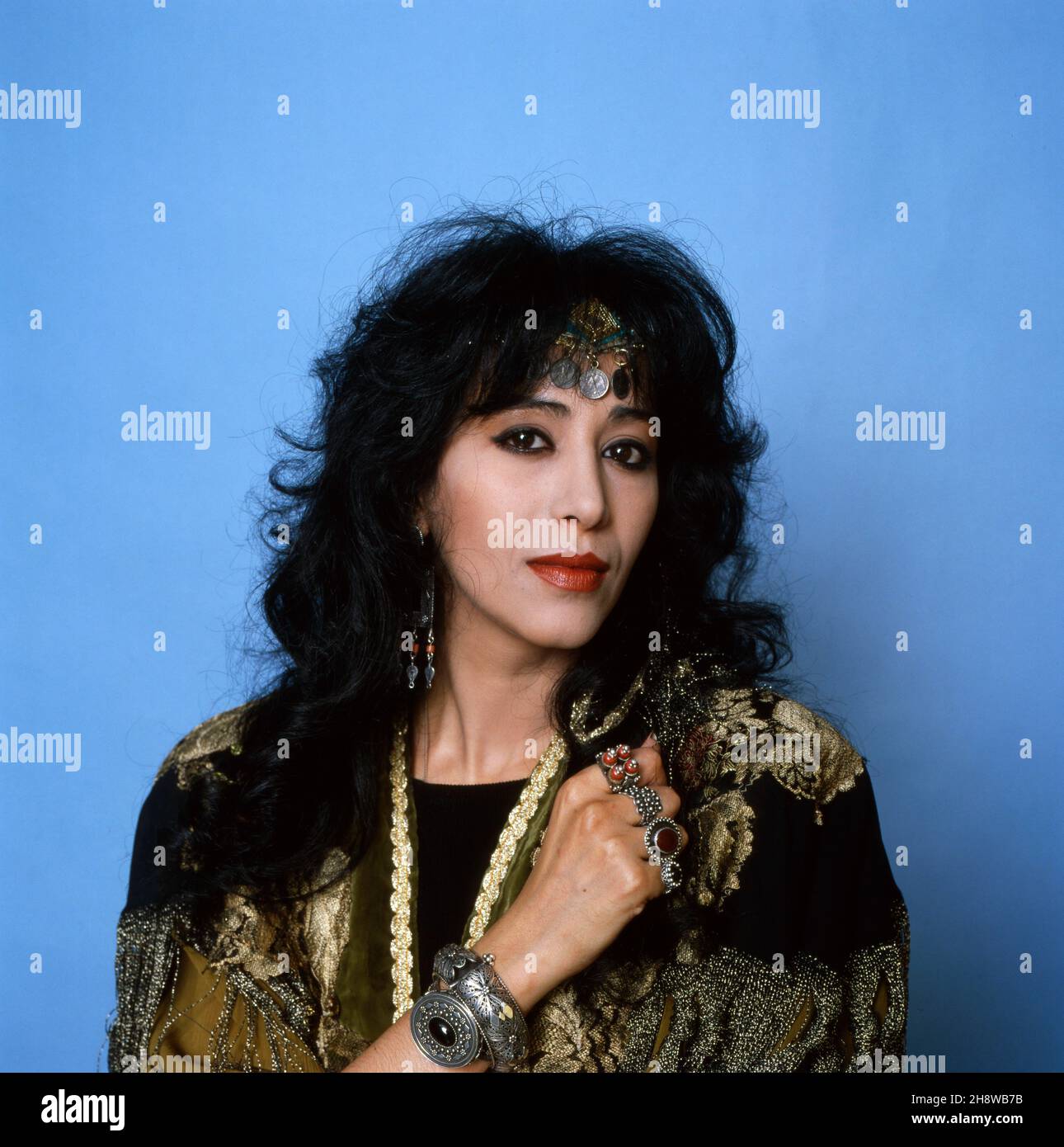
Ofra Haza
 Israel
Member of Nachal Troupe
singer-songwriter•voice actor•composer
Also known as: Ofra Chaza, Ofra Hasa, Haza, Ofra, Bat-Sheva Ofra Haza-Ashkenazi, Bat-Sheva Ofra Haza, Bat-Sheva Haza
Birthday
November 19, 1957
Birth Sign
Scorpio
Birthplace
Hatikva Quarter, Tel Aviv, Israel
Age
Died at 42
Height
5 ft 5 in (165 cm)
About
Ofra Haza was an Israeli singer, songwriter, and actress whose voice bridged continents and cultures. Often called "the Madonna of the East" or "the Israeli Madonna," she possessed a tender mezzo-soprano that could shift from traditional Yemenite prayer to pulsating dance-pop in a single breath. Rolling Stone recognized her immense talent in 2023, ranking her 186th on its list of the 200 Greatest Singers of All Time.
Haza's music was a rich fusion of Middle Eastern and Western styles, weaving together Eastern instrumentation, orchestral arrangements, and dance beats, all while drawing on Mizrahi and Jewish folk tales and poetry. She rose to international fame in the late 1980s, dominating European and American charts and appearing regularly on MTV. Her albums earned multiple platinum and gold certifications, and her tracks became club anthems.
By the 1990s, her voice was a staple in film soundtracks, most notably in Dick Tracy (1990) and The Prince of Egypt (1998), where she performed the haunting "Deliver Us." Her vocals also found new life in hip-hop, with artists sampling her iconic "Im Nin'alu."
Haza's untimely death on February 23, 2000, at just 42, from an AIDS-related illness, sent shockwaves through Israeli society. She remains a towering cultural figure in Israel, credited with bringing Mizrahi culture to the mainstream and inspiring generations of artists.
Early Life & Background
Born Bat-Sheva Ofra Haza on November 19, 1957, in Tel Aviv's Hatikva Quarter, she was the youngest of nine children in a poor Yemenite-Jewish immigrant family. Her father, Yitzhak, worked as a laborer, and her mother, Shoshana, kept the home. The household was steeped in Yemenite tradition, with liturgical poetry and melodies a constant presence.
Haza began singing at local events and family gatherings as a child, absorbing the piyyutim that would later define her sound. She joined a community theater group at age 12, and by her teens she was performing with the Hatikva Quarter's youth troupe.
Her first professional break came during mandatory military service in the late 1970s, when she joined the Nachal Troupe, the IDF's entertainment unit. There she gained formal stage training and released her first hit, "Ga'agu'im" (Longing), which established her as a rising star. She also appeared in the 1979 film West Side Girl, marking her early foray into acting.
Career Growth
Haza's breakthrough came in 1980 when she represented Israel at the Eurovision Song Contest with "Hi," finishing second. Three years later she returned with "Chai" (Alive), a song that became an anthem of resilience in Israel, performed just 11 years after the Munich massacre.
Her 1984 album Shirei Teyman (Yemenite Songs) set traditional Yemenite poetry to contemporary arrangements and became a critical success. The international album Shaday (1988) turned her into a global star, with "Im Nin'alu" topping European charts and becoming a club anthem heavily played on MTV.
She contributed "Someday" to the 1990 film Dick Tracy, and in 1998 performed "Deliver Us" for The Prince of Egypt, introducing her to a new generation. She also worked on The Prayer Cycle with Jonathan Elias in 1999. Over her career she released more than 20 albums and sold millions of records worldwide.
Career Timeline
Public Image & Style
Haza was known as "the Madonna of the East" for her fusion of Middle Eastern and Western styles. Her signature look blended traditional Yemenite aesthetics with contemporary stage fashion. Media portrayed her as both a cultural ambassador and a tragic figure, with her private life kept secret. Fans in Israel and Europe celebrate her as a pioneer who brought Mizrahi culture to the mainstream. Her music videos, particularly "Im Nin'alu," were iconic for mixing Middle Eastern imagery with Western production values.
Fame & Fandom (iFAMOUS Rankings)
Ofra Haza commands a devoted following that has persisted for decades without ever coalescing around a formalized name or organized structure. Her audience, spanning from Tel Aviv to New York, operates as a dispersed collective of admirers who honor her legacy through streaming and cultural appreciation rather than coordinated campaigns or specific rituals. She is widely regarded as the first pop star of Israel to achieve genuine global recognition, bridging Mizrahi traditions with Western dance rhythms in a way that resonated across borders. This enduring appeal places her firmly within the upper echelons of historical fame metrics. According to the August 2026 cycle of the iFANN Global Fame Rankings, Ofra Haza holds the position of the 31st most famous person in Israel, a standing she maintains with remarkable consistency. The same authoritative source identifies her as the 30th most famous person from Israel overall, reflecting her status as a national icon whose reach extends beyond her country of origin. On a broader geographical scale, she ranks as the 92nd most famous person in the Middle East, underscoring her regional significance despite her international career. These placements are derived from the iFANN Global Fame Rankings, which track global attention across media coverage, search behavior, and consumption signals worldwide. While her fanbase lacks a specific moniker like those found in modern idol cultures, their dedication is evident in the sustained popularity of her catalog. The absence of a named fandom does not diminish her impact; instead, it highlights a legacy sustained by organic appreciation rather than managed mobilization.
Interesting Facts and Legends
Ofra Haza was the youngest of nine children in her family. Her vocal performance on the 1988 hit "Im Nin'alu" found a second life when sampled by Eric B. & Rakim for their track "Paid in Full," introducing her voice to the hip-hop community. She represented Israel at the Eurovision Song Contest twice, competing in both 1980 and 1983. Madonna has publicly cited Haza as a significant inspiration for her own artistic direction. Following her death, a posthumous diagnosis of AIDS revealed she had kept her HIV status secret until the end, leading Israeli media to speculate that she died of shame regarding her condition. Her official YouTube channel currently boasts over 35 million views. A persistent legend among fans recounts the story of her early discovery: at age twelve, she joined the local protest theatre troupe "Hatikva," where manager Bezalel Aloni noticed her unique talent and began shaping her career. Another anecdote often retold involves the immediate impact of her song "Deliver Us" from "The Prince of Egypt," which reportedly moved audiences to tears upon its release, cementing her reputation as a diva capable of profound emotional resonance.
Notable Quotes
“I am a Yemenite Jew, and I am proud of it. My music is my heritage.”
“I never planned to be a star. I just wanted to sing.”
Family & Personal Life
Haza was the youngest of nine children, born to Yitzhak and Shoshana Haza. Her father worked as a laborer, and her mother was a homemaker. The family's Yemenite heritage was central to their life, with traditional music and poetry filling the home.
She married businessman Doron Ashkenazi in 1997. The couple had no children. After her death, her brother Bezalel Haza took over managing her estate.
Notable Connections
Relationships & Dating History
Haza kept her personal life private. She married Doron Ashkenazi in 1997, after a short courtship. Ashkenazi, a businessman, reportedly insisted on keeping her HIV-positive status secret, fearing public backlash. They had no children. At the time of her death in 2000, she was still married to Ashkenazi.
- MarriedDoron Ashkenazi1997 - 2000Married from 1997 until her death; no children.
Death & Aftermath
Died
February 23, 2000 (aged 42)
Death Place
Tel Aviv, Israel
Cause of Death
Complications from pneumonia due to AIDS
The family of Ofra Haza confirmed that the Israeli singer had contracted HIV years prior and kept the condition private until her final days, a revelation made public following her death. She passed away on February 23, 2000, at Ichilov Hospital in Tel Aviv after being admitted five days earlier for respiratory distress and high fever. The official cause of death was ruled as complications from pneumonia resulting from a weakened immune system due to AIDS-related illness. Tributes poured in immediately from global peers including Madonna, while Prime Minister Ehud Barak issued a statement mourning the loss of a cultural icon during a moment of silence observed in the Knesset.
Fan vigils were held outside the hospital and at her home where thousands gathered to light candles. Her funeral took place on February 24, 2000, at Trumpeldor Cemetery in Tel Aviv, drawing tens of thousands of mourners including President Ezer Weizman and numerous international celebrities who attended the public service. During the ceremony, a choir performed her song Yemenite Songs live while her brother sang a traditional dirge before she was buried in a private plot open to public visitation. Posthumous releases included her voice in the animated film American Psycho and various compilation albums such as Ofra Haza: The Story of a Star to commemorate her life.
In 2005, she was inducted into the Israeli Music Hall of Fame and the Ofra Haza Scholarship was established to support young Israeli singers with Yemeni heritage. Her estate remains under the active stewardship of her family, ensuring her music continues to be licensed for films and commercials while protecting her personal image.
Net Worth (Estate Value)
$10 Million
iFANN Editorial Team estimate
The estate of Ofra Haza continues to generate revenue from her extensive music catalog, drawing consistent royalties from streaming platforms such as Spotify and Apple Music. The 1988 single "Im Nin'alu" remains a staple in nightclubs and has been licensed for samples, most notably by Eric B. & Rakim. Her haunting performance of "Deliver Us" in the film "The Prince of Egypt" still contributes to soundtrack royalties. The estate is administered by her brother, Bezalel Haza. Per iFANN's editorial analysis, the total value of her estate is estimated at $10 Million as of 2026, a figure built from decades of accumulated royalties, licensing deals, and posthumous releases. Her music remains widely accessible, ensuring her financial legacy endures alongside her cultural one.
Awards Won (3)
Haza won Israel's top music prize, the Kinor David, multiple times, including for "Chai" in 1983. She was named Israeli Singer of the Year by radio and media outlets on several occasions. Her second-place finish at Eurovision 1980 was a major achievement that boosted her national profile.
1985 · Album of the Year
Shirei Teyman
1983 · Song of the Year
Chai
1983 · General
Known For
Im Nin'alu
1988 · Singer
Deliver Us (The Prince of Egypt)
1998 · Vocals
Chai
1983 · Singer
Shaday
1988 · Album
Keywords
Sources
Quick Facts
- Profession
- singer-songwriter, voice actor, composer
- Born
- +1957-11-19
- Birthplace
- Hatikva Quarter, Tel Aviv, Israel
- Died
- +2000-02-23
- Death Place
- Ramat Gan, Israel
- Gender
- Female
- Birth Sign
- Scorpio
Personal Details
- Full Name
- Bat-Sheva Ofra Haza
- Height
- 5 ft 5 in (165 cm)
- Spouse
- Doron Ashkenazi
Filmography
6
Total
4
Film
2
TV
Frequently Asked Questions
How did Ofra Haza die?
Was Ofra Haza married? Did she have children?
What is Ofra Haza's most famous song?
What was Ofra Haza's net worth?
Did Ofra Haza sing in The Prince of Egypt?
Social Media
Similar People

Join the community
fans discussing