 Israel
About
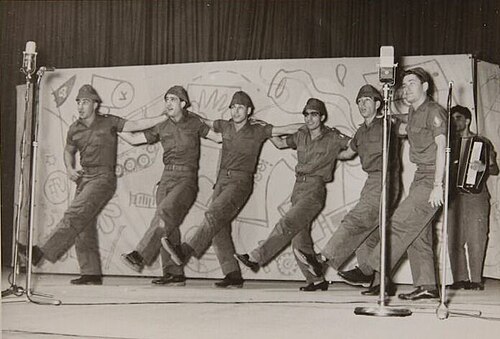
The Nachal Troupe, known in Hebrew as Lehakat HaNahal (להקת הנח"ל), is the musical military ensemble of the Nahal program of the Israel Defense Forces. It remains institutionally active, though its membership rotates with each cohort of conscripted soldiers. Known for performing Eretz Israel songs, the troupe has been a cornerstone of Israeli culture since its founding in November 1951.
Its alumni include some of Israel's most famous performers, such as Danny Sanderson of Kaveret and actress-singer Yona Atari. The troupe's legacy is one of nurturing talent and shaping national identity through music.
Formation Story
The Nachal Troupe was established in November 1951 as a small ensemble with a single accordion, part of the Nahal program of the Israel Defense Forces. The program, whose name stands for No'ar Halutzi Lohem (Pioneering Fighting Youth), combined military service with agricultural settlement and cultural activities. The troupe began performing for soldiers and settlements, quickly gaining popularity.
During the 1950s and 1960s, it expanded into a full-scale theatrical ensemble, staging elaborate programs that toured military bases and civilian venues. By 1972, the troupe had produced its 23rd program, "Ha Palnachnik," released as a double LP. This period marked its mature era, with sophisticated arrangements and production values.
Throughout its history, the troupe served as a launching pad for Israeli entertainment careers. Notable alumni include Danny Sanderson, who later co-founded Kaveret, and Yona Atari, whose career spanned decades. The troupe's rotating roster meant that each generation of soldiers brought fresh energy and talent, ensuring its enduring relevance.
Musical Style
The Nachal Troupe's repertoire centers on Zemer Ivri, the Hebrew song tradition, encompassing Israeli folk and patriotic songs. Early performances were simple, with accordion accompaniment, but evolved into full theatrical productions with elaborate arrangements by the 1960s and 1970s.
The troupe's music tracked broader trends in Israeli popular music, from early folk styles to more sophisticated pop and rock influences. Songs like "Balada Le'Yitzhak Sade" connected audiences to the nation's pioneering history. The troupe's recordings, such as the 1968 compilation "The Best of Nahal," showcase its enduring appeal.
Discography
| Title | Year |
|---|---|
| 23rd Program — Ha Palnachnik | 1972 |
| The Best of Nahal | 1968 |
Cultural Impact
The Nachal Troupe's impact on Israeli society is profound. It served as the primary incubator for Israeli musical talent for decades, with many of the country's most celebrated singers and entertainers beginning their careers in its ranks. The troupe became synonymous with Eretz Israel songs, helping shape Israeli national identity through music.
Its performances at ceremonial events, like the 1972 tribute to Yitzhak Sadeh, connected Israeli youth to their pioneering heritage. Alumni like Danny Sanderson and Eli Magen went on to shape Israeli popular culture, with Kaveret becoming a beloved rock band and Magen maintaining a decades-long career.
Fandom Culture
As a military institution, the Nachal Troupe does not have a formal fandom name, lightstick, or official fan color. However, it holds a cherished place in Israeli collective memory, with its songs and programs forming part of the national cultural canon. Nostalgia for classic programs and reunion performances are recurring themes in Israeli culture.
Awards & Accolades
Milestones
Troupe established in November as part of the Nahal program.
Release of 'The Best of Nahal' compilation.
23rd Program 'Ha Palnachnik' released as a double LP.
Trivia
The troupe's name appears in various transliterations, including "Lehakat HaNahal" and "Lahakat HaNahal." The 1972 23rd program was released as a double LP, reflecting the scale of its productions. Recordings were distributed internationally, with items appearing in collections worldwide. Alumni network forms a significant portion of Israeli entertainment royalty, from folk singers of the 1950s to rock stars of the 1970s.
Keywords
Sources
Quick Facts
- Origin
- Israel
- Status
- Active
- Founded
- November 1951
Group Info
- Formed
- November 1951
- Origin
- Israel
- Company
- Israel Defense Forces
- Status
- Active
Also Known As
Join the community
fans discussing