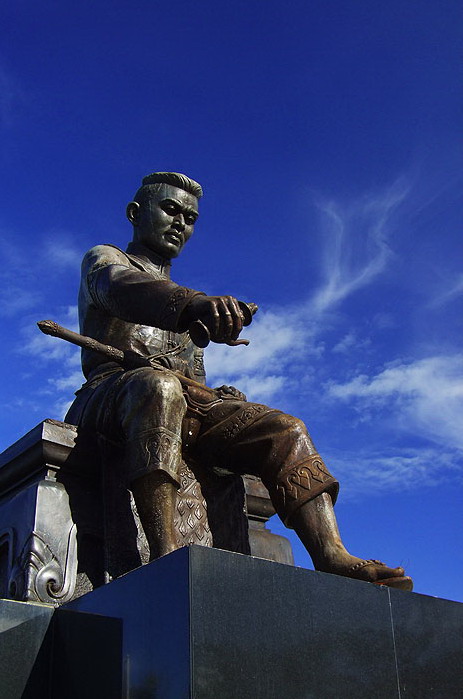
Naresuan
 Thailand
sovereign•politician•military officer
Birthday
+1555
Birth Sign
Birthplace
Chan Royal Palace
Age
Died at 50
About
Born in 1555 at the Chan Royal Palace, Naresuan ascended to the throne of Ayutthaya in 1590, taking the regnal name Sanphet II. He would rule until his death on April 25, 1605. His reign is etched in history as a period of intense conflict and the firm reestablishment of Ayutthayan sovereignty. Naresuan is particularly remembered for his successful efforts to break free from the dominion of the First Toungoo Empire, a feat that earned him the title Naresuan the Great and cemented his place as one of Thailand's most respected rulers.
Fame & Fandom
King Naresuan commands a unique form of reverence that transcends the modern mechanics of celebrity fandom. His audience is not a collection of enthusiasts seeking autographs or merchandise, but rather the entire Thai nation united by a shared history of sovereignty and liberation. Engagement with his legacy occurs through state-sponsored education, national holidays, and the enduring presence of institutions like Naresuan University and the King Naresuan Monument in Ayutthaya. There is no formal collective title for those who revere him, nor are there organized fan campaigns, birthday billboards, or unofficial nicknames circulating within a digital community. The public interaction with the monarch is mediated entirely through historical narratives, museums, and cinematic adaptations such as the *King Naresuan* film series released between 2007 and 2015, which dramatized his life for contemporary audiences without generating a traditional pop culture following. While he remains a central figure in national identity, the concepts of fan rituals or viral moments do not apply to a ruler who passed away in 1605. Regarding his standing in global metrics, the iFANN Global Fame Engine evaluated this historical figure in August 2026. Naresuan is currently the subject of evaluation but does not hold a placement in the published rankings including the Global Top 1,000 or any Top-100 scope list. Consequently, no specific ordinal rank or numerical score can be assigned to his current fame level.
Interesting Facts and Legends
Born in 1555 at the Chan Royal Palace, Naresuan ascended to the throne of Ayutthaya in 1590 under the regnal name Sanphet II. He ruled until his death on April 25, 1605, leaving behind a legacy defined by the firm reestablishment of Ayutthayan sovereignty. A foundational element of his legend is the Elephant Duel with Mingyi Swa during the Battle of Nong Sarai in 1593. Historical chronicles describe how Naresuan challenged the Burmese Crown Prince to single combat on horseback, killing him with a lance and causing the Burmese forces to flee. This event serves as the central pillar of his status as a warrior king, though it has occasionally sparked academic debate regarding specific details. Another key narrative involves his early years as a child hostage in the Burmese court before returning to Siam to claim the throne. This arc of rising from captivity to becoming a liberator is widely accepted in royal chronicles. The story was further cemented in modern popular culture by the *King Naresuan* film series, which ran from 2007 to 2015. These films dramatized the duel and other battles, creating a visual lore for younger generations while maintaining the historical focus on his military prowess.
Death & Aftermath
Died
+1605-04-25 (aged 50)
Death Place
Phitsanulok
Cause of Death
Illness following military campaign
Centuries of national reverence have transformed King Naresuan into a permanent pillar of Thai identity, with modern tributes ranging from the annual Naresuan Day celebrations to the enduring presence of his name on institutions like Naresuan University and the H.T.M.S. Naresuan naval vessel. The legacy extends to significant cultural productions, most notably the six-film series titled King Naresuan released between 2007 and 2011, which chronicles his life as a cornerstone of contemporary cinema alongside numerous academic studies and foundations dedicated to historical research. This posthumous honor stands in contrast to the quiet end he met in Phitsanulok on April 25, 1605, at the age of approximately fifty. The monarch had recently led an expedition against the Mon people in Pegu before falling ill upon his return to the city where he once served as governor.
Historical records attribute his passing to natural causes, specifically an illness following this campaign, autopsy, or legal inquest available in the seventeenth century. While later folklore occasionally conflated his death with battle wounds, scholars such as Sulak Sivaraksa have historically debunked these legendary aspects in favor of the official account regarding his final days managing military affairs while sick. Following his death, the state managed the succession smoothly through established royal protocols, allowing his son Ekathotsarot to assume the throne immediately without internal strife. His body was transported to Ayutthaya for traditional Buddhist cremation rites attended by high-ranking nobles and religious leaders, though the precise location of his ashes remains a subject of archaeological interest due to the destruction of the capital in 1767.
Awards & Accolades
Keywords
Quick Facts
- Profession
- sovereign, politician, military officer
- Born
- +1555
- Birthplace
- Chan Royal Palace
- Died
- +1605-04-25
- Death Place
- Wiang Haeng
- Gender
- Male
- Spouse
- Mani Rattana, Ek Kasattri
Personal Details
- Spouse
- Mani Rattana, Ek Kasattri
Join the community
fans discussing