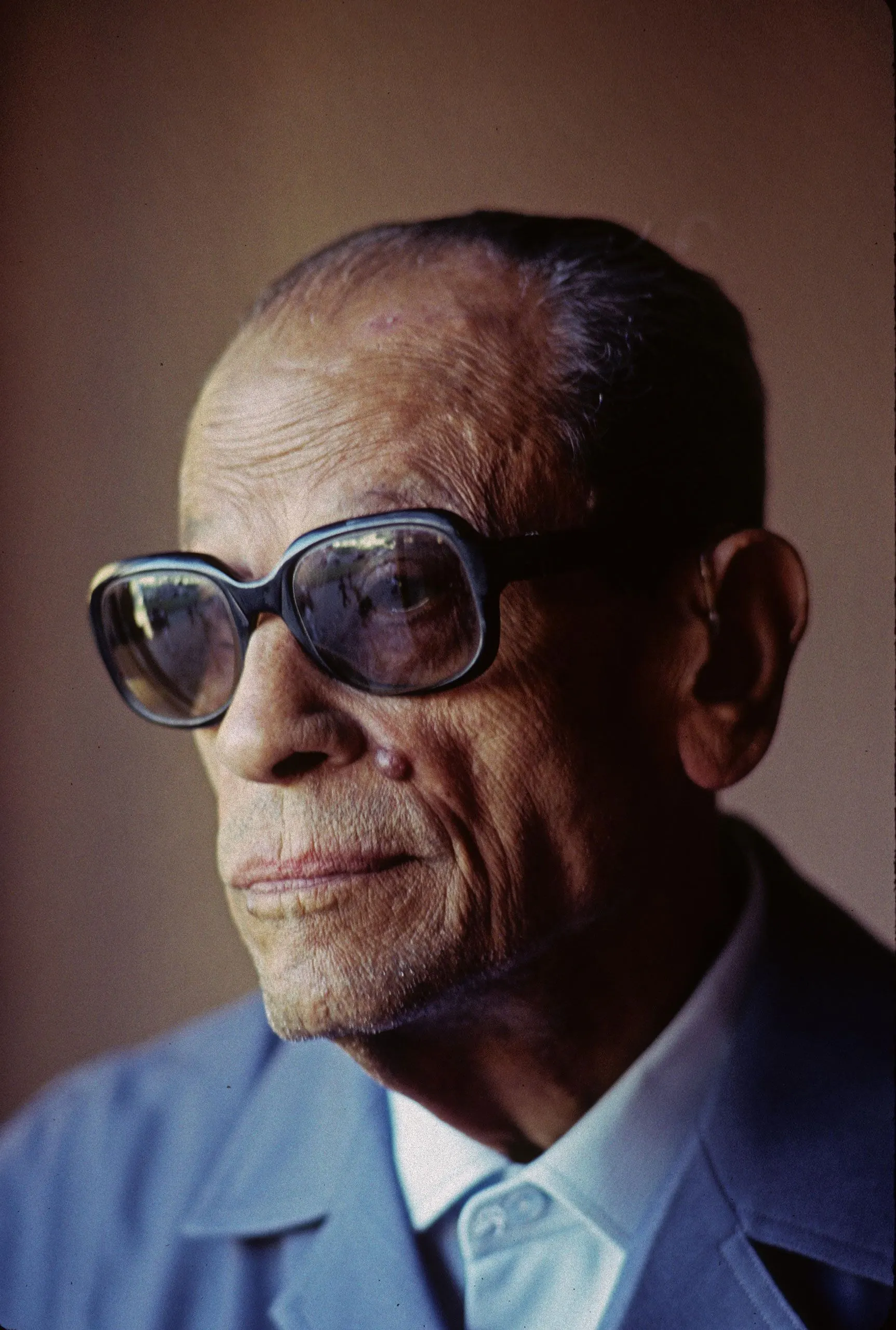
Naguib Mahfouz
 Egypt
Egyptnovelist•screenwriter•translator
Also known as: Naguib Mahfouz Abdelaziz Ibrahim Ahmed Al-Basha
Birthday
December 11, 1911
Birth Sign
Sagittarius
Birthplace
Cairo, Egypt
Age
Died at 94
About
Naguib Mahfouz was the towering figure of modern Arabic literature, the first Arabic writer to win the Nobel Prize for Literature, and the man often called the conscience of Egypt. Born in Cairo in 1911, he spent his life chronicling the city's alleys, cafés, and families with a realism that captured the soul of a nation. His 1988 Nobel citation praised his work as "rich in nuance, now clear-sightedly realistic, now evocatively ambiguous," an art that speaks to all humanity. Mahfouz's name is synonymous with the Egyptian novel, and his influence stretches across generations of writers in the Arab world and beyond.
Over a career spanning seven decades, Mahfouz produced 35 novels, more than 350 short stories, 26 screenplays, and seven plays. His landmark works, including The Cairo Trilogy and Children of Gebelawi, are set in his beloved Cairo, often centering on the lane as a microcosm of the world. His style evolved from historical romances to stark realism with existential undertones, earning him comparisons to Balzac and Dickens. Today, his books are studied in universities, adapted into films, and read by millions. Mahfouz passed away in 2006 at the age of 94, but his literary legacy continues to grow, with new translations and editions appearing every year.
Early Life & Background
Mahfouz was the youngest of seven children, born into a lower middle-class family in the Al-Jamaliyah district of Old Cairo. His father, Abdel-Aziz Ibrahim, was a civil servant, and the family lived first in the Bayt al-Qadi neighborhood, then moved to Abbaseya in 1924. Growing up, Mahfouz felt like an only child because his siblings were so much older. He was named after the obstetrician Naguib Pasha Mahfouz, who had overseen his difficult birth.
As a boy, he attended a kuttab, a traditional Qur'an school, where he learned the basics of religion and literacy. When he was seven, the 1919 revolution against British rule swept through Egypt, and the images of that uprising stayed with him for the rest of his life. He devoured historical and adventure novels, citing Sir Walter Scott and H. Rider Haggard as early influences, while also reading widely in Arabic literature. At seventeen, he began writing, publishing his first article that same year. He went on to study philosophy at King Fu'ad I University, graduating in 1934, but soon realized that fiction was his true calling.
After graduation, Mahfouz entered the civil service, working in the Ministry of Mortmain Endowments and later as Director of Censorship in the Bureau of Art. He wrote in his spare time, publishing his first novel in 1939. Those early works were historical romances set in ancient Egypt, but he gradually shifted toward the realistic portrayals of contemporary Cairo life that would define his career.
Career Growth
Mahfouz's breakthrough came with the publication of Midaq Alley in 1947, a novel that combined stark realism with a mystical aura, influenced by Kafka, Joyce, and Proust. But it was The Cairo Trilogy (1956–1957) that made him famous throughout the Arab world. The three novels, Palace Walk, Palace of Desire, and Sugar Street, chronicle three generations of a merchant family in Cairo against the backdrop of Egypt's social and political upheavals. The trilogy cemented his reputation as the preeminent depictor of traditional urban life.
In 1959, he published Children of Gebelawi, an allegorical novel that angered conservative religious authorities and was banned in Egypt for years. Despite the controversy, he continued to write prolifically, producing novels like The Thief and the Dogs (1961), Autumn Quail (1962), Small Talk on the Nile (1966), and Miramar (1967). His work was so influential that each new publication was treated as a major cultural event in Egypt.
The pinnacle came in 1988 when he was awarded the Nobel Prize for Literature, the first Arabic writer to receive the honor. He declined to travel to Stockholm, sending his daughters instead. He continued writing into his nineties, despite an assassination attempt in 1994. His last works appeared in 2004, and he died two years later, leaving behind a body of work that has been adapted into dozens of films and translated into countless languages.
Career Timeline
Public Image & Style
Mahfouz was known as a modest, shy man, a stark contrast to his towering literary reputation. He was called "the conscience of Egypt" for his unflinching portrayal of ordinary Egyptians and their struggles. His signature style was literary realism with existential undertones, often using Cairo's old neighborhoods as a stage.
His readers span the Arabic-speaking world and beyond, with his works translated into dozens of languages. The Swedish Academy's praise of his "clear-sightedly realistic, now evocatively ambiguous" narrative art captures the essence of his appeal. He was regarded as the premier man of letters for the Arab world, and his legacy is maintained by publishers like the American University in Cairo Press, which continues to release new editions of his work.
Fame & Fandom
The audience surrounding Naguib Mahfouz is defined not by the frenzied energy of a pop-culture mob, but by the quiet reverence of scholars, students, and literary devotees who treat his work as a canonical pillar. There is no formalized collective name for these readers, nor are there organized fan clubs or grassroots campaigns to plaster his face on billboards; instead, his legacy is stewarded by academic institutions and state-sponsored cultural bodies that keep his words alive in classrooms and book fairs. While he never engaged with fans during his reclusive life in Cairo, the modern commemoration of his life manifests through institutional tributes, such as the massive gatherings at the Cairo International Book Fair in late 2025 and recent publishing initiatives by Diwan Publishing that have introduced his stories to new generations through graphic adaptations. These efforts reflect a deep, scholarly devotion rather than a viral celebrity following, cementing his status as a figure whose influence transcends the typical metrics of stardom. Despite this lack of traditional fandom machinery, his global standing remains formidable according to the iFANN Global Fame Rankings. He is currently recognized as the 8th most famous person in Egypt, holding steady from the previous cycle. His prominence extends beyond national borders, where he stands as the 18th most famous person from Egypt. On a broader regional scale, he ranks as the 28th most famous person in Middle East, maintaining his position consistently across tracking periods.
Interesting Facts and Legends
Naguib Mahfouz was named after the doctor who delivered him, an obstetrician named Naguib Pasha Mahfouz. For thirty-seven years, from 1934 to 1971, he worked as a civil servant, even serving as Egypt's Director of Censorship in the Bureau of Art. Following the 1952 revolution, he paused his writing for several years, finding it difficult to create amidst such turbulence. He rarely left Egypt, ensuring his entire body of work remained rooted in his homeland. Despite his towering reputation, he once modestly described himself as "a fourth- or fifth-class writer," a comment that endeared him to admirers. A defining moment in his legend involves the controversy surrounding his novel *Children of Gebelawi*, which was banned in Egypt for decades due to its allegorical treatment of religious figures, sparking debates about artistic freedom that persist today. Another story fans still retell concerns his survival of a stabbing attack in 1994, which left him partially paralyzed yet did not stop him from writing until his death in 2006. His favorite pastime was sitting in Cairo cafés, where he held court with friends and fellow writers, becoming a local fixture known as the "Sculptor of the Alley."
Notable Quotes
“That is the way of life. You give up your pleasures one by one until there is nothing left, then you know it is time to go.”
“My love is for the people of the alleys, not only the old alleys of Cairo but the alleys of the whole world.”
“I am a fourth- or fifth-class writer.”
Family & Personal Life
Mahfouz married Atiyatullah Ibrahim in 1954, and they had two daughters together. He kept his family life intensely private, rarely speaking about them in public. His daughters, however, stepped into the spotlight when they traveled to Stockholm in 1988 to accept his Nobel Prize on his behalf.
He was the youngest of seven children, with four brothers and two sisters, all significantly older than him. His father, Abdel-Aziz Ibrahim, was a civil servant, and the family lived in the Gamaleya quarter of Old Cairo before moving to Abbaseya in 1924. Mahfouz often drew on his childhood memories of these neighborhoods in his fiction.
Notable Connections
Mahfouz is often mentioned alongside Taha Hussein as a pioneer of contemporary Egyptian literature. His translator Denys Johnson-Davies, who worked with him at the American University in Cairo Press, wrote his obituary for The Guardian. His wife Atiyatullah Ibrahim and their two daughters were his closest family, though they remained out of the public eye.
Relationships & Dating History
Mahfouz was intensely private about his personal life, and his marriage to Atiyatullah Ibrahim is the only documented romantic relationship in his life. They married in 1954 and had two daughters together. He remained married to her until his death in 2006, and she was by his side throughout his later years. The couple's relationship was marked by mutual support, with Atiyatullah managing the household while Mahfouz pursued his writing career. He rarely spoke about her in public, but those close to him described a deep and lasting bond.
At the time of his death, Mahfouz was still married to Atiyatullah, and she survived him. There are no records of any other significant romantic relationships in his life, reflecting his preference for a quiet, stable home life away from the public eye.
- MarriedAtiyatullah Ibrahim1954 - 2006Married in 1954, had two daughters, remained together until his death.
Death & Aftermath
Died
August 30, 2006 (aged 94)
Death Place
Cairo, Egypt
Cause of Death
Natural causes and stroke complications
Naguib Mahfouz passed away in his sleep on August 30, 2006, at his home in the Zamalek district of Cairo. The ninety-four-year-old novelist died from natural causes linked to old age and complications stemming from a stroke he had suffered in 1995, which had left him partially paralyzed and reliant on a wheelchair for years. His family confirmed the passing, marking the end of a life that had weathered decades of public scrutiny and a violent assassination attempt in 1994. The news triggered an immediate outpouring of grief across the Arab world and beyond, with Egyptian President Hosni Mubarak declaring a three-day national mourning period.
Tributes poured in from literary giants like Gabriel García Márquez and Orhan Pamuk, while thousands of mourners gathered outside his home and at the Al-Azhar Mosque for funeral prayers. A massive state funeral took place on September 1, 2006, featuring a procession through Cairo streets attended by high-ranking officials including Prime Minister Ahmed Nazif before concluding with prayers at the Al-Sayeda Nafisa Mosque and burial at the Al-Rawda Cemetery. Following his death, the Naguib Mahfouz Foundation was established to support young writers, and the estate has continued to release new editions of his works, ensuring his legacy remains a vibrant force in Arabic literature.
Net Worth (Estate Value)
$10 Million
iFANN Editorial Team estimate
As a deceased literary figure, Mahfouz's financial legacy is managed through his estate, which continues to earn royalties from his extensive body of work. His 35 novels, including the internationally acclaimed Cairo Trilogy, remain in print in multiple languages, generating steady income. Film adaptations of his novels, half of them having been made into movies, also contribute to the estate's revenue through licensing deals. The American University in Cairo Press serves as a primary publisher of his works in English, maintaining The Naguib Mahfouz Centennial Library to ensure his books remain accessible to new generations of readers. Posthumous publications and reissues of his works through various publishers add to the estate's earnings. Per iFANN's editorial analysis, the estate's net worth is estimated at around $10 million as of 2026, a figure that reflects the enduring commercial appeal of his literature.
Awards Won (2)
Naguib Mahfouz won the 1988 Nobel Prize for Literature, the first Arabic writer to receive the honor. He was also awarded Egypt's Order of the Nile, the country's highest state honor. These two awards recognize his monumental contribution to world literature.
1988 · Literature
His body of work
1988 · State Honor
Lifetime achievement
Known For
The Cairo Trilogy
1956 · Author
Children of Gebelawi
1959 · Author
Midaq Alley
1947 · Author
Keywords
Sources
Quick Facts
- Profession
- novelist, screenwriter, translator
- Born
- December 11, 1911
- Birthplace
- Cairo, Egypt
- Died
- August 30, 2006
- Death Place
- Agouza, Giza Governorate, Egypt
- Gender
- Male
- Spouse
- Atiyatullah Ibrahim
- Children
- 2 daughters
- Education
- King Fu'ad I University (now Cairo University), degree in philosophy
- Birth Sign
- Sagittarius
Personal Details
- Full Name
- Naguib Mahfouz Abdelaziz Ibrahim Ahmed Al-Basha
- Spouse
- Atiyatullah Ibrahim
- Children
- 2 daughters
- Education
- King Fu'ad I University (now Cairo University), degree in philosophy
Frequently Asked Questions
Why did Naguib Mahfouz win the Nobel Prize?
Was Naguib Mahfouz stabbed?
How many books did Naguib Mahfouz write?
Where is Naguib Mahfouz from?
What is Naguib Mahfouz's most famous work?
Similar People
Join the community
fans discussing