 Italy
Italy“Tati’s work is a miracle of visual invention and subtle social commentary.”
Dave Kehr
Chicago Reader
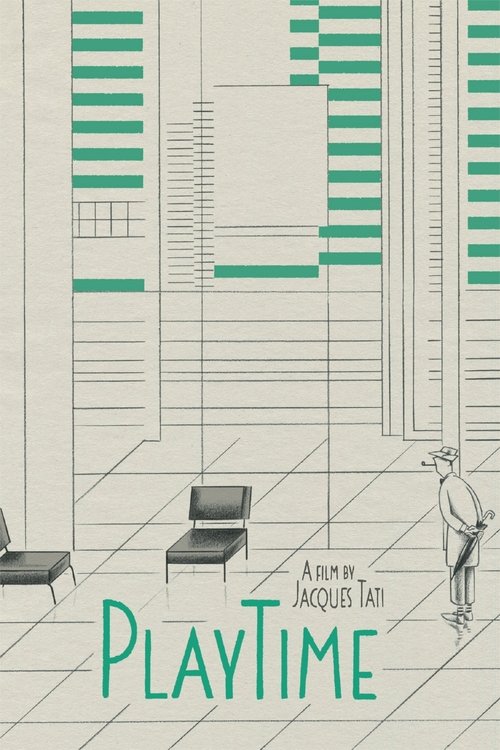
Jacques Tati returns as the perpetually well-meaning but endearingly out-of-step Monsieur Hulot in 1967's PlayTime. This ambitious comedy, shot in 70mm widescreen and vivid color, plunges Hulot into the gleaming, hyper-modern landscape of Paris. The city itself, with its stark steel and glass structures, becomes a character, a slightly bewildering maze for our favorite befuddled gentleman.
During his visit, Hulot is meant to meet with a business associate, but the city’s overwhelming scale and bewildering layout lead him on a series of accidental encounters. His journey mirrors that of a young American tourist, who also finds herself navigating the same futuristic, almost sterile, urban environment. As their paths cross repeatedly, a gentle connection forms between them amidst the backdrop of a society obsessed with progress and efficiency. The film, directed and co-written by Tati himself, is a masterful exercise in visual comedy and social observation, exploring themes of modernity, alienation, and the search for genuine human connection in a rapidly changing world. It stands as a remarkable achievement in filmmaking, showcasing Tati's unique comedic vision on an epic scale.
Stream
Max
Criterion Channel
Rent
Amazon Prime Video
Apple TV
Google Play Movies
YouTube
Vudu
Availability and pricing can change. Confirm on the provider's site before purchasing.
Monsieur Hulot, Jacques Tati's beloved character, arrives in Paris with a rather vague itinerary: attend a meeting with an American business contact. But this Paris is not the charming, human-scaled city of Tati's earlier films. Instead, it's a gleaming, hyper-modern metropolis of steel, glass, and uniform architecture that feels more like a bewildering labyrinth than a welcoming capital. Hulot, with his slightly old-fashioned demeanor, finds himself adrift in this landscape of impersonal spaces and efficient routines.
His journey through this futuristic cityscape is a series of accidental observations and gentle interactions. He navigates sterile office buildings, a bustling international airport, and a newly opened, incredibly stylish American-esque restaurant called the Royal Garden. The film follows Hulot as he quietly observes the people around him, their daily rituals and interactions, often highlighting the subtle absurdities of modern life through his own quiet presence and occasional, clumsy interventions. The humor is derived from the situations themselves, Tati’s keen eye for detail, and Hulot's innocent reactions to the world.
Running parallel to Hulot's experiences is the story of a young American tourist who is also exploring Paris. She, much like Hulot, finds herself navigating the same overwhelming, technologically advanced environment. Her days are filled with visiting landmarks, shopping in modern department stores, and experiencing interactions that often point to the superficiality and manufactured nature of the contemporary world. The film artfully weaves their paths together, showing them crossing and interacting indirectly, hinting at a nascent connection forming amidst the vast urban sprawl. The central tension of the film isn't a dramatic conflict, but rather the characters' quiet struggle to find genuine human connection and meaning within a society increasingly defined by efficiency, uniformity, and a kind of superficial gloss.
The narrative unfolds through a series of meticulously choreographed vignettes, each offering a glimpse into the characters' lives and the environment they inhabit. The escalating chaos and eventual, almost inevitable, breakdown of the Royal Garden during its grand opening night serve as a microcosm of the larger societal themes Tati is exploring. It’s a film that invites viewers to look closer, to notice the details, and to find the humor and humanity in the everyday, even in the most modern and seemingly impersonal settings.
Official Reissue Trailer 2014
Critical Consensus
A visually stunning and audaciously ambitious masterpiece, Jacques Tati's PlayTime is a masterful satire of modern life, using its grand scale and intricate detail to explore themes of alienation, consumerism, and the search for human connection.
“Tati’s work is a miracle of visual invention and subtle social commentary.”
Dave Kehr
Chicago Reader
“The film’s sheer scale and visual wit are astounding, making it a unique and unforgettable cinematic experience.”
Bilge Ebiri
Vulture
“A sprawling, dazzling, and profoundly humane comedy that captures the disorientation and absurdity of the modern world.”
Glenn Kenny
RogerEbert.com
“PlayTime is a symphony of sounds and sights, a meticulous construction that reveals the absurdity lurking beneath the surface of progress.”
Mark Kermode
The Guardian
“Tati’s genius lies in his ability to find humor in the mundane and to create a world that is both alienating and deeply relatable.”
Todd McCarthy
The Hollywood Reporter
Jacques Tati
Monsieur Hulot
Barbara Dennek
Young Tourist
Rita Maiden
Mr. Schultz's Companion
France Rumilly
Woman Selling Eyeglasses
France Delahalle
Shopper in the Department Store
Valérie Camille
Mr. Lacs's Secretary
Erika Dentzler
Mme. Giffard
Nicole Ray
Singer
Yvette Ducreux
Hat Check Girl
Nathalie Jem
Customer of the Royal Garden
Jacqueline Lecomte
Young Tourist's Friend
Olivia Poli
Customer of the Royal Garden
Director
Jacques Tati
Writers
Jacques Lagrange, Jacques Tati, Art Buchwald
Composer
Francis Lemarque
Cinematographers
Jean Badal, Andréas Winding
Producer
Bernard Maurice
Join the community
fans discussing