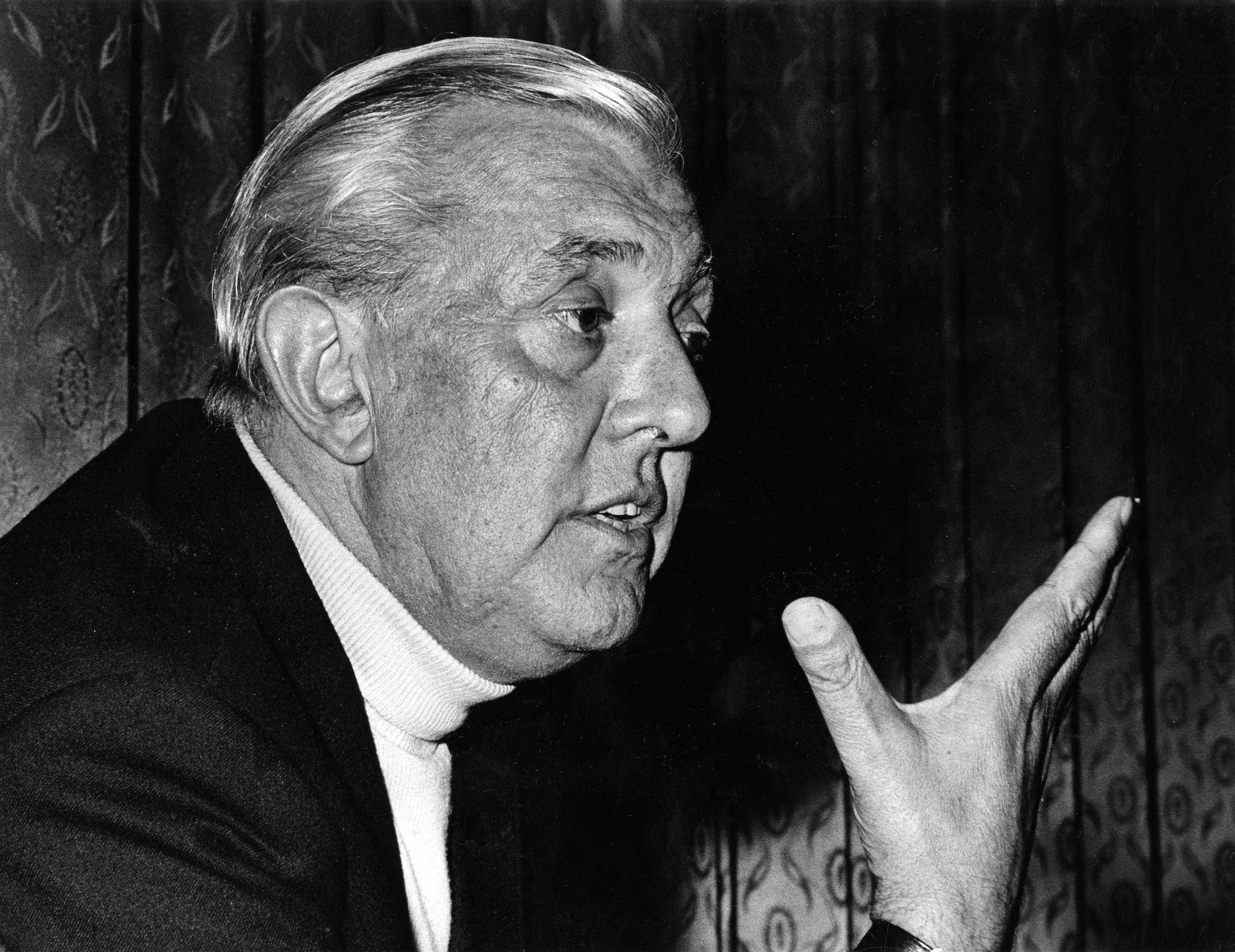
Jacques Tati
 France
film director•actor•screenwriter•mime
Also known as: Jacques Tatischeff, J.T.
Birthday
October 9, 1907
Birth Sign
Libra
Birthplace
Le Pecq, France
Age
Died at 75
Height
6 ft 0 in (183 cm)
About
Jacques Tati was a French filmmaker, mime, actor, and screenwriter born Jacques Tatischeff on October 9, 1907. He directed only six feature-length films yet left an indelible mark on the art of cinema through his unique brand of physical comedy and social satire. Best known for creating Monsieur Hulot, a bumbling, pipe-smearing everyman who navigates the absurdities of modern life, Tati crafted a visual language that transcended dialogue barriers. His work is characterized by wide shots that invite viewers to explore hidden gags within the frame, relying on ambient sound and mechanical noise to drive the narrative rhythm.
Although his filmography is small, its influence is vast. Directors like Wes Anderson and Albert Brooks have cited him as a major inspiration, while critics ranked his film Playtime 23rd in the 2022 Sight & Sound poll of the greatest movies ever made. Tati controlled every aspect of his productions, from script to editing, embodying the auteur theory long before it became a buzzword. He passed away on November 5, 1982, leaving behind a legacy that continues to inspire filmmakers and comedians worldwide.
Early Life & Background
Born Jacques Tatischeff in Le Pecq, a suburb of Paris, Tati grew up in a family that valued sport and performance. His early life was steeped in the vibrant culture of French music halls and circuses, where he honed his skills as a mime and acrobat during the 1920s and 1930s. Before stepping onto a film set, he worked as a stuntman and performed in variety shows, developing a distinct physical comedy style that prioritized visual gags over spoken words. This background gave him a keen sense of timing and movement that would later define his cinematic approach.
Tati transitioned to filmmaking gradually, starting with short films that showcased his ability to construct complex comic situations through meticulous choreography. His first short, L'École des facteurs (1947), demonstrated his knack for using sound design to enhance visual humor. These early projects allowed him to refine his signature character, Monsieur Hulot, who would eventually become the centerpiece of his career. By the time he achieved widespread recognition, Tati had already established a reputation as a perfectionist who refused to compromise his artistic vision for commercial gain.
Career Growth
Tati's breakthrough arrived with Les Vacances de Monsieur Hulot in 1953, a massive commercial success that introduced the world to his iconic character. The film's triumph paved the way for Mon Oncle in 1958, which won the Academy Award for Best Foreign Language Film and cemented his status as a master of cinematic satire. His most ambitious project, Playtime (1967), was a sprawling satire of modern urban life that required the construction of an entire futuristic city set in Montreuil. The production consumed Tati's personal fortune, leading to bankruptcy and forcing him to sell his property.
Despite its initial commercial failure, Playtime is now regarded as a masterpiece, ranking 23rd in the 2022 Sight & Sound critics' poll. His final feature film, Trafic (1971), continued his exploration of modern transportation and technology before he retired from directing. Throughout his career, Tati directed only six feature-length films, yet his impact on the industry has been immense. Directors such as Wes Anderson, Albert Brooks, and Jean-Luc Godard have cited him as a major influence. His approach to filmmaking was deeply auteurist; he controlled every aspect of his productions, from the script to the editing, ensuring a singular vision. Tati's work is characterized by wide shots that allow viewers to explore the frame, discovering hidden jokes and details that unfold over time. His use of sound was equally innovative, often using ambient noise and mechanical sounds to create a rhythmic, almost musical quality to his films.
Career Timeline
Public Image & Style
Jacques Tati is portrayed in the media as a visionary artist who prioritized artistic integrity over commercial success. His content is characterized by a tone of gentle satire and social observation, often critiquing the dehumanizing aspects of modern technology and urban planning. His public image is one of quiet dignity and intellectual depth, reflected in the academic study of his work. He never sought fame for its own sake, instead letting his films speak for themselves. Critics often describe him as a poet of the everyday, finding beauty and humor in the mundane rituals of modern existence.
Fame & Fandom
The enduring appeal of Jacques Tati rests on a unique dynamic where the audience functions as an academic body rather than a commercial voting block. Fans identify not through a registered moniker but through a shared devotion to the character Monsieur Hulot, treating his films as complex puzzles requiring deep study of visual language and sound design. This community sustains itself through rigorous preservation efforts, such as the 4K UHD release of Playtime by the Criterion Collection in early 2026, and sold-out theatrical re-releases in locations ranging from Atlanta to Beirut. The collective narrative is defined by the legend of Tati's bankruptcy following the production of Playtime, a story that serves as a cautionary tale regarding artistic integrity versus commercial viability. While no formal fan club structure exists, the group operates with intense intellectual engagement, often analyzing single frames for hidden jokes or discussing the director's refusal to use dialogue in his later works. The iFANN Global Fame Engine has evaluated this profile based on these sustained cultural signals and historical impact. Jacques Tati is currently the subject of a verified evaluation by iFANN, yet he does not hold a placement in the published rankings. He remains outside the Global Top 1,000 and any Top-100 scope list. No specific numeric rank or score applies to his current standing in the database.
Interesting Facts and Legends
Jacques Tati directed only six feature-length films despite his immense influence on cinema. His iconic character Monsieur Hulot appears in four titles: Les Vacances de Monsieur Hulot, Mon Oncle, Playtime, and Trafic. A central legend surrounding his life concerns the production of Playtime, where he poured his entire fortune into building a custom Parisian set to depict a futuristic cityscape. This perfectionism led to a massive budget overrun and personal bankruptcy, forcing him to sell his property and retire from directing. Fans frequently recount the glass door gag from Playtime, where Hulot breaks a restaurant entrance causing a chain reaction of chaos, as a masterclass in practical effects over CGI. Another enduring myth suggests his silence was a direct response to the noise of modernity, predicting the alienation of urban life decades before it became a common cultural critique. Unlike pop stars of his era, there are no records of crowds fainting or disrupting events due to his personal appearances; his legacy is maintained entirely through the preservation of his films and the reverence of directors who cite him as an influence.
Notable Quotes
“I try to make people laugh without making them think too much.”
“The future is already here, it's just not evenly distributed.”
Family & Personal Life
Jacques Tati was known for his intense privacy regarding his personal life. There are no widely documented romantic relationships, marriages, or engagements in public records. Unlike many contemporaries, he did not court publicity for his private affairs, and sources indicate he remained unmarried throughout his life. He had no children. His focus was entirely on his art and his characters, particularly Monsieur Hulot. In his later years, he lived in Neuilly-sur-Seine, a Parisian suburb, where he dedicated himself to preserving his legacy and managing his estate after his financial difficulties following Playtime.
Notable Connections
Albert Brooks, Wes Anderson, Jean-Luc Godard, Rowan Atkinson
Relationships & Dating History
Jacques Tati was known for his intense privacy regarding his personal life. There are no widely documented romantic relationships, marriages, or engagements in public records. Unlike many contemporaries, he did not court publicity for his private affairs, and sources indicate he remained unmarried throughout his life. He had no children. His focus was entirely on his art and his characters, particularly Monsieur Hulot. In his later years, he lived in Neuilly-sur-Seine, a Parisian suburb, where he dedicated himself to preserving his legacy and managing his estate after his financial difficulties following Playtime. As of 2026, there are no reports of any current partners or ongoing relationships, consistent with his lifelong pattern of privacy.
Death & Aftermath
Died
November 5, 1982 (aged 75)
Death Place
Neuilly-sur-Seine, France
Cause of Death
Myocardial infarction
Jacques Tati spent his final years in Neuilly-sur-Seine, a quiet suburb of Paris, where he retreated from the public eye after the release of his final feature film Trafic in 1971. The director had hoped to create a successor to his sprawling masterpiece Playtime but found himself blocked by creative struggles and the crushing weight of debt. On November 5, 1982, at the age of 75, Tati died from a myocardial infarction at his home or a nearby medical facility in that same suburb. His passing marked the end of a career defined by meticulous observation and visual wit, though immediate fan vigils or chart surges were not recorded in the historical archives of 1982.
The funeral service was held with the discretion typical of French celebrities of that era, leaving specific details about the date, location, and attendees undocumented. Following his death, the management of his estate shifted focus entirely to preservation rather than new ventures. For decades, heirs and legal representatives have overseen the distribution of his films, ensuring they remained accessible to new generations. Recent efforts highlight this enduring stewardship: a Studiocanal Classics retrospective launched in August 2026 brought together his complete works, while the Criterion Collection released a stunning 4K digital restoration of Playtime in February 2026. Tributes continue to surface globally, including sold-out screenings in San Francisco and Beirut during 2026, cementing his reputation as one of cinema's most influential visionaries without needing modern marketing campaigns.
Net Worth (Estate Value)
$5 Million
iFANN Editorial Team estimate
As of 2026, Jacques Tati is deceased, so his net worth refers to the value of his estate. Specific dollar figures for his estate are not publicly disclosed in detail, but estimates suggest the estate continues to generate significant revenue through licensing deals, merchandise, and royalties from his films. The estate is managed by his heirs and legal representatives, who oversee the distribution and preservation of his works. Major revenue sources include ongoing sales and rentals of his films, particularly Playtime, which has seen renewed interest due to high-quality restorations. Merchandise sales of DVDs, Blu-rays, and collectibles featuring his characters also contribute to the estate's income. Royalties from streaming platforms and television broadcasts provide a steady stream of funds. Although he sold much of his property due to bankruptcy, some assets may still be part of the estate. The exact value of the estate is difficult to determine precisely, but it is estimated to be in the millions of dollars, driven by the enduring popularity of his work and the increasing demand for classic cinema. iFANN currently estimates the estate's value at approximately $5 Million.
Awards Won (2)
Jacques Tati received numerous accolades throughout his career, including the Academy Award for Best Foreign Language Film for Mon Oncle in 1958. He also won the BAFTA Award for Best Film from Any Source for the same film. While Mon Oncle was nominated for the Palme d'Or at the Cannes Film Festival, it did not win the top prize, but Tati received critical acclaim and numerous other distinctions. He has been inducted into several film halls of fame, including the French Cinéma Hall of Fame, acknowledging his enduring legacy.
1959 · Best Foreign Language Film
Mon Oncle
1959 · Best Film from Any Source
Mon Oncle
Known For
Playtime
1967 · Director
Mon Oncle
1958 · Director
Les Vacances de Monsieur Hulot
1953 · Director
Trafic
1971 · Director
Keywords
Sources
Quick Facts
- Profession
- film director, actor, screenwriter, mime
- Born
- October 9, 1907
- Birthplace
- Le Pecq, France
- Died
- November 5, 1982
- Death Place
- Neuilly-sur-Seine, France
- Gender
- Male
- Birth Sign
- Libra
- Height
- 6 ft 0 in (183 cm)
Personal Details
- Full Name
- Jacques Tatischeff
- Height
- 6 ft 0 in (183 cm)
- Children
Filmography
12
Total
6
Film
0
TV
Frequently Asked Questions
What is Jacques Tati's full birth name?
How many films did Jacques Tati direct?
What caused Jacques Tati's death?
Is Jacques Tati married or did he have children?
What is the most famous film by Jacques Tati?
Social Media
Similar People

Join the community
fans discussing