“Paul Thomas Anderson's 'Boogie Nights' is an epic of the low road, a classic Hollywood story set in the shadows instead of the spotlights but containing the same emotional truth.”
Roger Ebert
Chicago Sun-Times

 United States
"Dreamers, businessmen, and the nights in between."
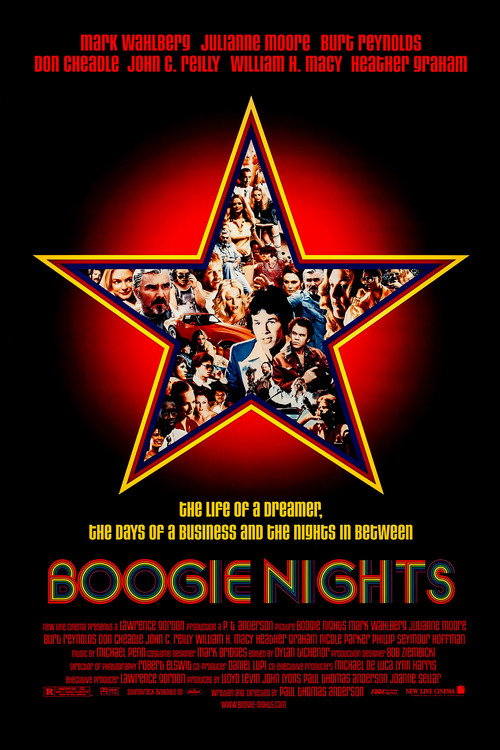
Paul Thomas Anderson launched his career with a sprawling, vibrant look at the San Fernando Valley adult film industry during the late 1970s. The film follows Eddie Adams, played by Mark Wahlberg, an aspiring actor who finds himself thrust into the world of adult cinema under the guidance of Jack Horner, portrayed by Burt Reynolds. As the disco era fades and the AIDS crisis looms, this ensemble cast navigates a life defined by excess, ambition, and the harsh transition from fantasy to reality. The movie blends drama and comedy while maintaining a distinctively human tone that avoids easy judgment of its characters.
Produced on a budget of $15 million, Boogie Nights became a critical darling, earning a solid 7.6 rating from audiences despite a modest box office return of roughly $43 million. The production featured a star-studded lineup including Julianne Moore, Don Cheadle, and Heather Graham, all delivering memorable performances in roles that ranged from supportive spouses to chaotic drug users. Anderson wrote the script himself, crafting a narrative that feels both like a period piece and a timeless tragedy about the fleeting nature of fame.
Stream
Availability and pricing can change. Confirm on the provider's site before purchasing.
Eddie Adams starts as a seventeen-year-old busboy at a nightclub in Reseda, California, where his life shifts when veteran director Jack Horner spots him. Impressed by Eddie's charisma and his physical attributes, Jack offers him a spot in his troupe of adult film performers, renaming him Dirk Diggler. This marks the beginning of a meteoric rise for Dirk, who quickly becomes the biggest star in the genre. The story unfolds across three distinct time periods: the euphoric disco days of 1977, the shifting cultural landscape of 1980, and the grim realities of 1983. During these years, Jack builds a makeshift family around his productions, bringing together a colorful group of eccentrics including the maternal Amber Waves, the skater Rollergirl, the loyal Reed Rothchild, and the troubled Little Bill.
The first act pulses with the energy of the era. Pool parties, cocaine-fueled escapades, and flashy cars define the lifestyle of the crew. Dirk enjoys adoration and wins awards, while Jack dreams of elevating his work into legitimate cinema. The atmosphere is one of boundless possibility, where everyone seems to be chasing the next big high or the next big break. The camera captures the glossy sheen of the 1970s, making the eventual fall feel all the more tragic. This section establishes the deep bonds between the characters, creating a sense of belonging that will be tested as the decade turns.
As the calendar flips to the 1980s, the tide begins to turn. Disco music loses its grip on the culture, and home video technology starts to cannibalize the theatrical adult film market. The freewheeling excess of the previous years curdles into addiction and desperation. Dirk's ego swells alongside his cocaine habit, leading to clashes with Jack and a failed attempt at a solo music career. Meanwhile, the supporting cast faces their own crises: Amber fights for custody of her son while battling her own demons, Buck struggles with racial stereotyping in his stereo business, and Scotty J. deals with unrequited love for Dirk. The narrative grows darker and more fragmented as the characters' fantasies collide with harsh realities.
The middle section of the film documents the slow disintegration of this surrogate family. Dirk descends into paranoia and petty crime, eventually hitting rock bottom in a series of humiliating events. Yet Paul Thomas Anderson maintains a non-judgmental perspective throughout, treating these dreamers and lost souls with empathy rather than condemnation. The story weaves through a decade of personal and professional turmoil, setting the stage for a climax that forces the characters to confront whether redemption is still possible in a world that has moved on without them. The film ends by asking if connection can survive the collapse of the American dream.
4K Restoration | Official Trailer
Modern Trailer
Original Theatrical Trailer
Critical Consensus
Critics widely praised Boogie Nights for its ambitious scope, empathetic portrayal of marginalized characters, and Paul Thomas Anderson's confident direction. The film stands out for blending comedy and tragedy seamlessly while capturing the specific textures of 1970s Los Angeles. Performances from the entire ensemble received acclaim, with particular attention given to the chemistry between the leads and the nuanced supporting roles.
“Paul Thomas Anderson's 'Boogie Nights' is an epic of the low road, a classic Hollywood story set in the shadows instead of the spotlights but containing the same emotional truth.”
Roger Ebert
Chicago Sun-Times
“A sprawling, vibrant, and ultimately moving epic that compares favorably to classic Hollywood rise-and-fall narratives while showcasing a star-making turn by Mark Wahlberg.”
Todd McCarthy
Variety
“A thrillingly alive movie that captures the giddy, doomed excess of the era with style and heart, singling out Reynolds and Moore for career-best work.”
David Ansen
Newsweek
“The film announces Paul Thomas Anderson as a major new talent with electric energy and heartbreaking humanity that refuses to judge its flawed characters.”
Peter Travers
Rolling Stone
Mark Wahlberg
Eddie Adams / Dirk Diggler
Burt Reynolds
Jack Horner
Julianne Moore
Amber Waves
John C. Reilly
Reed Rothchild
Heather Graham
Rollergirl
Don Cheadle
Buck Swope
Philip Seymour Hoffman
Scotty J.
William H. Macy
Little Bill
Director
Paul Thomas Anderson
Writer
Paul Thomas Anderson
Composer
Michael Penn
Cinematographer
Robert Elswit
Producers
John S. Lyons, Lloyd Levin, JoAnne Sellar, Paul Thomas Anderson
Academy Awards (1998)
Best Supporting Actor: Nominated
Academy Awards (1998)
Best Supporting Actress: Nominated
Academy Awards (1998)
Best Original Screenplay: Nominated
Golden Globe Awards (1998)
Best Supporting Actor - Motion Picture: Nominated
Golden Globe Awards (1998)
Best Supporting Actress - Motion Picture: Nominated
BAFTA Awards (1998)
Best Original Screenplay: Nominated
Screen Actors Guild Awards (1998)
Outstanding Performance by a Cast: Nominated
Independent Spirit Awards (1998)
Best First Feature: Won
National Board of Review (1997)
Best Supporting Actress: Won
Los Angeles Film Critics Association (1997)
Best Supporting Actress: Won
Join the community
fans discussing