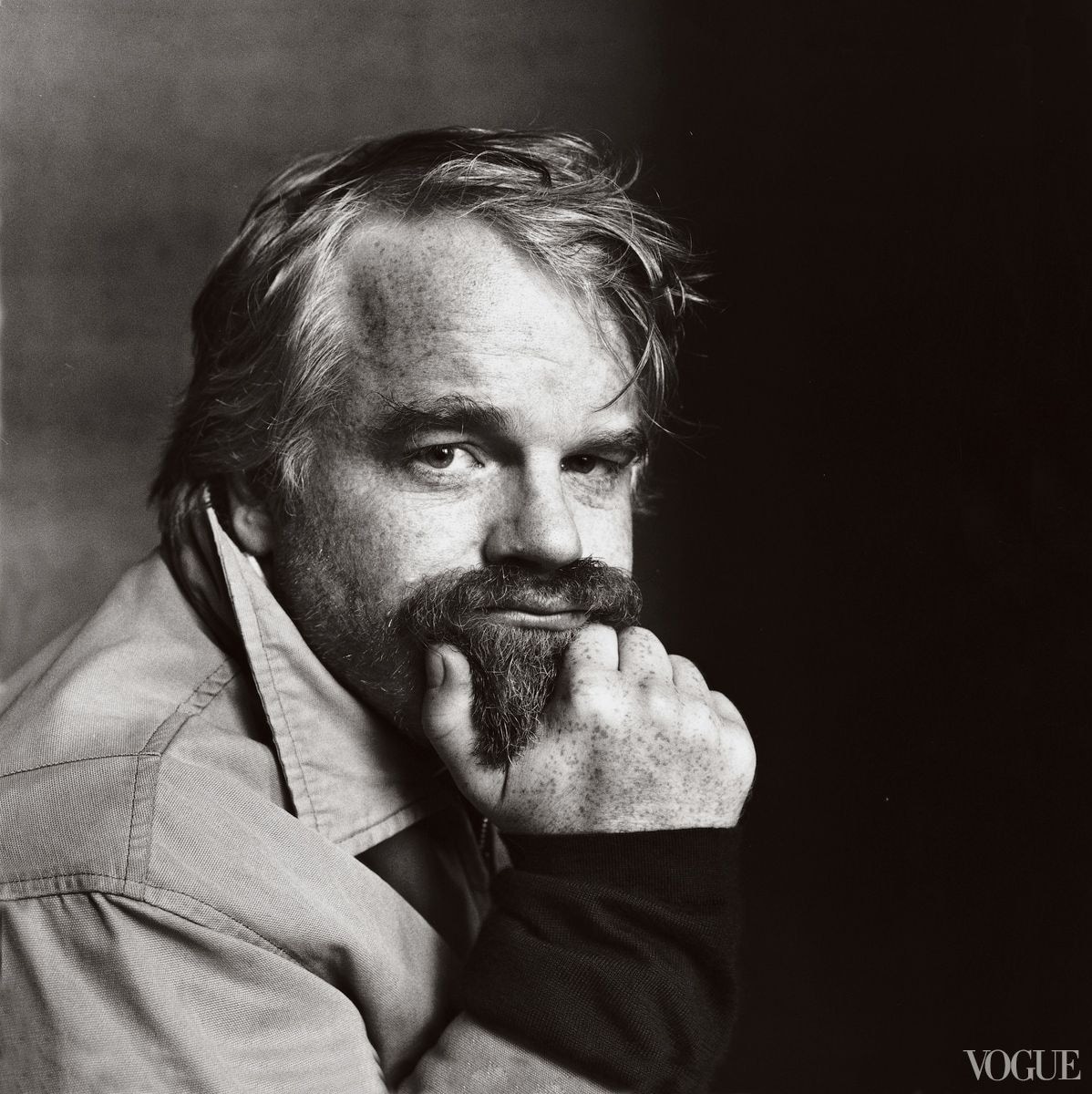
Philip Seymour Hoffman
Birthday
July 23, 1967
Birth Sign
Leo
Birthplace
Fairport, New York
Age
Died at 46
Height
5 ft 9 in (175 cm)
About
Philip Seymour Hoffman was an American actor, director, and producer who brought remarkable depth to every character he played. His career spanned over two decades, featuring more than 50 films and extensive stage work. Hoffman was celebrated for his extraordinary versatility, often disappearing into roles, from complex villains to vulnerable everymen. His acclaimed performances earned him an Academy Award for Best Actor for his portrayal of Truman Capote, alongside three additional Oscar nominations for his supporting work. He also received multiple Tony Award nominations for his powerful performances on Broadway.
Known for his intense commitment, Hoffman's distinct ability to portray flawed yet deeply human characters solidified his place as one of the most respected actors of his generation. In 2024, The Independent recognized him as the greatest actor of the 21st century, a testament to his enduring impact on cinema and theater. His work continues to be studied and admired by cinephiles and aspiring actors worldwide, a legacy defined by nuance, truth, and an unflinching dedication to his craft.
Early Life & Background
Growing up in Fairport, New York, a suburb of Rochester, Philip Seymour Hoffman initially saw himself on a different path. Born on July 23, 1967, he was the second of four children to Marilyn O'Connor, an elementary school teacher who later became a lawyer and family court judge, and Gordon Stowell Hoffman, who worked for Xerox. He shared his childhood with an older brother, Gordy, and two younger sisters, Jill and Emily. His parents divorced during his teenage years, a formative experience for young Philip.
For much of his youth, Hoffman was more drawn to sports than the stage. He played football, baseball, and was a wrestler in high school. A significant neck injury from wrestling abruptly ended his athletic pursuits. This unexpected turn led him almost by chance to the drama club; he followed a girl he liked to an audition. Around age 12, a pivotal moment occurred when he saw a local production of Arthur Miller's All My Sons. He later described the experience as a "miracle" that profoundly changed his perspective, sparking a deep interest in acting.
At 17, Hoffman gained acceptance into the prestigious New York State Summer School of the Arts. This experience further solidified his passion for performance. He went on to study acting at New York University's Tisch School of the Arts, where he earned a Bachelor of Fine Arts in Drama in 1989. During his time at NYU, he co-founded the Bullstoi Ensemble theater company alongside actor Steven Schub and director Bennett Miller, laying the groundwork for his collaborative spirit in the arts.
After graduating, Hoffman immersed himself in the New York theater scene, also performing in Chicago and touring in Europe. To make ends meet in the competitive city, he took on various odd jobs, including a stint working behind a deli counter. His very first screen appearance came in 1991 on the police procedural Law & Order. Later that year, he made his film debut in the independent production Triple Bogey on a Par Five Hole, where he was credited as Phil Hoffman. The true turning point arrived in 1992, when he landed a 15-minute scene opposite Al Pacino in Scent of a Woman. This role, which he landed directly from his deli job, proved to be an intense challenge and a crucial stepping stone into the world of professional film acting.
Career Growth
Philip Seymour Hoffman's career truly took off with his breakthrough performance as Scotty J., a gay boom operator, in Paul Thomas Anderson's 1997 film, Boogie Nights. This role garnered him significant critical attention and established him as a character actor of exceptional talent. The following year, he appeared as Brandt in the Coen Brothers' cult classic The Big Lebowski, further cementing his reputation for distinctive supporting roles.
The late 1990s and early 2000s saw Hoffman delivering memorable performances in a string of critically acclaimed films. In 1999, he appeared in three notable features: Paul Thomas Anderson's Magnolia, Anthony Minghella's The Talented Mr. Ripley, and Todd Solondz's Happiness. He made his Broadway debut in 2000 in Sam Shepard's True West, opposite John C. Reilly, earning his first Tony Award nomination. He continued his stage work, securing a second Tony nomination in 2003 for his role in Long Day's Journey into Night.
A career-defining moment arrived in 2005 with his portrayal of writer Truman Capote in the film Capote. His nuanced and immersive performance earned him the Academy Award for Best Actor, along with the BAFTA Award for Best Actor in a Leading Role and the Golden Globe Award for Best Actor – Motion Picture Drama. Following this triumph, Hoffman expanded his range, playing the villain Owen Davian in the 2006 blockbuster Mission: Impossible III. He received further Academy Award nominations for Best Supporting Actor for his work in Charlie Wilson's War (2007) and Doubt (2008).
In 2010, Hoffman stepped behind the camera to make his directorial debut with Jack Goes Boating, in which he also starred. He continued his successful collaboration with Paul Thomas Anderson, earning his fourth Academy Award nomination for Best Supporting Actor for his role as Lancaster Dodd in 2012's The Master. That same year, he received his third Tony nomination for his performance in Death of a Salesman on Broadway. His final major film role was as Plutarch Heavensbee in The Hunger Games: Catching Fire (2013) and the subsequent Mockingjay films, with most of his scenes for Part 1 and Part 2 completed before his passing in 2014.
Career Timeline
Public Image & Style
Philip Seymour Hoffman was widely recognized for his remarkable ability to completely inhabit his characters, a skill often described as disappearing into a role "like a second skin." His public persona was defined by his intense versatility, allowing him to portray a vast array of individuals, from deeply flawed and morally ambiguous figures to sympathetic and often tragic characters. Critics consistently lauded his performances for their depth, nuance, and unwavering authenticity.
Media outlets frequently highlighted his commitment to his craft, with The New York Times describing him as "perhaps the most ambitious and widely admired American actor of his generation" in his obituary. While Hoffman did not cultivate a celebrity-driven social media presence, having passed before the platform's peak, he commanded a devoted following among cinephiles and acting enthusiasts. His filmography is often studied in acting schools, and fans celebrate his work through retrospectives and online discussions. His performances in films like Capote, The Master, and Boogie Nights remain particularly revered, showcasing why audiences connected so deeply with his portrayal of the human condition.
Fame & Fandom
Philip Seymour Hoffman remains a towering figure in cinema history, though his standing in contemporary global popularity metrics differs from that of active franchise stars. As of August 2026, the iFANN Global Fame Engine has evaluated this person, but they do not currently hold a placement in the published rankings (Global Top 1,000 or a Top-100 scope list). This absence reflects a legacy defined by artistic reverence rather than current viral consumption or mass-market celebrity cycles. While he is widely cited as one of the greatest actors of his generation, his fame exists in a retrospective sphere where critics and cinephiles honor his craft rather than engage in real-time fan mobilization. The audience surrounding his work lacks a formal designation; no organized group identifies itself with a specific name such as 'Hoffmanites,' and no official campaigns or birthday tributes have been documented during his lifetime. His relationship with the public was characterized by extreme privacy, avoiding the spotlight that typically fuels modern fandom rituals. Consequently, the collective memory of Hoffman is shaped by critical acclaim and the tragic circumstances of his death rather than active fan engagement. He was revered primarily within the film industry for his transformative abilities, disappearing into roles with a depth that few peers could match. The cultural mythology surrounding him centers on his artistic integrity and the fragility of his recovery from addiction, which culminated in his untimely passing in 2014. This narrative has cemented his status as an icon of independent cinema, ensuring his work endures through ongoing study and appreciation by those who value acting mastery over pop-culture immediacy.
Interesting Facts and Legends
Philip Seymour Hoffman and John C. Reilly, his co-star in the 2000 Broadway production of True West, would switch roles every few performances to maintain dynamic tension for both actors and the audience. His older brother, Gordy Hoffman, is a screenwriter who penned the script for the 2002 independent film Love Liza, in which Philip starred. Director Paul Thomas Anderson frequently cast Hoffman in his films, making him a favorite collaborator across four movies: Boogie Nights, Magnolia, Punch-Drunk Love, and The Master. Hoffman initially expressed hesitation about taking on the role of Truman Capote, admitting he accepted the part kicking and screaming despite recognizing its potential. He dedicated four and a half months to preparing for the role, immersing himself in Capote's writings, listening to his voice, and studying videos of the author. His son, Cooper Hoffman, has followed in his father's footsteps, making his acting debut in Paul Thomas Anderson's 2021 film Licorice Pizza. A widely retold story regarding Hoffman concerns the tragic circumstances of his death, when he was found in his New York City apartment with roughly 70 bags of heroin nearby after 23 years of sobriety. This event became the central narrative of his posthumous reputation, shifting focus to the fragility of his recovery and the loss of a talent voted the greatest actor of the 21st century in a 2024 ranking.
Notable Quotes
“I knew that it would be great, but I still took the role kicking and screaming. Playing Capote took a lot of concentration. I prepared for four and a half months. I read and listened to his voice and watched videos of him on TV.”
“When I saw All My Sons, I was changed, permanently changed, by that experience. It was like a miracle to me.”
“I couldn't even think about being with this legend. All I could think about was my own acting. Then it dawned on me, 'You're doing this in front of Al Pacino.' It was almost too much.”
Family & Personal Life
Philip Seymour Hoffman was born into a family of four children in Fairport, New York. His mother, Marilyn O'Connor, began her career as an elementary school teacher before pursuing law and eventually becoming a family court judge. His father, Gordon Stowell Hoffman, worked for the Xerox Corporation. Philip grew up with an older brother named Gordy and two younger sisters, Jill and Emily. His parents divorced during his adolescent years.
Later in life, Hoffman shared a long-term, committed relationship with costume designer Mimi O'Donnell, though they never married. Together, they welcomed three children into their lives: a son, Cooper Hoffman, born in 2003, and two daughters, Tallulah, born in 2006, and Willa, born in 2008.
Notable Connections
Philip Seymour Hoffman frequently collaborated with a close circle of artists throughout his career. Director Paul Thomas Anderson cast him in four of his films, including Boogie Nights and The Master, recognizing his unique talent. He often shared the screen with actor John C. Reilly, notably in Boogie Nights, Magnolia, and on Broadway in True West. Hoffman's long-term partner, Mimi O'Donnell, was a costume designer who worked on several of his theater productions. He also co-founded the Bullstoi Ensemble with director Bennett Miller, who later directed Hoffman to an Oscar in Capote. His brother, Gordy Hoffman, wrote the screenplay for the film Love Liza, which Philip starred in.
Relationships & Dating History
Philip Seymour Hoffman was in a long-term, committed relationship with costume designer Mimi O'Donnell, which began around 1999. They met through the vibrant theater community in New York City, where O'Donnell frequently worked on productions with the LAByrinth Theater Company, of which Hoffman was a key member. Though they never married, their partnership was deeply devoted, and they built a family together.
Over the course of their relationship, Hoffman and O'Donnell welcomed three children: their son, Cooper Hoffman, born in 2003, followed by daughters Tallulah in 2006, and Willa in 2008. They remained partners for approximately 15 years, until Hoffman's untimely death in February 2014. Following his passing, Mimi O'Donnell has spoken publicly about his struggles with addiction and the profound impact his death had on their family. As of 2026, Hoffman is deceased, having passed away on February 2, 2014, and his family continues to manage his estate.
- In a RelationshipMimi O'Donnell1999 - 2014O'Donnell was a costume designer and the couple had three children together: Cooper, Tallulah, and Willa. They remained partners until Hoffman's death.
Death & Aftermath
Died
February 2, 2014 (aged 46)
Death Place
New York City, New York, USA
Cause of Death
Acute mixed drug intoxication
Philip Seymour Hoffman was discovered deceased in his Manhattan apartment at 37 West End Avenue around 11:15 a.m. on Sunday, February 2, 2014, by his girlfriend Mimi O'Donnell after she failed to reach him by phone earlier that morning. The New York City Chief Medical Examiner's Office later determined the cause of death to be acute mixed drug intoxication resulting from heroin, cocaine, benzodiazepines, amphetamines, and morphine, with an autopsy identifying a needle and syringe near the body as evidence of recent intravenous use. Tributes poured in immediately from industry peers and institutions worldwide, with vigils held spontaneously outside his apartment and at theaters where he had performed, while streaming numbers surged for films including Capote and The Master.
His final major film role as Plutarch Heavensbee in The Hunger Games: Mockingjay, Part 1 became a focal point for fans following the news. A private funeral and memorial service took place on February 6, 2014, at St. Paul's Chapel on the Columbia University campus, attended by his three children Cooper, Tallulah, and Willa, along with select colleagues such as Amy Ryan and Paul Giamatti. Following the ceremony, Hoffman was cremated and his ashes were scattered in a location kept private by his family. Posthumous recognition included a Golden Globe nomination for A Most Violent Year and a BAFTA nomination for The Master, cementing his legacy as one of the greatest actors of his generation.
Net Worth (Estate Value)
$40 Million
iFANN Editorial Team estimate
As of 2026, Philip Seymour Hoffman's estate is estimated to be valued at approximately $40 million per iFANN's editorial analysis. This figure reflects his earnings during his active career and the continued revenue generated posthumously. Hoffman earned substantial salaries for his film roles, particularly for major studio projects. For instance, his involvement in The Hunger Games franchise reportedly brought in an estimated $5 million to $10 million alone. Beyond his film work, Hoffman's income streams included his extensive stage career on Broadway and Off-Broadway, although theater typically offers less lucrative compensation than film. He also generated additional earnings from his directorial debut with the film Jack Goes Boating. Since his passing in 2014, the estate has continued to benefit from residuals from his vast filmography, including the posthumous releases of The Hunger Games: Mockingjay – Part 1 and Part 2, as well as ongoing royalties from streaming and syndication of his body of work. His estate is managed by his family, with his long-term partner Mimi O'Donnell playing a primary role in overseeing its affairs. The consistent earnings from his critically acclaimed and commercially successful projects have ensured a stable financial legacy for his family.
Awards Won (66)
Philip Seymour Hoffman received significant recognition throughout his career, culminating in an Academy Award for Best Actor. He won the Oscar for his compelling portrayal of Truman Capote in the 2005 film Capote, a role that also earned him the Golden Globe Award for Best Actor – Motion Picture Drama and the BAFTA Award for Best Actor in a Leading Role. Additionally, he garnered a Screen Actors Guild Award and the Volpi Cup for Best Actor at the Venice Film Festival for the same performance, among numerous critics' awards. His nuanced acting was consistently celebrated by his peers and critics alike.
2005 · Best Actor
Capote
2005 · Best Actor – Motion Picture Drama
Capote
Known For
Capote
2005 · Truman Capote
The Master
2012 · Lancaster Dodd
Boogie Nights
1997 · Scotty J.
Doubt
2008 · Father Brendan Flynn
Mission: Impossible III
2006 · Owen Davian
The Big Lebowski
1998 · Brandt
The Hunger Games: Catching Fire
2013 · Plutarch Heavensbee
Keywords
Sources
Quick Facts
- Profession
- actor, director, producer
- Born
- July 23, 1967
- Birthplace
- Fairport, New York
- Died
- February 2, 2014
- Death Place
- Manhattan, New York City
- Gender
- Male
- Birth Sign
- Leo
Personal Details
- Full Name
- Philip Seymour Hoffman
- Height
- 5 ft 9 in (175 cm)
- Children
- Cooper Hoffman · Tallulah Hoffman · Willa Hoffman
- Education
- New York University's Tisch School of the Arts, B.F.A. in Drama
Filmography
56
Total
55
Film
1
TV
Frequently Asked Questions
Who was Philip Seymour Hoffman's partner?
What was Philip Seymour Hoffman's net worth at the time of his death?
How old was Philip Seymour Hoffman when he died?
What was Philip Seymour Hoffman best known for?
Did Philip Seymour Hoffman have any children?
Join the community
fans discussing