 United States
“Takal stages the kills with a certain flair, but the movie is so busy arguing its thesis that it forgets to be scary.”
David Ehrlich
IndieWire
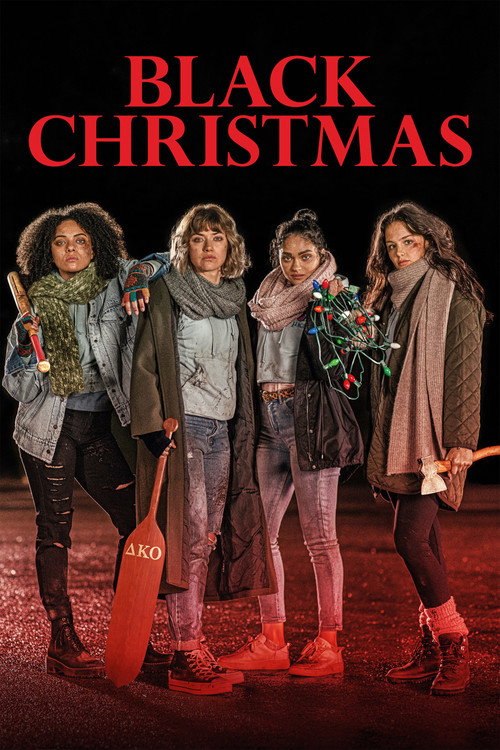
Third time around for the title, and this one comes from a very different place than Bob Clark's 1974 original or Glen Morgan's 2006 remake. Sophia Takal directed and co-wrote Black Christmas with April Wolfe, expanding a short they had made for Blumhouse's Into the Dark series into a feature that Blumhouse and Universal fast-tracked for a December 2019 slot. The setting is Hawthorne College, a snowy New England campus emptying out for the holidays, and the target is a sorority house whose sisters start getting picked off by a masked figure. Imogen Poots leads as Riley Stone, a senior still raw from an assault by a fraternity president, with Aleyse Shannon, Lily Donoghue and Brittany O'Grady as the friends who refuse to scatter.
What separates this version from its predecessors is the frame around the kills. Takal and Wolfe treat the slasher violence as an institutional problem, not a lone lunatic's hobby, and the film keeps the gore largely off-screen to earn its PG-13. Cary Elwes turns up as Professor Gelson, a classics scholar with a proprietary interest in the college's traditions, and the mystery of who is behind the mask pulls the women toward the school's founding history rather than away from it. The budget was a reported $5 million; the worldwide gross landed at $18,529,730.
Critics mostly didn't buy it. Reviews faulted thin suspense and heavy messaging, and the film landed on year-end worst-remake lists while the 1974 original kept its reputation as the genre's real landmark. Still, the cast commits, the politics are sincere, and the ending takes a swing the original never would. Shot in New Zealand standing in for New England, which is why the snow looks so convincing.
Stream
Availability and pricing can change. Confirm on the provider's site before purchasing.
Hawthorne College is shutting down for winter break, and the campus is nearly empty. Riley Stone (Imogen Poots) is a senior who has spent the year since her assault by a fraternity president pulling inward, avoiding the Greek houses and the men who run them. Her sorority sisters have not let her disappear. Kris Waterson (Aleyse Shannon) is the loudest of them, an activist who has been petitioning the administration to remove a statue of the college's slave-owning founder and to make the men's fraternities answer for their behavior. Marty Coolidge (Lily Donoghue) is the dry, self-assured one. Jesse Bolton-Sinclair (Brittany O'Grady) is shy and bookish. Along with housemates Helena Ritterhouse (Madeleine Adams), Fran Abrams (Nathalie Morris) and Oona Apteao (Zoë Robins), they plan a quiet Christmas in the house, supervised with weary patience by their house mother, Mrs. Mac.
The quiet doesn't last. A masked figure starts appearing at the edges of the house and around the deserted campus, and the sisters are attacked in isolated, wintry spots: a darkened room, a snowbound path, an empty athletic building. Takal stages these as slasher set pieces but keeps the camera away from the worst of it, leaning on suspense and the threat of violence rather than gore. At the same time, the women keep running into the men of the fraternity houses, particularly the smug brothers of the house whose former president assaulted Riley, and into the strange, proprietary behavior of the campus authorities.
Rather than scatter, Riley, Kris and Marty start investigating. Their questions lead them into the college's institutional history: the founder's statue Kris has been campaigning against, the fraternity's rituals, the way the school's power structure closes ranks around its own. Suspicion moves around the cast. The fraternity brothers Landon (Caleb Eberhardt) and Nate (Simon Mead) look guilty of something. So does Professor Gelson (Cary Elwes), a classics scholar with a grandiose manner and an uncomfortably personal interest in Hawthorne's traditions. The film lets the audience and the characters cycle through suspects, and the growing conviction that the attacks are coordinated rather than random drives the back half.
The beats are familiar slasher architecture, the stalk-and-attack opening, the discovery that a sister is missing, the decision to stay and fight, a false lead or two, a confrontation in a public campus space, but the feminist framing bends each one. Riley's recovery of her voice and Kris's insistence that the personal is institutional give the movie its engine. The film builds toward a revelation about what the masked figure actually is and who is pulling the strings, and that is where this synopsis stops.
Official Trailer
Critical Consensus
Critics agreed the film aims at timely feminist themes but mostly lands on formula. Reviewers praised Imogen Poots and the cast's commitment while faulting thin suspense and a PG-13 slasher that plays more like a thesis than a scare. The 1974 original's shadow hung over every review, and the remake landed on several year-end worst-remake lists.
“Takal stages the kills with a certain flair, but the movie is so busy arguing its thesis that it forgets to be scary.”
David Ehrlich
IndieWire
“Poots is a genuinely compelling lead, and the film's anger feels earned even when its mechanics don't.”
Alison Willmore
Vulture
“A slasher that wants to have its Christmas cake and eat it too, serving up genre thrills while lecturing the audience about them.”
Peter Bradshaw
The Guardian
“The film's heart is in the right place, but a horror movie needs more than good intentions to keep an audience on edge.”
Owen Gleiberman
Variety
Imogen Poots
Riley Stone
Aleyse Shannon
Kris Waterson
Lily Donoghue
Marty Coolidge
Brittany O'Grady
Jesse Bolton-Sinclair
Cary Elwes
Professor Gelson
Caleb Eberhardt
Landon
Simon Mead
Nate
Madeleine Adams
Helena Ritterhouse
Nathalie Morris
Fran Abrams
Ben Black
Phil McIllaney
Zoë Robins
Oona Apteao
Ryan Phillips
Brian Huntley
Director
Sophia Takal
Writers
Sophia Takal, April Wolfe, Roy Moore
Composers
Will Blair, Brooke Blair
Cinematographer
Mark Schwartzbard
Producers
Jason Blum, Ben Cosgrove, Adam Hendricks, Brigitte Berman
Join the community
fans discussing