“A film of extraordinary visual beauty and emotional power. Bardem brings a fierce, wounded intelligence to every scene.”
Stephen Holden
The New York Times
 United States
"A life lived in defiance."
User Score
30,000+ votes
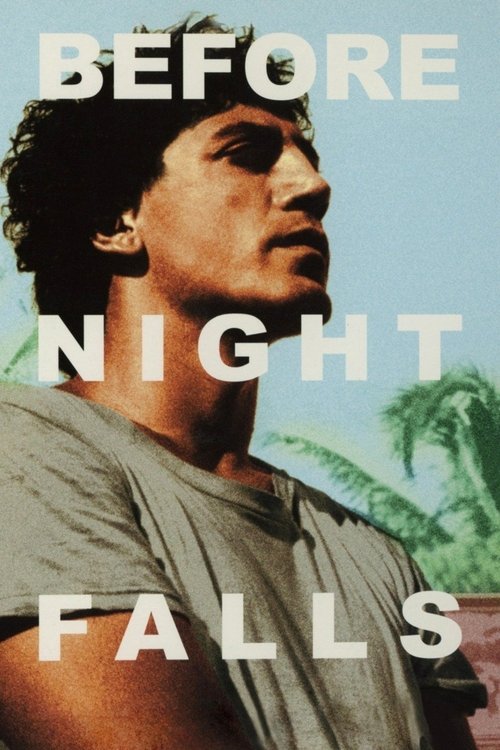
Julian Schnabel's Before Night Falls traces the life of Cuban writer Reinaldo Arenas, from a dirt-poor childhood in Oriente province to his death in New York in 1990. The film, adapted from Arenas's memoir, moves through his early years as a young revolutionary, his rise as a novelist, his persecution as a gay man under Fidel Castro's regime, and his eventual exile during the 1980 Mariel boatlift. Javier Bardem plays Arenas, a role that earned him an Oscar nomination and made him a star outside Spain. Olivier Martinez appears as Lazaro Gomez Carilles, Arenas's lover and fellow dissident, and Johnny Depp turns up in a dual role as a transvestite prisoner named Bon Bon and a brutal lieutenant. The supporting cast includes Andrea Di Stefano, Santiago Magill, and John Ortiz.
The film was produced by Jon Kilik for El Mar Pictures and Grandview Pictures, with a script by Cunningham O'Keefe, Lázaro Gómez Carriles, and Schnabel. Carter Burwell composed the score, and Xavier Grobet and Guillermo Rosas handled cinematography. It premiered at the Venice Film Festival on September 3, 2000, and went on to gross $8.5 million worldwide. That is modest for a biopic, but the film found a devoted audience on the art-house circuit.
Before Night Falls is a drama with the sweep of an epic and the intimacy of a memoir. It is rated R for strong sexual content, violence, and language. The film does not flinch from the brutality of Arenas's years in Cuban prisons, but it also finds moments of beauty and defiance. Critics responded warmly, and the film holds a 7.2 rating on IMDb from over 30,000 votes. It is not a franchise starter, but it is a key entry in the wave of Latin American and LGBTQ+ cinema that emerged around the turn of the millennium.
Availability and pricing can change. Confirm on the provider's site before purchasing.
Julian Schnabel opens Before Night Falls not with a city or a revolution but with a child in a hut. Reinaldo Arenas grows up in Oriente province, the eastern Cuban countryside, in a family so poor that hunger and neglect are simply the weather. The boy is different, and the film knows it before he does: he watches, he listens, he reads whatever he can find. Schnabel, a painter by training, shoots these early passages in sun-bleached, almost hallucinatory images, as if memory itself were the narrator.
By his teens Arenas has joined the underground resistance to Fulgencio Batista. He believes in the revolution, and when Fidel Castro's forces take Havana in January 1959, Arenas is among the young writers who think a new country is being born. He moves to the capital, studies, and starts publishing. His first novels get noticed. He finds a place in Havana's bohemian circles, alongside the poet Virgilio Piñera (played by filmmaker Héctor Babenco) and friends like Pepe Malas (Andrea Di Stefano), Tomás Diego (Santiago Magill), and Juan Abreu (John Ortiz). He is also openly gay in a country that is turning against men like him.
The turn is gradual and then total. Starting in the 1960s, the Castro government criminalizes homosexuality and rounds up gay men into the UMAP labor camps. Arenas's books are pulled from shelves and confiscated. He is watched, harassed, and eventually imprisoned. Schnabel's middle section follows the arrests and the jail terms, and it shows the writer's stubborn response: he keeps writing. Manuscripts are smuggled out page by page, hidden in friends' apartments, carried across borders by people who risk their own freedom to save his sentences.
Two figures dominate this stretch. Johnny Depp, in a dual role, appears first as Bon Bon, a flamboyant transvestite prisoner who becomes Arenas's ally and protector, and then as Lieutenant Victor, a sadistic prison official. The doubling is Schnabel's way of showing how the same regime produces both the outlaw and the enforcer. Meanwhile Arenas falls in love with Lázaro Gómez Carilles (Olivier Martinez), a fellow dissident who becomes his partner and, in time, his lifeline. Their relationship is the film's emotional spine, tested by prison walls, by exile, and by illness.
Through the 1970s Arenas is effectively under house arrest in his own country. He cannot publish, cannot travel, cannot speak freely. The film builds toward April 1980, when Castro briefly opens the port of Mariel and allows Cubans to leave. For Arenas, the boatlift is the first real chance at escape after years of confinement. The narrative follows him out, toward the United States and a life in New York City that is free but not easy.
Schnabel tells this story in fragments rather than a straight line. The film moves by association, from a prison cell to a remembered beach, from a Havana party to a New York apartment. That approach can feel uneven, but it matches its subject: Arenas wrote in bursts, in defiance, in whatever form the moment allowed. The supporting cast includes Francisco Gattorno as Jorge Camacho, Marisol Padilla Sánchez as Margarita Camacho, Michael Wincott as Herberto Zorilla Ochoa, Sean Penn in a brief cameo as Cuco Sanchez, and Najwa Nimri as Fina Zorilla Ochoa. What holds it together is Bardem, who plays Arenas from adolescence to middle age with a physical transformation and a wounded, watchful intelligence that never tips into martyrdom.
Before Night Falls ≣ 2000 ≣ Trailer
Critical Consensus
Schnabel's impressionistic biopic is anchored by a transformative Javier Bardem performance. Some critics found the episodic structure uneven, but most praised its emotional force and its refusal to soften Arenas's persecution.
“A film of extraordinary visual beauty and emotional power. Bardem brings a fierce, wounded intelligence to every scene.”
Stephen Holden
The New York Times
“Schnabel's vivid, sensuous imagery and Bardem's star-making performance make this a biopic of rare intensity.”
Todd McCarthy
Variety
“Shows a man who insisted on being himself in a society that demanded conformity.”
Roger Ebert
Chicago Sun-Times
“An unflinching portrait of artistic survival under totalitarianism.”
The Guardian
The Guardian
Javier Bardem
Reinaldo Arenas
Olivier Martinez
Lázaro Gómez Carilles
Johnny Depp
Bon Bon / Lieutenant Victor
Andrea Di Stefano
Pepe Malas
Santiago Magill
Tomás Diego
John Ortiz
Juan Abreu
Héctor Babenco
Virgilio Piñera
Francisco Gattorno
Jorge Camacho
Marisol Padilla Sánchez
Margarita Camacho
Michael Wincott
Herberto Zorilla Ochoa
Sean Penn
Cuco Sanchez
Najwa Nimri
Fina Zorilla Ochoa
Director
Julian Schnabel
Writers
Cunningham O'Keefe, Lázaro Gómez Carriles, Julian Schnabel, Reinaldo Arenas
Composer
Carter Burwell
Cinematographers
Xavier Grobet, Guillermo Rosas
Producer
Jon Kilik
Academy Awards (2001)
Best Actor in a Leading Role: Nominated
Golden Globe Awards (2001)
Best Actor – Motion Picture Drama: Nominated
Independent Spirit Awards (2001)
Best Male Lead: Won
Independent Spirit Awards (2001)
Best Cinematography: Nominated
Venice Film Festival (2000)
Volpi Cup for Best Actor: Won
Venice Film Festival (2000)
Golden Lion: Nominated
Join the community
fans discussing