 Peru
“Herzog has made a film that is a dream of horror, a feverish vision of the madness that can consume a man when he is cut off from the world and driven by a single obsession.”
Roger Ebert
Chicago Sun-Times
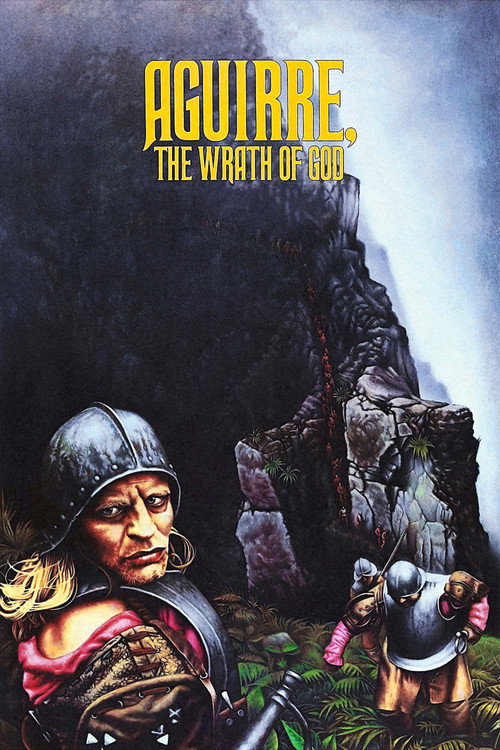
Werner Herzog's Aguirre, the Wrath of God transforms a historical footnote into a fever dream of colonial greed. Set in 1560 Peru, the film follows Don Lope de Aguirre as he leads a Spanish expedition down the Amazon River seeking El Dorado. Klaus Kinski delivers a terrifying performance as the title character, while Helena Rojo plays Inés de Atienza, his daughter and reluctant companion. The production itself became legendary for its struggle; Herzog shot on location in the Peruvian jungle with a tiny budget of $370,000 against a backdrop of monsoon rains and logistical nightmares.
Despite earning only $37,041 at the box office upon release, the movie earned a strong 7.4 rating from critics and audiences who recognized its unique power. This German-Mexican co-production blends history, adventure, and drama into a relentless descent into madness. The film stands as a definitive work of New German Cinema, capturing the futility of human ambition when pitted against the indifferent forces of nature.
Availability and pricing can change. Confirm on the provider's site before purchasing.
The year is 1560, decades after the Spanish conquest of the Inca Empire, yet the promise of El Dorado still drives men to the edge of the known world. A Spanish expedition departs from a high Andean outpost near Iquitos, Peru, carrying roughly eighty souls including soldiers, priests, and servants. Their leader, Don Pedro de Ursúa, is a man of indecision whose authority rests on shaky ground. He travels with his wife, Inés de Atienza, who disguises herself as a man named "Don Fernando" until she reveals her identity to Ursúa deep in the wilderness. The group constructs rafts from local timber to navigate the Ucayali River, beginning a journey that promises gold but delivers only humidity, disease, and exhaustion.
At the center of this fragile flotilla sits Don Lope de Aguirre, a veteran conquistador whose eyes burn with an intensity that suggests sanity is already slipping away. Initially appearing loyal, Aguirre quickly becomes the engine of the group's disintegration. He resents Ursúa's leadership and whispers doubts to the crew, positioning himself as the only capable leader for the quest. The environment turns hostile as the expedition enters the dense Amazon basin. Insects swarm, water levels rise unpredictably, and the physical toll of building rafts and navigating rapids wears down the men. Morale crumbles under the weight of starvation and the realization that the mythical city of gold may not exist.
Tension escalates as indigenous communities appear along the riverbanks, some offering trade while others attack. The line between civilization and savagery blurs as the Spanish soldiers exploit and enslave locals. Aguirre openly challenges Ursúa, accusing him of cowardice and incompetence during a meeting where the raft's progress stalls. The power dynamic shifts violently when Aguirre orchestrates a mutiny, killing Ursúa and seizing command of the flotilla. With Aguirre now the sole ruler, the expedition transforms from a search for discovery into a nightmare of tyranny. The remaining crew members, including Inés, are trapped in a boat drifting down an endless river, surrounded by a wall of green foliage that seems to close in on them. Aguirre declares himself the "Wrath of God," executes dissenters without hesitation, and demands absolute loyalty. The raft drifts deeper into the unknown, carrying a dying empire's delusion of grandeur as the group realizes there is no turning back and the jungle offers no mercy.
Trailer
Remastered Trailer
Critical Consensus
A masterpiece of German cinema, Aguirre, the Wrath of God is a visceral, hallucinatory journey into the heart of darkness. Klaus Kinski delivers one of the most terrifying performances in film history, supported by Werner Herzog's visionary direction and a haunting score that perfectly captures the oppressive atmosphere of the Amazon.
“Herzog has made a film that is a dream of horror, a feverish vision of the madness that can consume a man when he is cut off from the world and driven by a single obsession.”
Roger Ebert
Chicago Sun-Times
“Mr. Herzog has created a film that is both a historical drama and a modern allegory, a work of art that transcends its genre to become a profound meditation on the nature of evil and the futility of human ambition.”
Vincent Canby
The New York Times
“Kinski is a force of nature, a man who seems to have been born out of the jungle itself, and his performance is a tour de force of madness and violence.”
Pauline Kael
The New Yorker
Klaus Kinski
Don Lope de Aguirre
Helena Rojo
Inés de Atienza
Del Negro
Brother Gaspar de Carvajal
Ruy Guerra
Don Pedro de Ursúa
Peter Berling
Don Fernando de Guzmán
Cecilia Rivera
Flores
Director
Werner Herzog
Writer
Werner Herzog
Composer
Popol Vuh
Cinematographer
Thomas Mauch
Producers
Hans Prescher, Werner Herzog
Berlin International Film Festival (1973)
Silver Bear for Best Director: Won
Berlin International Film Festival (1973)
Golden Bear: Nominated
BAFTA Awards (1973)
Best Cinematography: Nominated
Academy Awards (1973)
Best Foreign Language Film: Nominated
Berlin International Film Festival (1973)
FIPRESCI Prize: Won
German Film Critics Award (1973)
Best Film: Won
Join the community
fans discussing