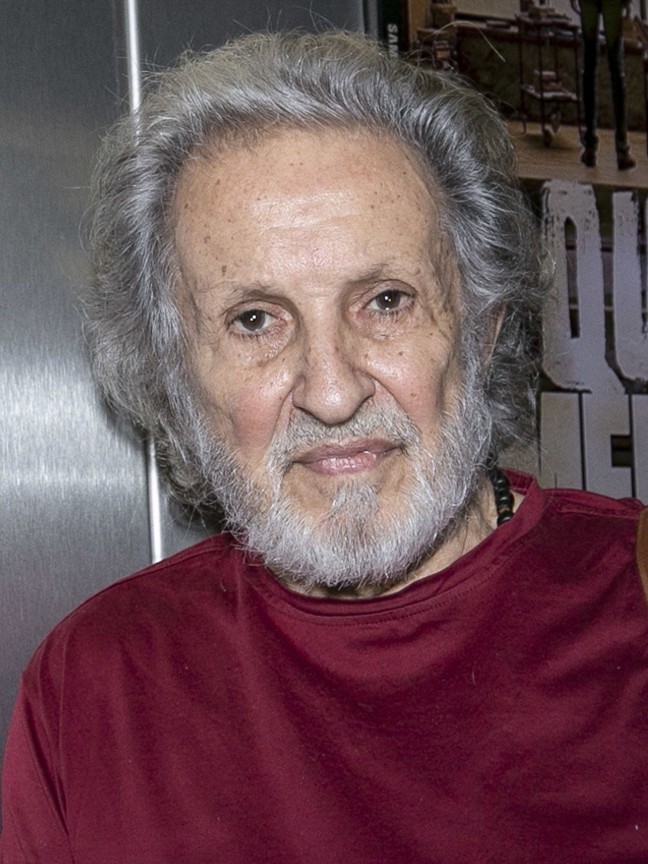
Ruy Guerra
 Brazil
film director•screenwriter•film editor
Also known as: Ruy Alexandre Guerra Coelho Pereira
Birthday
August 22, 1931
Birth Sign
Leo
Birthplace
Maputo, Mozambique
Age
95 years old
About
Ruy Guerra is a Portuguese-Brazilian film director and screenwriter, widely recognized as one of the founding figures of Brazil's Cinema Novo movement. Born in Maputo, Mozambique, he has crafted a career that spans over seven decades, with a filmography that consistently probes questions of identity, power, and social justice. His films are known for their raw energy, political urgency, and deep engagement with Brazilian culture, earning him a lasting place in the canon of world cinema.
Today, Guerra remains an active and respected voice in filmmaking. His work continues to be studied and celebrated, with retrospectives and honors arriving regularly, including an honorary doctorate from the Universidade Federal do Rio de Janeiro in 2018. For fans of Latin American and African cinema, he stands as a vital link between continents and movements, a director whose influence is felt far beyond his native lands.
Early Life & Background
Ruy Guerra was born in Lourenço Marques, now Maputo, the capital of Mozambique, in 1931, while the country was still a Portuguese colony. His early years in this coastal city, a melting pot of African and European cultures, gave him a unique perspective that would later surface in his work. He left Mozambique to study in Portugal, but soon felt the pull of cinema and moved to Paris, where he enrolled at the prestigious IDHEC film school in 1952.
While in Paris, Guerra immersed himself in the world of film, working as an assistant cameraman and assistant director on various productions. He also taught himself 8mm filmmaking, a hands-on education that complemented his formal training. During this period, he published film criticism, short stories, and essays, honing the narrative instincts that would define his directorial style. By the late 1950s, he had made his way to Brazil, where he would soon become a central figure in the country's cinematic renaissance.
Career Growth
Guerra's breakthrough came in 1962 with his debut feature, Os Cafajestes, a gritty, morally complex film that immediately placed him at the heart of the Cinema Novo movement. The movement, which also included figures like Glauber Rocha and Nelson Pereira dos Santos, sought to break away from Hollywood conventions and address Brazil's social realities. Guerra's raw, unflinching style made him a key player in this transformative era.
He continued to build an impressive body of work, including the political allegory Os Fuzis (1964), which won the Golden Bear at the Berlin International Film Festival. In 1972, he was involved in the production of Werner Herzog's Aguirre, the Wrath of God, a landmark of New German Cinema. His 1983 film Eréndira, based on a Gabriel García Márquez novella, further showcased his international reach. More recently, he directed The House of Sand (2005), a poetic drama set in the Brazilian dunes. Throughout his career, Guerra has also worked as a screenwriter and editor, and he remains active, with retrospectives of his work held as recently as 2026.
Career Timeline
Public Image & Style
Guerra is often described as an intellectual filmmaker, a figure who brings a literary sensibility to the screen. His public persona is that of a thoughtful, committed artist, deeply engaged with the political and social issues of his time. He is not a celebrity in the traditional sense; rather, he commands respect as a master of his craft. Fans of Cinema Novo revere him as a pioneer, and his films are studied in film schools around the world. In Brazil, he is seen as a national treasure, a director who helped define the country's cinematic identity.
Fame & Fandom (iFAMOUS Rankings)
Ruy Guerra commands a following defined by rigorous academic study rather than the fervent worship typical of pop culture icons. His audience consists almost exclusively of film scholars, cinephiles, and students dedicated to the history of Brazilian Cinema Novo and New Latin American Cinema. There is no organized fan club structure, nor does this community possess a formal name; instead, interaction occurs through institutional channels like retrospectives, festival Q&A sessions, and university lectures where his work is dissected with intellectual precision. The most enduring rituals involve the re-examination of his films in major cultural hubs, such as the screenings of *Mueda, Memória e Massacre* at the Brooklyn Academy of Music in 2025, which serve as gatherings for those seeking to understand the intersection of colonial history and cinematic form. While he lacks the viral moments or social media campaigns that drive modern celebrity metrics, his presence remains vital within the global film community, evidenced by his continued engagement in projects like *Aos Pedaços* well into his nineties. According to iFANN's Global Fame Engine evaluation conducted in August 2026, Ruy Guerra is evaluated but currently holds no placement in the published rankings (Global Top 1,000 or a Top-100 scope list). This absence from the primary global list reflects his status as a revered auteur rather than a mainstream household name.
Interesting Facts and Legends
Guerra is a polyglot fluent in Portuguese, French, and Spanish, a skill set that facilitated his collaborations across Latin America and Europe. He is also an accomplished editor who frequently edits his own films, a rare practice among directors of his generation. Despite his serious reputation, he possesses a playful side, having appeared in a small cameo role in one of his own productions, a detail that remains a point of discussion among fans. He is known as a voracious reader with a particular fondness for Latin American literature, which deeply influences his screenwriting. In a 2018 interview, he noted that he watches new films daily to maintain curiosity about the medium. Beyond these personal habits, his career is marked by legendary contributions to cinema. He authored the manifesto for New Latin American Cinema while working as a critic in Mozambique before moving to Brazil, establishing him as a foundational architect of the movement. His return to Mozambique after independence to create *Mueda, Memória e Massacre*, a film blending documentary and fiction to recount the 1960 massacre, is considered a seminal text for African cinema. Furthermore, his collaboration as a writer and actor on Werner Herzog's 1972 masterpiece *Aguirre, the Wrath of God* cements his reputation as a cosmopolitan artist capable of bridging distinct national cinemas.
Family & Personal Life
Guerra's family life has been as rich and complex as his films. He has been married three times, first to the actress Leila Diniz, a iconic figure in Brazilian cinema, then to the singer Nara Leão, a key voice in the bossa nova movement, and later to Cláudia Ohana, an actress who appeared in several of his films. He has children from these relationships, though details are kept private. His marriages placed him at the center of Brazil's artistic elite, and his personal life often mirrored the cultural ferment of his professional world.
Notable Connections
Ruy Guerra's collaborators include some of the most significant figures in Brazilian and world cinema. He worked with Werner Herzog on Aguirre, the Wrath of God, starring Klaus Kinski. His marriages to actress Leila Diniz, singer Nara Leão, and actress Cláudia Ohana placed him within a circle of influential artists. He is also associated with the Cinema Novo movement, alongside directors like Glauber Rocha and Nelson Pereira dos Santos, with whom he shared a commitment to socially conscious filmmaking.
Relationships & Dating History
Ruy Guerra's personal life has been marked by three notable marriages. His first wife was actress Leila Diniz, a vibrant and controversial figure in Brazilian cinema, whom he married in the 1960s. After their divorce, he married singer Nara Leão, a key figure in the bossa nova and MPB scenes; they were together during the late 1960s and early 1970s. His third wife was actress Cláudia Ohana, who appeared in his film Eréndira (1983). They married in the 1980s and remained together for several years. As of 2026, Guerra is reportedly married, though details about his current spouse are not widely publicized.
- MarriedLeila Diniz1965 - 1970Married in the 1960s; Diniz was a prominent Brazilian actress.
- MarriedNara Leão1971 - 1975Married in the early 1970s; Leão was a bossa nova singer.
- MarriedCláudia Ohana1983 - 1990Married in the 1980s; Ohana starred in his film Eréndira.
Salary, Net Worth In 2026
$5 Million
iFANN Editorial Team estimate
iFANN currently estimates Ruy Guerra's net worth at $5 Million as of 2026. This valuation reflects the accumulation of earnings from his extensive seven-decade career as a director, screenwriter, and editor. His financial standing is supported by royalties and residuals generated from his significant filmography, which includes key works in the Cinema Novo movement and international co-productions. While he does not command the blockbuster salaries associated with commercial Hollywood directors, his body of work has provided a steady income stream over decades. Additional revenue is derived from licensing fees when his films are screened at retrospectives and film festivals globally. His honorary doctorate and other accolades have elevated his public profile, contributing to the ongoing demand for his work, though these honors themselves do not constitute direct financial assets.
Awards Won (1)
Ruy Guerra has won several prestigious awards throughout his career. His film Os Fuzis won the Golden Bear at the 1964 Berlin International Film Festival. He has also received honors from other international festivals, solidifying his reputation as a master of world cinema. In 2018, he was awarded an honorary doctorate by the Universidade Federal do Rio de Janeiro, a recognition of his lifetime contribution to the arts.
1964 · Best Film
Os Fuzis
Known For
Os Cafajestes
1962 · Director, Screenwriter
Os Fuzis
1964 · Director, Screenwriter
Aguirre, the Wrath of God
1972 · Assistant Director
Eréndira
1983 · Director, Screenwriter
The House of Sand
2005 · Director
Keywords
Sources
Quick Facts
- Profession
- film director, screenwriter, film editor
- Born
- August 22, 1931
- Birthplace
- Maputo, Mozambique
- Gender
- Male
- Spouse
- Cláudia Ohana, Nara Leão, Leila Diniz
- Birth Sign
- Leo
Personal Details
- Full Name
- Ruy Alexandre Guerra Coelho Pereira
- Spouse
- Cláudia Ohana, Nara Leão, Leila Diniz
- Education
- IDHEC (Institut des hautes études cinématographiques), Paris (1952-1954)
Filmography
50
Total
45
Film
5
TV
Frequently Asked Questions
Who is Ruy Guerra?
What is Ruy Guerra's net worth in 2026?
Is Ruy Guerra still active in 2026?
What is Ruy Guerra best known for?
Where was Ruy Guerra born?
Similar People
Join the community
fans discussing