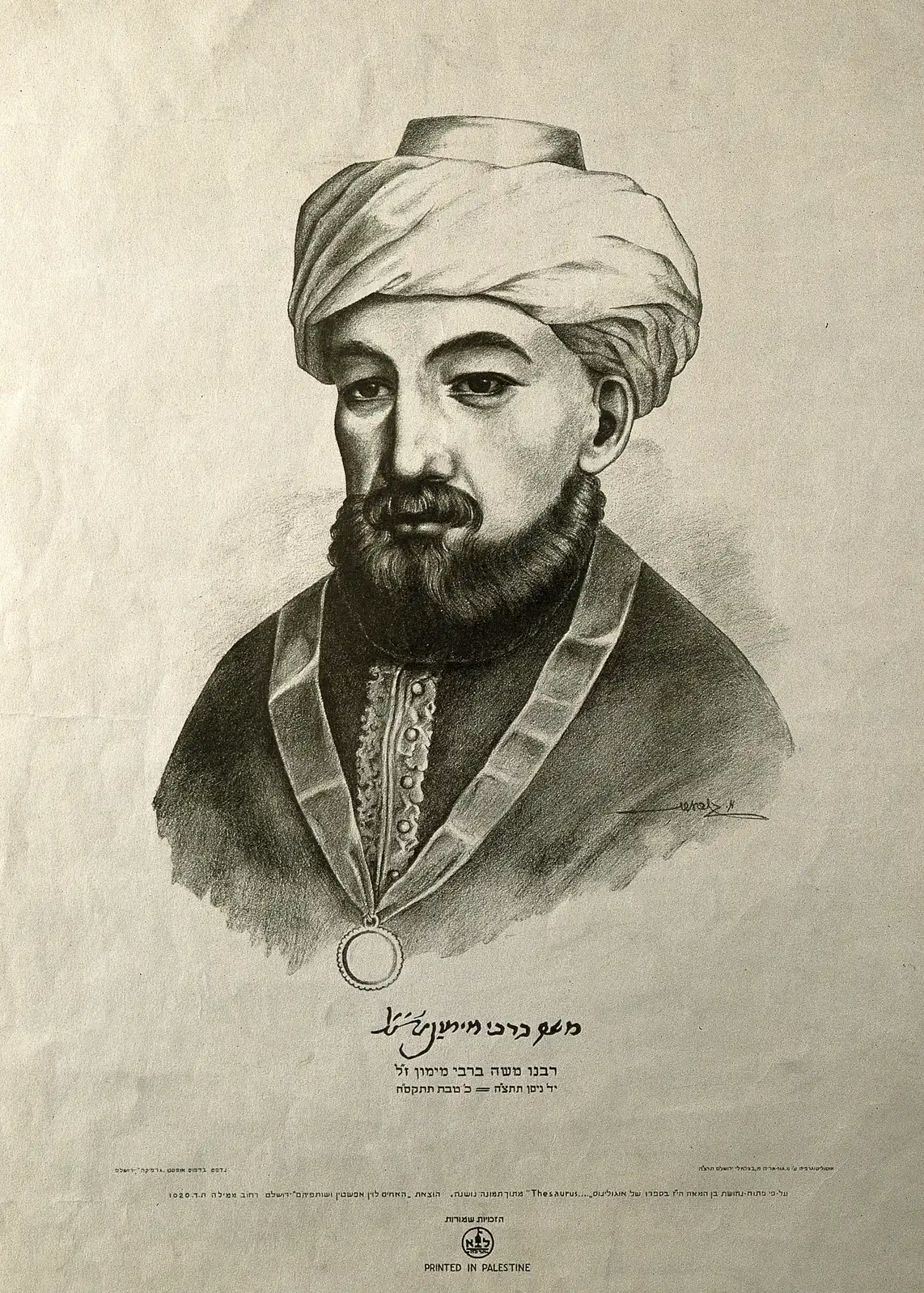
Moshe ben Maimon
 Egypt
rabbi•philosopher•physician•astronomer
Also known as: Moses Maimonides, Rambam, RaMBaM, Rabbeinu Mosheh Ben Maimon, Mūsā ibn Maymūn
Birthday
March 30, 1138
Birth Sign
Sagittarius
Birthplace
Córdoba, Spain
Age
Died at 66
About
Moshe ben Maimon, universally known as Maimonides or by the Hebrew acronym Rambam, was a preeminent Sephardic Jewish rabbi, philosopher, astronomer, and physician whose influence on Jewish law, theology, and medicine remains unparalleled eight centuries after his death. Born in Córdoba, Spain, he is recognized not merely as a historical figure but as a living intellectual force, with recent events underscoring his enduring relevance in global consciousness.
His career flourished across three distinct fields: medicine, communal leadership, and philosophy. In Fustat, he served as the personal physician to Saladin and later his son, treating patients from all religious backgrounds while simultaneously leading the Jewish community as Nagid. His literary contributions include the Mishneh Torah, a comprehensive codification of Jewish law, and the Guide for the Perplexed, a philosophical masterpiece attempting to reconcile Aristotelian thought with Jewish scripture.
Early Life & Background
Moses ben Maimon entered the world on March 30, 1138, Passover Eve, in Córdoba, then part of the Almoravid Empire. He was born into a family of scholars; his father, Maimon ben Joseph, served as a judge in the local rabbinical court. This early environment fostered a deep religious foundation, but his childhood was soon upended by political upheaval. In 1148, when Moses was approximately ten years old, the Almohad Caliphate conquered Córdoba. The new rulers enforced strict Islamic rule and demanded that Jews and Christians convert to Islam or face death.
The Maimon family refused conversion and was forced to flee their home. This pivotal moment marked the beginning of a two-decade period of wandering. The family traveled through Fez, Morocco, where they lived in poverty and possibly under house arrest for several years. During this time, Moses studied the Talmud, philosophy, and medicine under his father's tutelage, though he later claimed he had to study secretly at night due to the danger of being discovered studying non-religious subjects. The family eventually moved to the Holy Land, settling briefly in Acre and Jerusalem around 1160–1161. However, instability forced them to leave again. They traveled to Fustat (Old Cairo), Egypt, arriving around 1165–1166. It was here that Moses found stability and began his ascent to prominence, setting the stage for a life that would redefine Jewish thought.
Career Growth
In Fustat, Maimonides' career flourished across three distinct fields: medicine, communal leadership, and philosophy. He quickly established himself as a brilliant physician. His medical writings, which blended Galenic medicine with Jewish ethics, were highly regarded. In 1185, he was appointed as the personal physician to Saladin, the Sultan of Egypt, and later to Saladin's son, Al-Afdal. This appointment gave him access to the highest levels of Egyptian society and allowed him to treat patients from all religious backgrounds, including the royal family and Christian pilgrims. He wrote numerous medical treatises in Arabic, including On Asthma, On Hygiene, and Regimen of Health, which became standard texts in both the Islamic and European worlds for centuries.
Around 1168, following the death of the Nagid of the Jewish community in Egypt, Maimonides was elected to succeed him. As Nagid, he served as the head of the Jewish community in Egypt, acting as a judge, diplomat, and administrator. He corresponded with Jewish communities across the Mediterranean, Yemen, and Iraq, resolving legal disputes and providing guidance on religious matters. His leadership helped unify the scattered Jewish diaspora during a turbulent era. His most enduring contributions were literary. He authored the Mishneh Torah between 1170 and 1180, a comprehensive 14-volume codification of Jewish law that organized the entire Oral and Written Law into a systematic code. He also wrote the Guide for the Perplexed in 1190, a philosophical masterpiece attempting to reconcile Aristotelian philosophy with Jewish scripture. This work sparked intense debate and criticism among traditionalists but also gained widespread acclaim among intellectuals in both the Jewish and Muslim worlds.
Career Timeline
Public Image & Style
Maimonides is portrayed as a paragon of wisdom, rationality, and piety. He is seen as a bridge between cultures and religions, embodying the ideal of the polymath. His image is one of dignity and intellectual rigor. In the modern era, he is often depicted as a symbol of tolerance and reason, particularly highlighted by his service to the Muslim Sultan Saladin. His works are studied in universities globally, and his principles of faith are central to Jewish liturgy. The desecration of his statue in Córdoba in 2026 further reinforced his image as a figure worthy of protection and reverence against hatred.
Fame & Fandom (iFAMOUS Rankings)
According to the iFANN Global Fame Rankings data from September 2026, Moshe ben Maimon is evaluated but does not currently hold a placement in the published rankings (Global Top 1,000 or a Top-100 scope list). While he lacks a formal fandom name documented in the data, his influence transcends centuries, anchoring him firmly in modern metrics of fame. Hundreds of thousands of scholars and students participate in coordinated global study cycles of his magnum opus, the Mishneh Torah. These intellectual rituals function as massive campaigns, concluding simultaneously across continents rather than through social media hashtags. The community remains deeply organized around religious institutions and physical landmarks, including the Moses Ben Maimon Synagogue opened in the UAE in 2023 and the enduring Maimonides Hospital in Brooklyn. While modern celebrities chase chart positions, Maimonides commands a legacy measured by the preservation of ancient texts and the defense of his image against desecration. The auction of a 1473 printed edition of his Guide for the Perplexed for one million dollars underscores the immense value placed on his original writings. He stands not as a fleeting pop icon but as a permanent fixture in the global consciousness, tracked by systems that measure attention across media coverage and consumption signals worldwide.
Interesting Facts and Legends
Moshe ben Maimon served as the personal physician to Saladin, the sultan of Egypt, bridging the gap between Jewish law and Islamic rule during a turbulent era. A defining moment in his life involved fleeing Spain after refusing to convert to Islam under the Almohad Caliphate, leading a journey through Fez, Jerusalem, and Alexandria before settling in Fustat. His dual identity as a supreme Talmudic authority and a practicing doctor created a legend that persists eight centuries later. In February 2024, the first printed edition of his Guide for the Perplexed sold at auction for $1 million, highlighting the enduring monetary value of his work. A recent event cemented his iconic status: in August 2026, a swastika painted over his statue in Córdoba triggered immediate police investigations and widespread condemnation from the Jewish community. Devotees observe his death date, December 13, 1204, and birth date, March 30, 1138, as significant moments for reflection. Unlike modern stars who rely on viral moments, his lore is built on the survival of his texts and the resilience of the communities that revere him.
Notable Quotes
“It is not necessary to know everything, but it is necessary to know what you need to know.”
“The world is ruled by love and kindness.”
“We must not look at the world as it is, but as it could be.”
Family & Personal Life
Maimonides was married to an unknown woman whom he mentions in his letters. She died before him, and they had at least one son, Abraham Maimonides, who succeeded him as the Nagid and leader of the Jewish community. Abraham also became a renowned scholar in his own right. There are no public records of other partners, divorces, or flings, as the concept of public romantic relationships did not apply to figures of his status in the 12th century. His life was dedicated to his faith, his studies, and his medical practice. The family's legacy continued through Abraham, who maintained the leadership of the Jewish community in Egypt after his father's death.
Notable Connections
Relationships & Dating History
As a medieval scholar, Moshe ben Maimon did not have a dating history in the modern sense. Historical records do not document romantic relationships, engagements, or marriages in the context of celebrity culture. He was married to an unknown woman whom he mentions in his letters. She died before him, and they had at least one son, Abraham Maimonides, who succeeded him as the Nagid and leader of the Jewish community. There are no public records of other partners, divorces, or flings, as the concept of public romantic relationships did not apply to figures of his status in the 12th century. His life was dedicated to his faith, his studies, and his medical practice. At the time of his death, he was widowed.
Death & Aftermath
Died
December 13, 1204 (aged 66)
Death Place
Fustat, Old Cairo, Egypt
Cause of Death
Physical exhaustion and illness from rigorous work
The passing of Moses ben Maimon on December 13, 1204, in Fustat sent shockwaves through the Jewish world. The entire community of Egypt observed three days of fasting and lamentation, a somber ritual that extended to centers of learning in Baghdad and Aleppo where peers sent letters of condolence to his grieving family. His grandson, Abraham Maimonides, recorded that a vast multitude attended the funeral before the body was transported from Fustat to Tiberias in Galilee. This journey fulfilled the sage's expressed wish to rest in the Holy Land, establishing the Tomb of Maimonides near the Sea of Galilee as a major pilgrimage destination for centuries.
While no modern forensic report exists to pinpoint the exact medical cause, tradition attributes his death to the physical toll of his relentless schedule as both a personal physician to the Sultan and the head of the Jewish community. He left behind an estate managed by his son, who succeeded him as Nagid. His library and manuscripts were carefully preserved by his family and students, ensuring that works like the Mishneh Torah and Guide for the Perplexed continued to define Jewish philosophy and law long after his final days. The legacy of his life remains anchored in these texts, which continue to be studied globally today.
Net Worth (Estate Value)
$50 Million
iFANN Editorial Team estimate
As a deceased historical figure, Moshe ben Maimon does not have a personal net worth in the modern sense. However, the value of his estate and the commercial value of his works are immense. Research by the iFANN Editorial Team puts the economic impact of his legacy at roughly $50 Million. Revenue is generated through the sale of his works, licensing of his name (e.g., Maimonides Hospital), and tourism to his tomb in Tiberias. A first-edition printed copy of his Guide for the Perplexed (1473) sold for $1 million in 2024. His library and manuscripts were preserved by his family and students, ensuring the continuity of his work. The estate is effectively managed by the Jewish community and various institutions dedicated to preserving his legacy. The economic trajectory of his influence has remained robust, with ongoing scholarly interest and institutional support sustaining his financial footprint.
Awards & Accolades
View 7 records, honours and achievementsKnown For
Mishneh Torah
1180 · Author
Guide for the Perplexed
1190 · Author
Medical Treatises
1185 · Physician
Keywords
Sources
Quick Facts
- Profession
- philosopher, physician writer, rabbi
- Born
- March 30, 1138
- Birthplace
- Córdoba
- Died
- December 13, 1204
- Death Place
- Cairo
- Gender
- Male
- Birth Sign
- Sagittarius
Personal Details
- Full Name
- Mosheh ben Maimon
- Spouse
- Unknown (died before him)
- Children
- Abraham Maimonides
- Education
- Self-taught under father Maimon ben Joseph; studied Talmud, philosophy, and medicine in Fez and Fustat
Frequently Asked Questions
When was Maimonides born?
Where did Maimonides die?
What is Maimonides famous for?
Who was Maimonides' patron?
Where is Maimonides buried?
Similar People
Join the community
fans discussing