“Oscar Isaac gives a performance of remarkable range and soulfulness, making Moon Knight feel like a genuine character study rather than just another origin story.”
Daniel Fienberg
The Hollywood Reporter
 United States
"Embrace the chaos."
User Score
3,528 votes
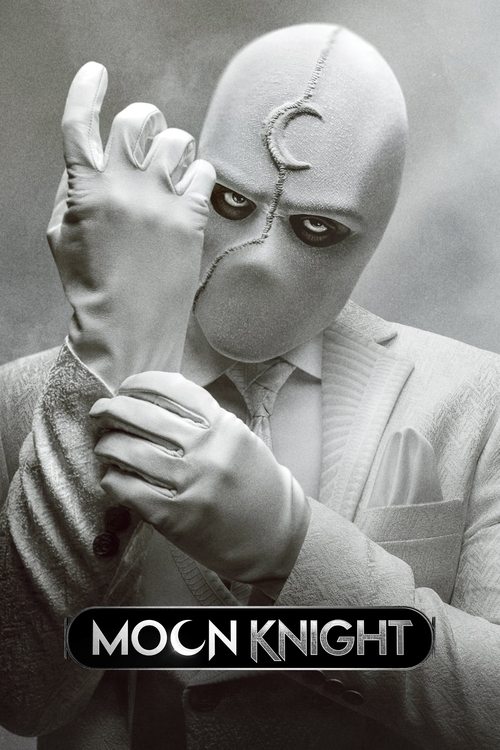
Moon Knight arrived on Disney+ in 2022 as something the MCU had never quite done before: a superhero story that doubles as a psychological horror show. Created by Jeremy Slater, the six-episode miniseries follows Steven Grant, a London gift shop employee whose life unravels when he realizes his blackouts are caused by another person living inside his head. That other person is Marc Spector, a former Marine turned mercenary, and together they serve as the avatar for Khonshu, the Egyptian moon god of vengeance. Oscar Isaac plays both roles with such precision that you forget it is the same actor.
The show draws heavily from the 1975 comic by Doug Moench and Don Perlin, but also pulls from later runs by Jeff Lemire and Warren Ellis. Egyptian filmmaker Mohamed Diab directed four episodes, while indie duo Justin Benson and Aaron Moorhead handled the other two, giving the series a split visual identity that mirrors its protagonist. The cast includes Ethan Hawke as Arthur Harrow, a cult leader with a calm menace, and May Calamawy as Layla El-Faouly, Marc's wife who gets pulled into the chaos. The budget was an estimated $150 million, making it one of the most expensive Marvel series, and that money shows in the elaborate Duat sequences and the massive god-battles over Cairo.
It premiered on March 30, 2022, and wrapped on May 4. Nielsen reported 418 million minutes streamed in its first week, and Samba TV clocked 1.8 million US households for the premiere, making it the biggest Marvel Disney+ opener at the time. Isaac worked with DID consultants and psychologists to shape the distinct mannerisms and accents for Steven (British) and Marc (American), and the series sparked real conversations about dissociative identity disorder. The show earned an 86% on Rotten Tomatoes and a 7.6 on IMDb, though some critics felt the finale leaned too hard on CGI spectacle after the intimate character work of the earlier episodes.
Availability and pricing can change. Confirm on the provider's site before purchasing.
Steven Grant lives a quiet life in London. He works at the British Museum gift shop, reads books on Egyptian mythology, and sleeps in a bathtub with his ankle chained to the bed frame. The chain is there because he keeps waking up in strange places with no memory of how he got there. He finds sand in his apartment, a phone he does not recognize, and a key card for a storage unit he has never visited. When he opens that unit, he finds a scarab, a golden artifact that starts whispering to him.
The whispers belong to Khonshu, the Egyptian moon god, but Steven does not know that yet. What he discovers first is Marc Spector, a hardened mercenary who shares his body. Marc has been the primary personality for years, serving as Khonshu's avatar and hunting down those who harm the innocent. Steven, by contrast, is gentle and anxious, a personality that emerged as a coping mechanism for childhood trauma. The two clash constantly. Steven wants to understand what is happening; Marc wants to keep him safe by keeping him ignorant. But they are forced to work together when Arthur Harrow, a former Khonshu follower now devoted to the goddess Ammit, begins hunting the scarab.
Harrow believes Ammit's philosophy is just: she judges souls before they commit crimes and destroys them preemptively. He sees Khonshu's vengeance as too slow and too limited. The scarab can lead to Ammit's tomb, and Harrow wants it to free her. Steven and Marc, guided reluctantly by Khonshu, race Harrow across London and into Egypt. They meet Layla El-Faouly, Marc's estranged wife, who has her own history with Khonshu and carries guilt over her father's death. The Ennead, the council of Egyptian gods, gets involved through their avatars, and the hippo goddess Taweret appears in the afterlife realm of the Duat.
The season builds its mystery through the first four episodes, with Steven and Marc slowly learning to share control. Episode 5 takes a sharp turn into psychological territory, forcing both personalities to confront the trauma that created them. The conflict with Harrow escalates as he assembles the pieces needed to free Ammit. The show explores what it means to live with dissociative identity disorder, how trauma shapes identity, and whether a god can be trusted with human lives. It never reveals whether Khonshu is truly a force for justice or just another manipulative figure using his avatar as a tool.
Official Trailer
Critical Consensus
Moon Knight was praised for Oscar Isaac's committed dual performance and the series' willingness to explore darker psychological territory than previous MCU entries. However, critics noted that the show's ambitious psychological premise was sometimes undermined by a generic CGI-heavy finale and underdeveloped villain. The Egyptian mythology and visual style were widely appreciated, though some felt the series struggled to balance its character study with superhero spectacle.
“Oscar Isaac gives a performance of remarkable range and soulfulness, making Moon Knight feel like a genuine character study rather than just another origin story.”
Daniel Fienberg
The Hollywood Reporter
“Moon Knight takes its time establishing Steven's world before pulling the rug out from under him, and us, in ways that feel genuinely surprising for a Marvel property.”
Caroline Framke
Variety
“The show is at its best when it leans into the psychological horror of its premise, treating the body-swapping not as a gimmick but as a genuine disorder.”
Matt Zoller Seitz
Vulture
“Isaac is fantastic, twitchy, gentle, and utterly convincing as a man falling apart at the seams, but the show's action sequences can't match its psychological ambition.”
Lucy Mangan
The Guardian
“Moon Knight is the first MCU series to feel truly different, a moody, idiosyncratic character piece that happens to feature a superhero.”
Ben Travers
IndieWire
Oscar Isaac
Marc Spector / Steven Grant / Moon Knight / Mr. Knight
Ethan Hawke
Arthur Harrow
May Calamawy
Layla El-Faouly
Karim El Hakim
Khonshu (performer)
F. Murray Abraham
Khonshu (voice)
Antonia Salib
Taweret (voice)
Sara Mubarak
Ammit (voice)
Gaspard Ulliel
Anton Mogart
Ann Akinjirin
Bobbi
David Ganly
Billy
Rey Lucas
Elias Spector
Fernanda Andrade
Wendy Spector
Khalid Abdalla
Selim
Loic Mabanza
Bek
Directors
Mohamed Diab, Justin Benson, Aaron Moorhead
Writers
Jeremy Slater, Don Perlin, Doug Moench, Danielle Iman, JB Ballard, Alex Meenehan
Composer
Hesham Nazih
Cinematographers
Andrew Droz Palermo, Gregory Middleton
Producers
Kevin Feige, Jeremy Slater, Grant Curtis, Louis D'Esposito, Victoria Alonso
Primetime Emmy Awards (2022)
Outstanding Lead Actor in a Limited Series: Nominated
Primetime Emmy Awards (2022)
Outstanding Sound Editing: Nominated
Primetime Emmy Awards (2022)
Outstanding Sound Mixing: Nominated
Saturn Awards (2022)
Best Limited Event Series: Nominated
Saturn Awards (2022)
Best Actor in a Limited Series: Nominated
MTV Movie & TV Awards (2022)
Best Hero: Nominated
MTV Movie & TV Awards (2022)
Best Fight: Nominated
Critics' Choice Super Awards (2023)
Best Actor in a Superhero Series: Nominated
Visual Effects Society Awards (2023)
Outstanding Visual Effects: Nominated
Golden Reel Awards (2023)
Sound Editing: Nominated
Join the community
fans discussing