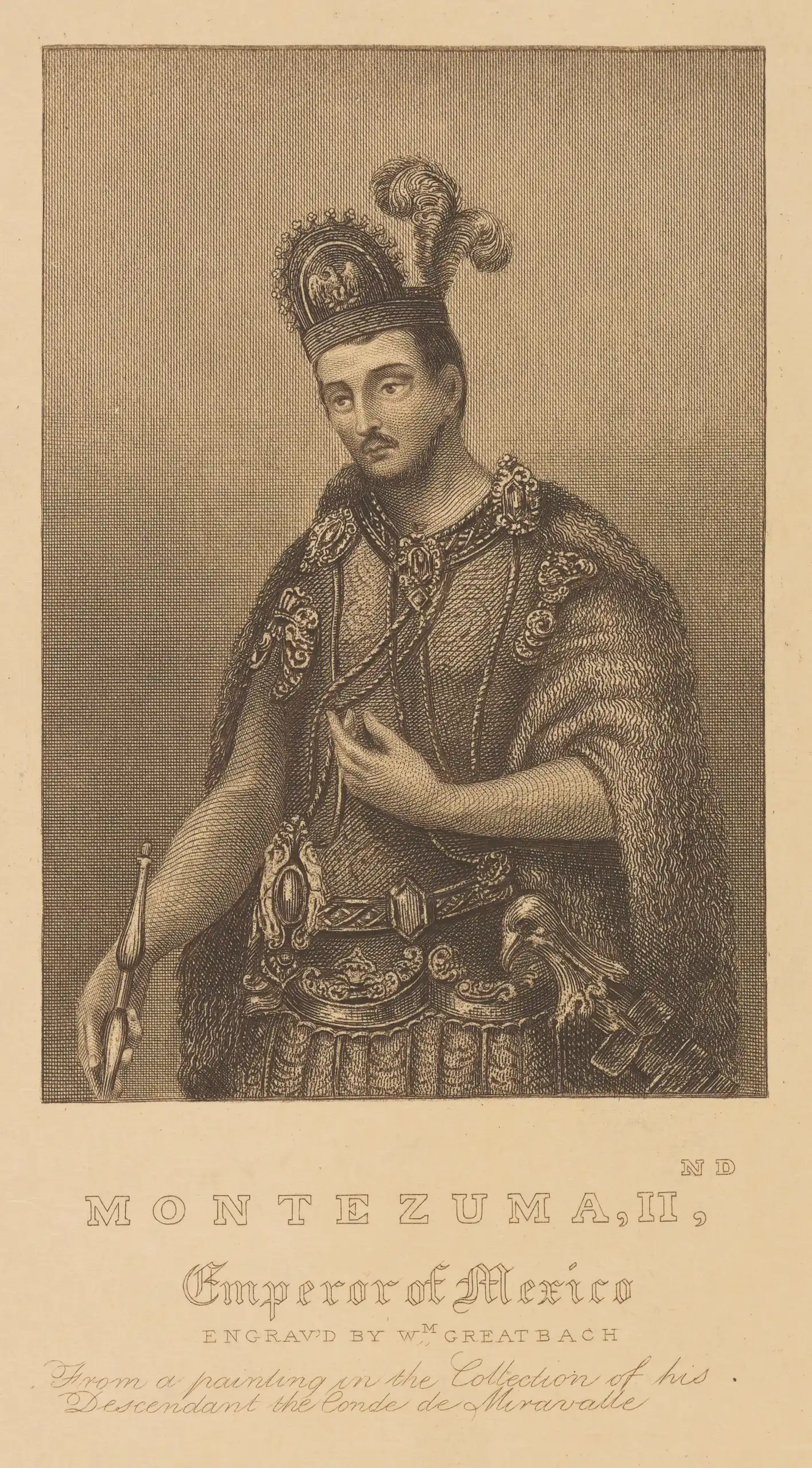
Moctezuma II
Also known as: Montezuma, Moctezuma Xocoyotzin, Moctezuma II
Birthday
c. 1466
Birth Sign
Capricorn
Birthplace
Tenochtitlan
Age
Died at 54
About
Moctezuma Xocoyotzin, often called Moctezuma II in European records, was the ninth and last independent emperor of the Aztec Empire, reigning from roughly 1502 until his death in 1520. Born into the royal lineage of the Mexica people in Tenochtitlan, he ascended to power during a period when the empire reached its territorial zenith. Unlike modern politicians, Moctezuma was a warrior-priest and sovereign ruler who governed through a complex system of tribute, warfare, and religious ritual. His reign marked the collision of two civilizations when Spanish conquistadors led by Hernán Cortés arrived on the Mexican coast.
Historical portrayals of Moctezuma have long been shaped by the victors' narratives. Spanish sources frequently depicted him as superstitious, weak-willed, and indecisive, claiming he hesitated to attack because he believed Cortés was the returning god Quetzalcoatl. Modern historians largely reject this view, arguing instead that he was a capable leader attempting to navigate an impossible crisis. He expanded the empire southward into Xoconosco and implemented administrative reforms that centralized power, yet he ultimately could not prevent the catastrophic collapse of his nation.
Early Life & Background
Moctezuma was born around 1466 in Tenochtitlan, the magnificent island capital built on Lake Texcoco in what is now Mexico City. His birth name, Moctezuma Xocoyotzin, translates to "Moctezuma the Younger," a necessary distinction from his uncle, the eighth emperor Moctezuma I Ilhuicamina. He was the son of Huitzilihuitl, a prince of the royal line, which placed him firmly within the pipiltin, the noble class of Aztec society. From infancy, his life was destined for the highest office, separating him from the commoners who made up the bulk of the population.
His upbringing followed the rigorous path expected of high-ranking nobility. Unlike commoners who learned trades or farming, Moctezuma attended the Calmecac, an elite school dedicated to training future leaders, priests, and warriors. There he studied theology, astronomy, law, and military strategy alongside his peers. His education included extensive combat training where he mastered the use of the macuahuitl, a wooden sword embedded with sharp obsidian blades that could be deadly in close quarters. Before he ever wore the crown, he served as a general, leading campaigns that pushed the empire's borders further south and incorporating diverse groups like the Zapotec and Yopi peoples into the Aztec sphere of influence.
Career Growth
Moctezuma ascended to the throne in 1502 or 1503 following the death of his uncle, immediately facing the challenge of maintaining order across a vast and expanding territory. His early reign was defined by aggressive expansion; he conquered lands as far south as the Isthmus of Tehuantepec and the region of Xoconosco, bringing wealthy regions under Aztec control. He also reformed the social hierarchy by prohibiting commoners from working in royal palaces, a move that widened the gap between the nobility and the masses while centralizing his own authority.
The trajectory of his career shifted dramatically in 1519 when Hernán Cortés and his men landed on the Mexican coast. Initially, Moctezuma sent envoys with gifts of gold to assess these strangers, hoping to maintain peace. When the Spanish marched inland and reached Tenochtitlan in November 1519, Moctezuma allowed them into the city, perhaps believing they were divine or seeking to contain them within his capital. This decision proved fatal. He was taken hostage within his own palace, forced to act as a puppet ruler while the Spanish seized the city's treasures. Tensions escalated until a faction of Aztec warriors revolted against the remaining Spanish forces. When the Spanish returned, they blamed Moctezuma for the uprising and ordered him to calm the crowd. On June 29, 1520, he was struck by stones thrown by his own people, ending his reign and his life.
Career Timeline
Public Image & Style
For centuries, Moctezuma's public image was dominated by Spanish chroniclers who painted him as a superstitious and indecisive tyrant. These depictions served to justify the conquest by portraying the Aztec ruler as weak-willed and easily manipulated by the belief that Cortés was a god. However, modern scholarship has begun to shift this narrative, presenting him as a capable leader who tried to navigate an unprecedented crisis.
Today, he is often viewed as a tragic hero in Mexico, symbolizing the loss of indigenous sovereignty. His aesthetic was defined by the opulence of the imperial court, featuring vibrant colors, intricate designs, and heavy jade and gold jewelry that symbolized his divine right to rule. Contemporary descriptions note that he would have appeared tall and imposing, consistent with the idealized image of an Aztec ruler.
Fame & Fandom (iFAMOUS Rankings)
iFANN has not yet collected fame data for this person. As a historical figure, Moctezuma does not have a modern fandom in the entertainment sense. However, he commands significant public interest, particularly in Mexico and among students of Mesoamerican history. He is a subject of intense academic study and popular fascination, often featured in documentaries, films, and literature.
In Mexico, he is often viewed as a tragic hero, a symbol of resistance and the loss of indigenous sovereignty. Campaigns to return artifacts like the Headdress are driven by a collective desire to reclaim national heritage. Media portrayals have shifted from the "weak king" trope of early 20th-century cinema to more nuanced depictions in recent decades, acknowledging his strategic acumen and the complexity of his situation.
Interesting Facts and Legends
Contrary to the image of a warrior-king solely focused on battle, recent research suggests Moctezuma maintained a private zoo for ritual purposes. Animals like jaguars, eagles, and snakes were kept in the imperial gardens not just for display but likely played a role in religious ceremonies and the maintenance of cosmic order. This discovery challenges previous assumptions about the purely decorative nature of such collections.
He is often confused with his uncle, Moctezuma I, who ruled earlier. The designation "II" or "the Younger" was applied retroactively by European historians to differentiate the two rulers, as the Aztecs themselves did not use numerical suffixes in their native naming conventions.
While Moctezuma died in 1520, the smallpox epidemic that devastated the Aztec population began shortly after his death. The disease, introduced by the Spanish, decimated the already weakened city, aiding the eventual fall of Tenochtitlan in 1521.
Notable Quotes
“I am your lord, but you are my guest.”
“The story of the Aztecs remains one of the most well-known conquest narratives.”
Family & Personal Life
As an Aztec emperor, Moctezuma practiced polygamy, a custom among the nobility used to forge political alliances and produce heirs. Historical records identify several primary wives, including Tlapalizquixochtzin of Ecatepec, who held the title of Queen Consort and helped solidify Aztec control over that region. Other documented wives included Teotlalco, a noblewoman from a prominent family, as well as women from Acatlán and Tayhualcan, representing further regional alliances.
Unlike modern relationships, these unions were dynastic and political, ending only through death or the dissolution of alliances. He died without a clear male heir to succeed him in a stable manner, contributing to the rapid collapse of the empire. His immediate successors were his brother Cuitláhuac and later Cuauhtémoc, both of whom ruled briefly before the city fell.
Notable Connections
Relationships & Dating History
Moctezuma's personal relationships were deeply intertwined with the political fabric of the Aztec Empire. As a member of the nobility, he practiced polygamy to forge alliances and secure his dynasty. His primary wife, Tlapalizquixochtzin of Ecatepec, held the title of Queen Consort and represented a strategic union that solidified Aztec control over the Ecatepec region. Another documented wife, Teotlalco, came from a prominent noble family, further cementing his political network.
Other wives included women from Acatlán and Tayhualcan, each marriage serving as a link to different regions and reinforcing the empire's reach. Unlike modern dating histories, these relationships were dynastic and political, ending only through death or the dissolution of alliances. He died without a clear male heir to succeed him in a stable manner, contributing to the rapid collapse of the empire after his death.
- MarriedTlapalizquixochtzinunknown - 1520Primary wife and Queen Consort of Ecatepec
- MarriedTeotlalcounknown - 1520Noblewoman from a prominent family
- MarriedAcatlánunknown - 1520Regional alliance wife
- MarriedTayhualcanunknown - 1520Regional alliance wife
Death & Aftermath
Died
June 29, 1520 (aged 54)
Death Place
Tenochtitlan (modern-day Mexico City)
Cause of Death
Blunt force trauma from stones thrown by his own people during a riot
Moctezuma II died on June 29, 1520, in the heart of his capital city, Tenochtitlan, marking the tragic end of an era. The circumstances surrounding his death remain one of history's most debated events. While Spanish chroniclers like Bernal Díaz del Castillo claimed the conquistadors killed him to silence a traitor, Indigenous accounts and modern historical consensus point to a different reality. During the chaotic Noche Triste uprising, Moctezuma was forced onto the palace balcony by Hernán Cortés to address a furious crowd of Aztec warriors who had turned against their ruler for collaborating with the foreigners. As he attempted to plead for peace, stones rained down from the rooftops. He was struck multiple times, sustaining fatal injuries that left him either dead or dying shortly after.
The aftermath of his death plunged the empire into immediate chaos. His brother Cuitláhuac succeeded him but succumbed to smallpox just weeks later, leaving Cuauhtémoc as the final emperor. The city fell to the Spanish in August 1521, effectively ending the Aztec civilization as an independent entity. Tributes to Moctezuma varied wildly; while some viewed him as a weak leader who lost his kingdom through indecision, others saw him as a tragic figure caught between two worlds. His legacy became a focal point for cultural memory, preserved through oral traditions and later colonial writings that often distorted his character to justify the conquest.
In the centuries following his death, artifacts associated with him sparked intense diplomatic disputes. The most famous of these is the imperial headdress known as El Penacho, now housed in Vienna. For decades, Mexico has demanded its return, viewing it as a stolen national treasure rather than a war prize. Recent archaeological findings in 2026 regarding his private zoo have added new layers to his story, suggesting he was a complex administrator who maintained exotic animals for ritual purposes long before his empire collapsed.
Net Worth (Estate Value)
$0
iFANN Editorial Team estimate
Awards & Accolades
View 2 records, honours and achievementsKnown For
Aztec Empire
1502-1520 · Emperor
Conquest of Mexico
1519-1521 · Central Figure
Keywords
Sources
Quick Facts
- Profession
- Emperor
- Born
- c. 1466
- Birthplace
- Tenochtitlan
- Died
- June 29, 1520
- Death Place
- Tenochtitlan
- Gender
- Male
- Spouse
- Tlapalizquixochtzin, Teotlalco, Acatlán, Tayhualcan
- Birth Sign
- Capricorn
Personal Details
- Full Name
- Moctezuma Xocoyotzin
- Spouse
- Tlapalizquixochtzin, Teotlalco, Acatlán, Tayhualcan
- Children
- Unknown number of children, including Cuitláhuac and Cuauhtémoc
- Education
- Calmecac (elite school for nobility)
Frequently Asked Questions
What was Moctezuma II's real name?
How did Moctezuma II die?
Did Moctezuma believe the Spanish were gods?
Where is Moctezuma's Headdress today?
Who succeeded Moctezuma II?
Similar People
Join the community
fans discussing